


Introduction
Electricity has become an essential part of modern living, yet many homeowners still struggle to understand exactly how much power they consume daily. This lack of clarity often leads to high electricity bills, poorly sized solar systems, and inefficient energy usage.
If you have ever wondered why your energy costs seem unpredictable or why your inverter drains faster than expected, the answer usually lies in not properly calculating your daily power consumption.
This guide provides a complete, step-by-step explanation of how to calculate your home’s daily electricity usage. It is written in a clear and practical format, making it useful whether you are planning a solar installation, managing your energy budget, or simply trying to become more energy efficient.
What Is Daily Power Consumption?
Daily power consumption refers to the total amount of electrical energy used in your home within 24 hours. Electricity providers measure this in kilowatt-hours (kWh), which represents how much power is consumed over time.
To put this into perspective, a 100-watt bulb running for 10 hours consumes 1 kWh of energy. This simple relationship between power and time is the foundation of all energy calculations.
The Formula You Need to Know
At the core of power consumption calculation is a simple formula:
Energy (kWh) = Power (Watts) × Time (Hours) ÷ 1000
This formula allows you to determine how much energy any appliance uses daily. Once you apply it across all devices in your home, you can estimate your total consumption accurately.
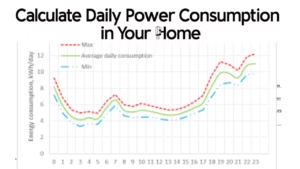
Step-by-Step Calculation Method
The process begins by identifying all electrical appliances in your home. This includes lighting, fans, refrigerators, televisions, air conditioners, pumps, and kitchen equipment. Every device that consumes electricity should be included.
The next step involves finding the power rating of each appliance. This information is usually printed on the appliance label or provided in the manual. If it is not available, standard estimates can be used.
After that, you determine how many hours each appliance operates daily. Some devices, such as refrigerators, run throughout the day, while others are used intermittently.
Finally, you apply the formula to calculate the daily energy consumption of each appliance and sum up the results.
Sample Home Energy Consumption Table
The table below shows a realistic example of daily electricity usage in a typical household:
| Appliance | Power Rating (W) | Hours/Day | Daily Consumption (kWh) |
| LED Bulbs (10 units) | 100 | 6 | 0.6 |
| Ceiling Fans (4) | 300 | 8 | 2.4 |
| Refrigerator | 150 | 24 | 3.6 |
| Television | 120 | 5 | 0.6 |
| Laptop | 60 | 6 | 0.36 |
| Air Conditioner | 1500 | 6 | 9.0 |
| Water Pump | 750 | 1 | 0.75 |
The total daily energy consumption in this example is 17.31 kWh.
Where Your Electricity Goes
Understanding how energy is distributed across appliances can help you identify areas where savings are possible.
Household Energy Consumption Distribution
Air Conditioner ██████████████████████████ 52%
Refrigerator ██████████ 21%
Fans ██████ 14%
Lighting ██ 3%
Other Appliances ████ 10%
Cooling systems clearly dominate energy usage, which explains why reducing air conditioner usage can significantly lower electricity bills.
Peak Load vs Daily Energy Consumption
Daily consumption measures total energy used over time, while peak load measures the maximum power demand at a specific moment. Both are important for energy planning.
Peak load becomes relevant when multiple appliances are running simultaneously. It determines the size of your inverter or generator.
Example Peak Load Table
| Appliance | Power (W) |
| Air Conditioner | 1500 |
| Refrigerator | 150 |
| Television | 120 |
| Lighting | 100 |
The total peak load here is 1,870 watts (1.87 kW). This means any backup system must be able to handle at least this capacity.
Estimating Your Monthly Electricity Bill
Once you know your daily consumption, calculating your monthly usage becomes straightforward.
For example:
17.31 kWh × 30 days = 519.3 kWh per month
If your electricity tariff is ₦70 per kWh:
519.3 × 70 = ₦36,351
This calculation provides a realistic estimate of your monthly electricity expenses.
Energy Consumption Table for Common Household Appliances
To make calculations easier, the table below provides average power ratings for common devices:
| Appliance | Average Power (W) | Typical Usage (Hours) | Daily kWh |
| LED Bulb | 10 | 6 | 0.06 |
| Ceiling Fan | 75 | 8 | 0.6 |
| Refrigerator | 150 | 24 | 3.6 |
| Television | 100 | 5 | 0.5 |
| Laptop | 60 | 6 | 0.36 |
| Washing Machine | 500 | 1 | 0.5 |
| Air Conditioner | 1500 | 6 | 9.0 |
How to Reduce Your Daily Power Consumption
Reducing energy consumption does not require drastic lifestyle changes. It starts with awareness and small adjustments.
Energy-efficient appliances consume less power while delivering the same performance. Replacing traditional bulbs with LED lighting is one of the simplest ways to reduce consumption.
Cooling systems should be used strategically, as they account for the largest share of energy usage. Adjusting thermostat settings and limiting usage hours can significantly lower electricity bills.
Appliances that are not in use should be unplugged to prevent standby power consumption, which often goes unnoticed but adds up over time.
Using Your Calculation for Solar System Sizing
If you are planning to install a solar power system, your daily energy consumption is the most important factor to consider.
A home consuming 17.31 kWh daily will require a solar system capable of generating at least that amount of energy. Additional capacity is usually added to account for inefficiencies and cloudy days.
Battery storage should also be sized based on your daily usage, especially if you need backup power during outages.
Similarly, your inverter must be able to handle your peak load. In the earlier example, a system rated above 2 kW would be appropriate.
Example for a Small Household
Not all homes have high energy demands. A smaller household with fewer appliances will consume significantly less power.
| Appliance | Power (W) | Hours | Daily kWh |
| LED Lights | 60 | 5 | 0.3 |
| Fan | 75 | 8 | 0.6 |
| TV | 100 | 4 | 0.4 |
| Refrigerator | 120 | 24 | 2.88 |
The total daily consumption here is approximately 4.18 kWh, demonstrating how appliance usage directly affects energy demand.
Common Mistakes to Avoid
Many people underestimate their electricity usage because they ignore certain appliances or use incorrect wattage values. Standby power consumption is often overlooked, even though devices like televisions and decoders continue to draw power when not in active use.
Another common issue is underestimating usage hours. Appliances like refrigerators and air conditioners cycle on and off but still consume significant energy over time.
Accurate calculations require realistic assumptions and careful attention to detail.
Conclusion
Calculating your daily power consumption is one of the most practical skills you can develop as a homeowner. It provides clarity, helps you manage your electricity costs, and ensures that any energy system you install is properly sized.
With the simple formula and structured approach outlined in this guide, you can accurately estimate your energy usage and take control of your electricity consumption.
Whether your goal is to reduce your monthly bills, improve energy efficiency, or transition to solar power, understanding your daily consumption is the first and most important step.
Frequently Asked Questions (FAQs)
How do I calculate power consumption for multiple appliances?
You calculate each appliance individually using the standard formula and then add all the values together to get the total daily consumption.
What is a good daily electricity usage for a home?
This depends on the size of the household and the appliances used. Smaller homes may consume between 3–5 kWh daily, while larger homes can exceed 15 kWh.
Does switching off appliances reduce electricity consumption completely?
Not always. Some devices still consume standby power when plugged in, so unplugging them is more effective.
How can I measure actual electricity usage?
You can use a power meter or smart energy monitoring device to track real-time consumption.
Can this method be used for solar system design?
Yes, this is the standard method used to estimate energy requirements when designing solar and inverter systems.



Pingback: Daily Power Consumption Calculator for Homes (Complete Guide + Built-In Calculation Method) - solarinverter