
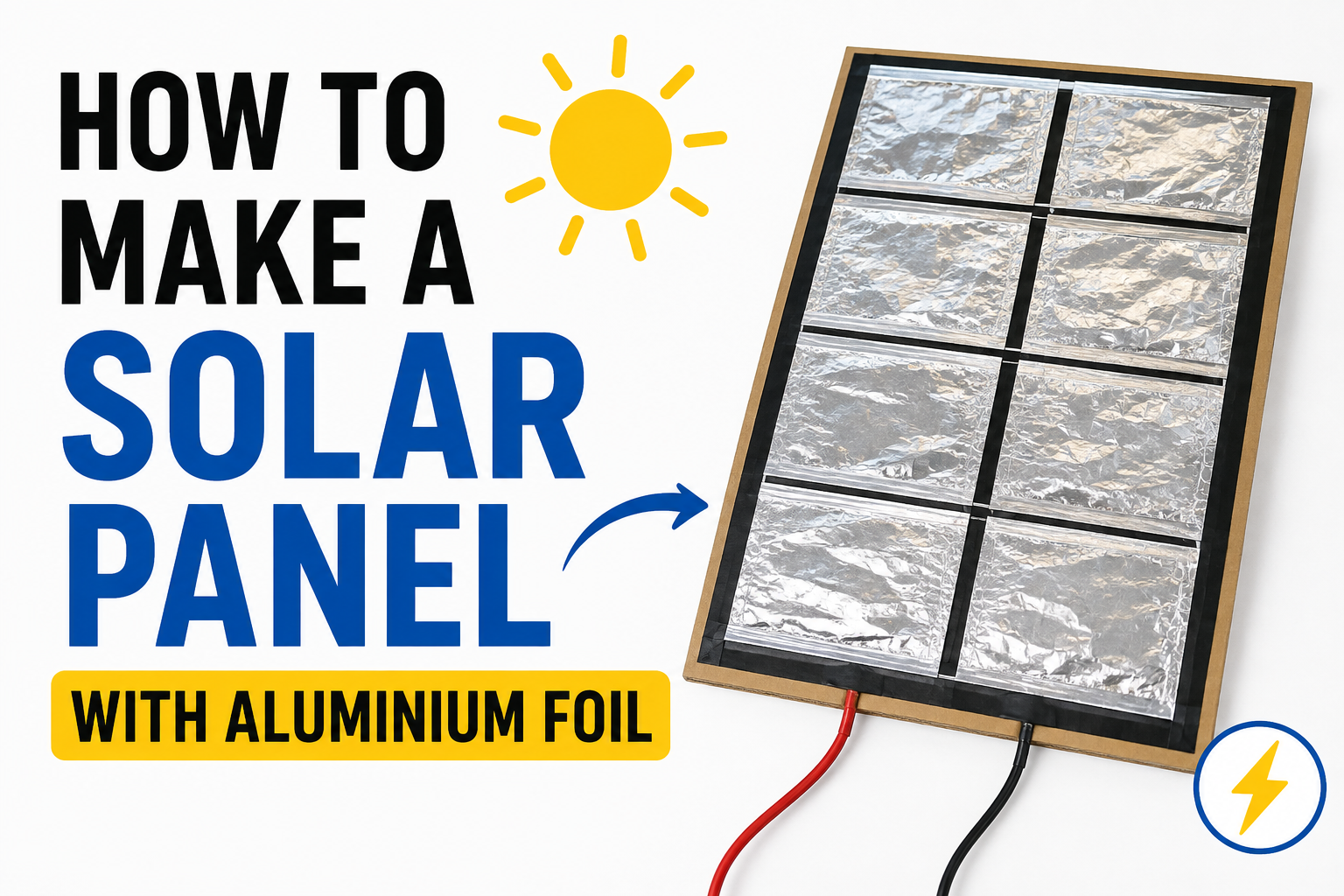
If you are searching for how to make a solar panel with aluminium foil, there is something you need to understand before you start. Aluminium foil can be used to reflect and concentrate sunlight, but it cannot replace the photovoltaic cells found inside a real solar panel.
That does not mean your idea is useless.
You can still build a simple solar energy project using aluminium foil, cardboard, and a few household materials. The project can demonstrate how sunlight can be captured, reflected, and converted into heat.
In this guide, I’ll show you what you can actually make with aluminium foil, how to build it step by step, what materials you need, what results to expect, and why some online tutorials give people the wrong impression about homemade solar panels.
Can You Really Make a Solar Panel With Aluminium Foil?
No, not if by “solar panel” you mean a device that generates electricity.
A real solar panel uses photovoltaic cells. These cells are normally made from semiconductor materials, especially silicon. When sunlight hits the cells, they convert light energy into electrical energy.
Aluminium foil works differently.
Aluminium is a metal and a good electrical conductor, but it is not a photovoltaic material. Simply putting aluminium foil in sunlight will not produce useful electrical power.
However, aluminium foil is highly reflective, which makes it useful for solar thermal projects.
Instead of converting sunlight into electricity, you can use the foil to reflect sunlight toward a particular surface. That surface can become hot.
So there are actually two different projects you could be talking about:
- A photovoltaic solar panel that produces electricity.
- A solar reflector or solar thermal collector that uses sunlight to produce heat.
For a simple DIY project, the second option is much more realistic.
How Does an Aluminium Foil Solar Project Work?
The basic principle is simple.
Sunlight contains energy. When sunlight hits a reflective surface such as aluminium foil, some of that light is reflected.
You can position the reflective surface so that the reflected sunlight reaches a specific area.
If that area contains a dark object, the object can absorb the sunlight and become hot.
This is essentially the same basic principle behind solar cookers and some solar thermal systems.
Aluminium Foil Reflects Sunlight
The shiny surface of aluminium foil can reflect sunlight.
That is why it is useful for this type of experiment.
You are not asking the foil to generate electricity. You are using it to redirect sunlight.
Dark Surfaces Absorb Solar Energy
A dark container or surface can absorb more sunlight than a highly reflective surface.
For a basic experiment, you can place water inside a dark container and monitor its temperature as sunlight is reflected toward it.
The temperature increase demonstrates that solar radiation is being converted into heat.
What You Need to Make an Aluminium Foil Solar Collector
You don’t need expensive equipment for a basic experiment.
Here are the materials you can use:
- Aluminium foil
- Cardboard
- A cardboard box
- Glue or tape
- Scissors
- Ruler
- A dark-colored container
- Water
- Thermometer
- Wooden sticks or cardboard supports
- Direct sunlight
You can build the basic version with materials you already have at home.
If you’re doing this as a school science project, you can also use a notebook to record temperature changes.
Why Cardboard?
Cardboard gives you a lightweight structure for holding the aluminium foil.
You can cut it, fold it, and change its angle easily.
The disadvantage is that cardboard is not designed for long-term outdoor use. Rain, humidity, and strong wind can damage it.
So think of this as an experiment, not a permanent solar installation.
Why Aluminium Foil?
The aluminium foil acts as the reflective surface.
The shiny side should face toward the sunlight.
You want the foil to reflect as much sunlight as practical toward your target.
How to Make a Solar Panel With Aluminium Foil Step by Step
Now let’s get into the actual project.
Remember, you’re building a solar reflector or solar thermal collector, not a photovoltaic electricity-generating panel.
Step 1: Prepare Your Cardboard
Start with a reasonably large piece of cardboard or a shallow cardboard box.
The larger the surface, the more sunlight you can potentially reflect toward your target.
If you’re using a cardboard box, you can cut away unnecessary sections while leaving enough material to provide support.
Make sure the cardboard is reasonably strong.
You don’t want the entire structure collapsing as soon as you put it outside.
Step 2: Cut the Aluminium Foil
Measure the cardboard surface and cut pieces of aluminium foil that are slightly larger than the areas you want to cover.
Don’t worry if you need several pieces.
You can overlap them slightly.
Try not to tear the foil while working.
Aluminium foil is extremely thin, so it can rip easily.
Step 3: Attach the Aluminium Foil
Apply glue or tape to the cardboard and carefully attach the aluminium foil.
Keep the shiny side facing outward.
Try to keep the foil reasonably smooth.
This doesn’t mean every wrinkle has to disappear. A few small wrinkles aren’t a disaster.
However, large folds can scatter reflected light in different directions, making your collector less effective.
Take your time during this step.
A messy reflector can still work, but a reasonably smooth surface will make it easier to control where the sunlight goes.
Step 4: Create Angled Reflective Panels
This is where your project starts becoming more useful.
Instead of using one completely flat sheet, create several panels.
You can fold pieces of cardboard at different angles and cover each one with aluminium foil.
The objective is to position the panels so they reflect sunlight toward the same general area.
Think of each panel as a mirror.
You’re trying to direct sunlight toward your target.
Why the Angle Matters
The sun isn’t always directly above your project.
Its position changes throughout the day.
Therefore, you may need to change the angle of your reflector.
A reflector that works well at 12 p.m. might perform differently at 4 p.m.
This is actually one of the best things about the experiment because you can observe how the position of the sun affects solar energy.
Step 5: Prepare Your Dark Container
Take a suitable dark-colored container.
If you’re using the project for a simple temperature experiment, put some water inside the container.
Place the container where the reflected sunlight is concentrated.
The dark surface should absorb the incoming sunlight.
You can then measure the temperature before and after exposing it to sunlight.
For a school project, this gives you measurable results instead of simply saying, “It got hot.”
Step 6: Place the Collector in Direct Sunlight
Take your setup outside on a sunny day.
Place it somewhere with direct sunlight and minimal shade.
Trees, buildings, walls, and other objects can block sunlight.
Adjust the reflector until the reflected light reaches your target.
You may have to move the panels several times.
Don’t expect the first position to be perfect.
Step 7: Monitor the Temperature
Before starting the experiment, record the temperature of the water.
For example:
| Time | Temperature |
|---|---|
| Start | 28°C |
| 10 minutes | 31°C |
| 20 minutes | 35°C |
| 30 minutes | 38°C |
| 40 minutes | 41°C |
Your actual results will be different.
Weather conditions, sunlight intensity, reflector size, wind, container material, and positioning can all affect the result.
The point is to observe whether the temperature increases and understand why.
Step 8: Adjust the Reflector
If the temperature isn’t increasing much, don’t immediately assume the experiment failed.
Check your setup.
Is the reflector facing the sun?
Is the sunlight actually reaching the target?
Are some panels creating shadows?
Is the aluminium foil badly wrinkled?
Is the container positioned correctly?
Is strong wind carrying heat away?
Small changes can make a noticeable difference.
How to Make a Solar Panel With Aluminium Foil That Produces Electricity
This is where we need to separate fact from internet myths.
You cannot make a functioning photovoltaic solar panel simply by covering cardboard with aluminium foil.
If you want electricity, you need actual photovoltaic cells.
What You Need for a Real DIY Solar Panel
A small homemade photovoltaic panel generally requires:
- Solar cells
- Electrical connecting wire or tabbing material
- A suitable backing surface
- Protective covering
- Junction or connection components
- A multimeter for testing
- Appropriate electrical connectors
The exact materials depend on the type and size of panel you’re building.
The solar cells are the important part.
They are responsible for converting sunlight into electricity.
The aluminium foil is not.
Can Aluminium Foil Generate Electricity?
Aluminium foil itself does not generate electricity simply because sunlight hits it.
This is one of the biggest misconceptions surrounding the topic.
Aluminium is electrically conductive. But electrical conductivity and photovoltaic electricity generation are two different things.
Copper is also an excellent conductor.
You could put copper wire under sunlight all day and it wouldn’t suddenly become a solar panel.
The photovoltaic effect requires a suitable semiconductor structure.
That’s why commercial solar panels contain photovoltaic cells rather than simple sheets of metal.
Can You Charge a Phone With an Aluminium Foil Solar Panel?
No.
Aluminium foil by itself cannot provide the electrical energy required to charge your phone.
If someone tells you that you can connect aluminium foil directly to a USB cable and charge your phone using sunlight, be skeptical.
That’s not how photovoltaic power generation works.
To charge a phone from solar energy, you need an actual photovoltaic panel or solar cell capable of producing electricity.
You also need the appropriate charging and voltage regulation equipment.
A small solar cell may produce electricity, but that doesn’t automatically mean it can safely charge a modern smartphone.
Can You Use Aluminium Foil With Real Solar Cells?
Yes.
This is where aluminium foil can become useful.
You can potentially use reflective material as part of an experimental solar setup, provided you don’t block the photovoltaic cells.
For example, a reflective surface can be positioned around a small solar cell to experiment with how additional reflected light affects its output.
However, you need to be careful.
More reflected sunlight does not automatically mean more useful electricity.
Extra heat can also affect solar cell performance.
For a serious solar installation, proper panel positioning is much more important than randomly adding aluminium foil.
Aluminium Foil Solar Panel vs Real Solar Panel
The difference is straightforward.
| Feature | Aluminium Foil Project | Real Solar Panel |
|---|---|---|
| Generates electricity | No | Yes |
| Uses photovoltaic cells | No | Yes |
| Uses reflected sunlight | Yes | Not necessarily |
| Produces heat | Yes | Can produce heat as a byproduct |
| Cheap to build | Yes | More expensive |
| Suitable for home electricity | No | Yes |
| Good for science experiments | Yes | Yes |
| Suitable for phone charging | No | Yes, with proper equipment |
This distinction can save you a lot of wasted time.
If your goal is education, the aluminium foil project is excellent.
If your goal is electricity, buy photovoltaic cells or a proper solar panel.
How to Improve Your Aluminium Foil Solar Collector
You can make your project more effective by improving several parts of the design.
Use a Larger Reflective Surface
A larger surface can intercept more sunlight.
However, bigger isn’t automatically better.
A huge cardboard reflector that constantly moves in the wind isn’t particularly useful.
You need a balance between size and stability.
Keep the Foil Relatively Smooth
Large wrinkles can send reflected sunlight in unwanted directions.
Try to attach the foil carefully.
You don’t need a perfect mirror, but avoid unnecessary folds.
Use a Dark Target
A dark container can absorb solar radiation effectively.
This can make your temperature experiment easier to observe.
Use an Adjustable Stand
An adjustable stand makes it easier to point the reflector toward the sun.
This is especially useful because the sun appears to move across the sky during the day.
Reduce Heat Loss
If your objective is heating water, heat can escape through the container and surrounding air.
Wind can make this worse.
A suitable insulated design can help you retain more heat.
Safety Tips When Making a Solar Foil Project
Don’t underestimate concentrated sunlight.
A simple piece of foil isn’t necessarily dangerous, but a large reflector designed to concentrate sunlight can create extremely hot areas.
Don’t Look Directly at the Sun
Never stare directly at the sun.
Also avoid staring into intensely reflected sunlight.
Your eyes are not something you want to gamble with for a DIY experiment.
Keep Flammable Materials Away
Concentrated sunlight can become hot enough to damage or ignite certain materials.
Keep dry paper, leaves, fabrics, plastics, and other combustible materials away from concentrated sunlight.
Be Careful With Hot Containers
If your project heats water or metal, remember that the container may become hot.
Use appropriate protection when handling it.
Don’t Leave the Reflector Unattended
Especially if your design concentrates sunlight into a small area.
Always know where the reflected light is going.
Be Careful With Aluminium Foil
The edges of aluminium foil can be surprisingly sharp.
Scissors can also cause injuries.
If children are performing the experiment, adult supervision is a good idea.
Common Mistakes When Making a Solar Panel With Aluminium Foil
There are several mistakes you should avoid.
Mistake 1: Thinking Aluminium Foil Is a Solar Cell
It isn’t.
Foil reflects sunlight. Photovoltaic cells convert sunlight into electricity.
Those are completely different functions.
Mistake 2: Expecting to Charge a Phone
A cardboard reflector isn’t a phone charger.
If you need electricity, use photovoltaic cells.
Mistake 3: Confusing Heat With Electricity
If your container becomes extremely hot, congratulations—you’ve demonstrated solar thermal energy.
You haven’t generated electricity.
Heat and electrical energy aren’t interchangeable.
Mistake 4: Making the Reflector Too Large
A large reflector can become difficult to control.
Start small and learn how the system behaves.
Mistake 5: Ignoring the Sun’s Position
The sun’s position changes.
Your reflector needs to be adjusted if you want to maintain good performance.
What Can You Learn From This Solar Project?
A simple aluminium foil solar experiment can teach you more than you might expect.
You can learn about:
- Solar radiation
- Reflection
- Heat absorption
- Energy conversion
- Temperature measurement
- Solar positioning
- Renewable energy
- Basic scientific experimentation
You can also turn the project into a proper science experiment.
For example, test three different reflector designs and measure the temperature increase produced by each one.
Record the results.
Compare them.
Then determine which design performed best.
That’s far more useful than simply building something and taking a picture.
Is an Aluminium Foil Solar Panel Worth Making?
Yes, if you understand what you’re building.
If you want a cheap science project, an aluminium foil solar collector is a good choice.
It’s inexpensive, easy to modify, and demonstrates how sunlight can be reflected and converted into useful heat.
But if you’re trying to generate electricity for your house, this isn’t the solution.
Don’t confuse a $5 experiment with a residential solar power system.
A real solar installation requires photovoltaic panels, mounting equipment, wiring, protection devices, batteries where needed, charge controllers for battery systems, and potentially an inverter.
The scale and engineering requirements are completely different.
Frequently Asked Questions
Can I make a solar panel with aluminium foil?
You can make a solar energy experiment using aluminium foil, but you cannot make a conventional electricity-generating photovoltaic panel from aluminium foil alone.
What does aluminium foil do in a solar panel project?
Aluminium foil can reflect sunlight toward a particular area. It is useful for solar thermal experiments, solar cookers, and reflective demonstrations.
Can aluminium foil convert sunlight into electricity?
No. Aluminium foil does not function as a photovoltaic cell.
Can I use aluminium foil to charge a battery?
Not by itself. You need an actual photovoltaic cell or solar panel capable of generating suitable electrical power.
Can aluminium foil make water hot?
Yes. If you use it as a reflector to direct sunlight toward a suitable container, it can help increase the amount of solar energy reaching the container.
Can I use cardboard for a solar collector?
Yes. Cardboard is useful for making a temporary solar reflector because it is inexpensive and easy to cut and shape.
Does the shiny side of aluminium foil need to face the sun?
For a reflective experiment, you generally want the shiny surface facing the sunlight so that it can reflect light toward your target.
Can I use this project for a school science experiment?
Absolutely. It can be used to demonstrate reflection, solar radiation, heat absorption, and renewable energy.
Final Thoughts on How to Make a Solar Panel With Aluminium Foil
Learning how to make a solar panel with aluminium foil is a great way to explore solar energy, but you need to understand what aluminium foil can and cannot do.
It cannot replace the photovoltaic cells inside a real solar panel.
What it can do is reflect sunlight. By attaching aluminium foil to cardboard and carefully positioning the reflective surface, you can build a simple solar thermal collector that concentrates sunlight and produces heat.
That’s a real and useful experiment.
If your goal is to learn how solar energy works, start with the foil project. If your goal is to generate electricity, skip the internet hacks and use genuine photovoltaic cells.
The biggest lesson here is simple: use the right material for the job. Aluminium foil is excellent as a reflector, but photovoltaic cells are what you need when you want sunlight converted into electricity.