
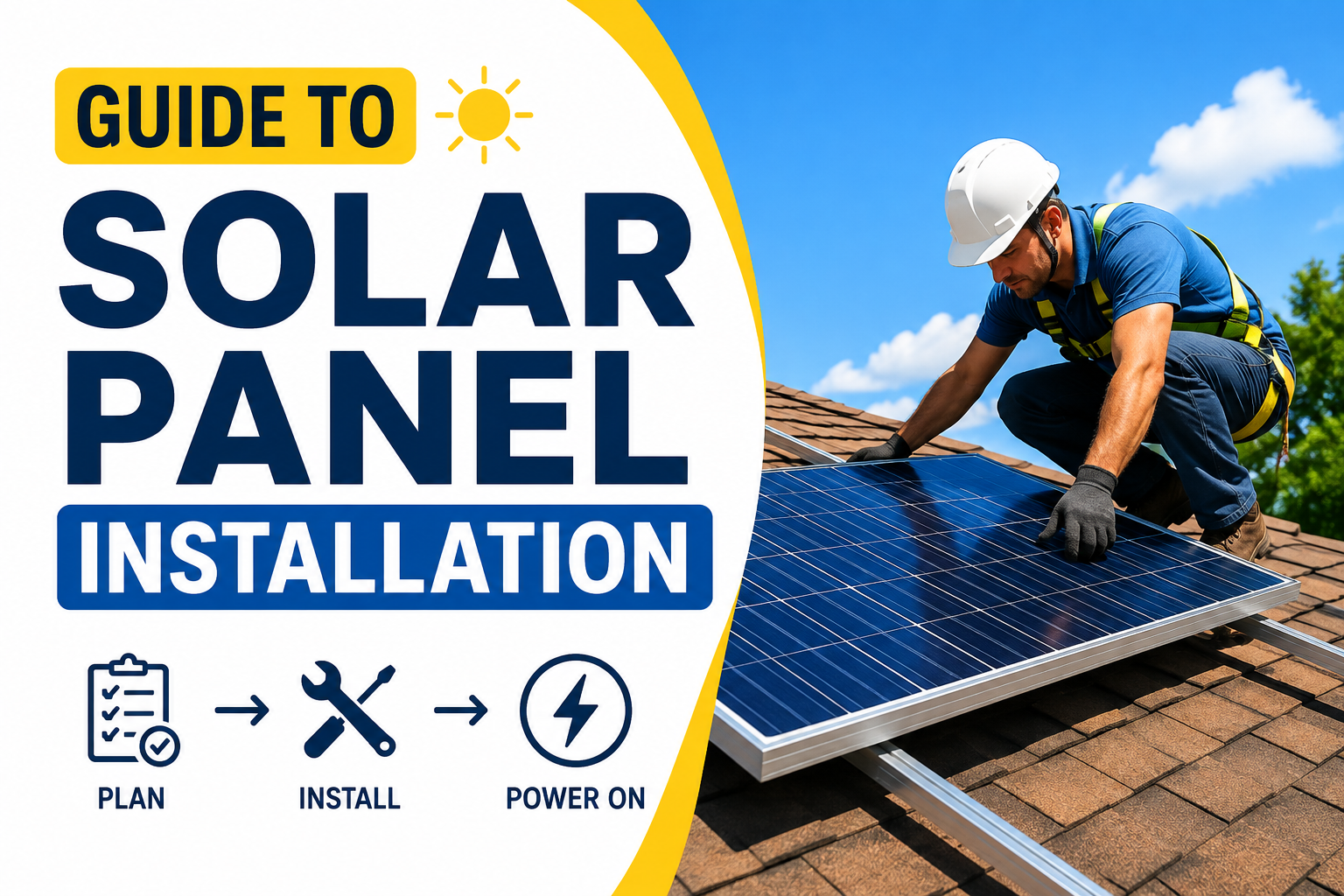
Solar panel installation in 2026 is no longer a niche upgrade. Hardware is cheaper and more efficient than it was five years ago, N-type TOPCon modules dominate new rooftops, and batteries have become the default add-on in markets where export credits are weak. What changed most for homeowners is not the physics of sunlight. It is the paperwork, the incentive stack, and the way utilities pay you for surplus power.
This Blog.Stella guide walks through solar panel installation the way a careful homeowner should: start with your bill and roof, price a real system, understand what incentives still exist after the U.S. federal residential credit expired, hire the right installer, and stay in control of permits and interconnection. The goal is a system that produces for 25 years, not a contract you regret in month three.
Why solar still makes sense in 2026 and 2027
Electricity rates keep rising in most regions. A typical U.S. home that uses 10,000 to 14,000 kWh a year can still lock in a large share of that load at a known capital cost. Panels themselves now cost roughly $0.25 to $0.45 per watt at the module level. The expensive part of solar panel installation is no longer silicon. It is labor, racking, inverters, electrical work, permitting, and customer acquisition.
Three forces keep the 2026/27 case alive even without a 30 percent federal homeowner tax credit in the United States:
- Retail power prices and time-of-use peaks that make self-consumed solar valuable.
- State, utility, and local programs that still cut net cost in high-incentive markets.
- Home value, energy resilience, and the option to add storage later or at the same time.
Solar is not automatically a good deal everywhere. Payback is fast in high-rate, sunny, full-retail net metering states. It is slower where power is cheap and export rates are low. The rest of this guide is about measuring that difference before you sign.
Is your home a good candidate for solar panels?
A professional site assessment is the official answer. You can do a first-pass screen in an afternoon.
Roof, sun, and structure
- Orientation: south-facing roofs in the Northern Hemisphere still win. East-west splits work if you have enough space.
- Shading: chimneys, dormers, and neighboring trees can wipe out a surprising share of annual output. Ask for a shade report, not a sales sketch.
- Age and condition: if the roof has fewer than 10 to 12 years of life left, replace or repair it before panels go on. Ripping a five-year-old array off for a reroof is expensive.
- Load path: most modern asphalt-shingle roofs can take a solar array. Older rafters, tile, metal standing seam, and flat commercial membranes need specific racking and, often, a structural letter.
Your electric bill is the design brief
Pull 12 months of usage, not one summer bill. Size the system to the load you want to offset after planned changes such as an EV or heat pump. Oversizing into a weak export market wastes money. Undersizing leaves you buying peak power forever.
Solar panel installation cost in 2026
Across the United States in 2026, a typical homeowner-owned rooftop system lands around $2.50 to $3.40 per watt installed before local incentives. That puts a common 8 kW array in the $20,000 to $27,000 range. Competitive Sun Belt markets often bid closer to $2.20–$2.80 per watt; high-labor coastal markets can exceed $3.20. The module is only about a third of the invoice. Labor, inverters, racking, electrical work, design, and permits make up the rest.
| System size | Typical home | Gross installed cost (2026) | Ballpark annual output |
| 4 kW | Small home / partial offset | $10,000–$15,000 | 4,800–6,400 kWh |
| 6 kW | Average 1,500–2,000 sq ft | $15,000–$22,000 | 7,200–9,600 kWh |
| 8 kW | Most common residential size | $20,000–$28,000 | 9,600–12,800 kWh |
| 10 kW | Large home or EV charging | $24,000–$35,000 | 12,000–16,000 kWh |
| 12 kW | High use + battery prep | $29,000–$42,000 | 14,400–19,200 kWh |
Figures are U.S. residential ranges before state and utility incentives. Output assumes a decent solar resource; desert Southwest homes produce more, Pacific Northwest homes produce less.
What actually sits on the invoice
- Modules: N-type TOPCon is the 2026 volume standard at roughly 22–24 percent efficiency.
- Inverter: string inverter, string plus power optimizers, or microinverters. Microinverters cost more and handle shade and monitoring better.
- Racking and flashing: rails or rail-less systems, plus weatherproof roof penetrations.
- Electrical: homerun wiring, disconnects, rapid shutdown, possible main-panel upgrade ($1,500–$4,500 when needed).
- Soft costs: design, permits, interconnection, sales, and warranty administration.
Add a home battery and the project jumps. A 13.5 kWh unit in the Tesla Powerwall 3 class typically installs for $10,000 to $16,000 in 2026. An 8 kW array plus one battery often lands in the mid-$30,000s to mid-$40,000s before local rebates.
Incentives after the federal residential credit
This is the headline policy change for 2026 U.S. buyers. The federal Residential Clean Energy Credit (Section 25D), which paid 30 percent of a homeowner-owned system, is not available for property placed in service after December 31, 2025. If your system went live in 2025, you may still claim it on that tax year. If it goes live in 2026, model the federal homeowner credit at zero unless a tax professional confirms an exception.
That does not mean incentives disappeared. It means the stack is now local.
- State income tax credits (examples historically include New York up to $5,000 and Massachusetts at 15 percent of cost, subject to current statute).
- Upfront utility or state rebates and capacity-based payments.
- SRECs or performance-based incentives in markets that still run certificate programs.
- Sales-tax and property-tax exemptions that protect the added home value.
- Net metering or net billing. This is now the single largest driver of payback in many states.
- Leases and power purchase agreements. The company that owns the system may still access commercial credits and pass some of that value into a lower monthly rate.
Net metering is not uniform. Many states still credit exports near the retail rate. California’s NEM 3.0 and several other markets pay much less, which is why batteries moved from optional to strategic there. Check DSIRE, your state energy office, and your utility’s current tariff before you compare quotes.
The solar panel installation process, step by step
From signed contract to Permission to Operate, most residential jobs take six to sixteen weeks. Roof work is the short part. Paperwork is the long part.
1. Research and first quotes
Get at least three bids from licensed installers with verifiable local reviews and proof of insurance. Compare production estimates, equipment brands, workmanship warranties, and what happens if the company disappears. A cheap quote that uses last-generation P-type clearance panels and a thin workmanship warranty is not a bargain.
2. Site assessment and system design
Expect a roof inspection, electrical-panel photo set, and a layout that shows setbacks from ridges and fire access paths. Good designers use satellite and, when needed, a drone or on-roof measurement. The design package should list module model, inverter model, stringing or microinverter map, estimated annual kWh, and a line-item price.
3. Contract and payment structure
You can buy with cash, take a solar loan, or sign a lease or PPA. Cash usually produces the best lifetime return. Loans preserve liquidity but add interest. Leases and PPAs lower the upfront check when a third-party owner can capture incentives you cannot. Read the escalation clause, the buyout formula, and who is responsible for roof leaks.
4. Permits and interconnection application
Most jobs need a building permit for structure and mounting, an electrical permit for wiring and the inverter, and a utility interconnection application. HOA approval still appears in some neighborhoods, though many states limit an association’s power to block solar. Jurisdictions on SolarAPP+ or similar instant-permit tools can approve in a day. Manual city reviews still take one to six weeks.
5. Equipment order and installation day
Once permits clear, the crew typically spends one to three days on site. Sequence is predictable: safety setup and staging, attach flashing and rails, land modules, run DC and AC homeruns, set the inverter or microinverter trunk, label disconnects for rapid shutdown, and leave the system off until inspection and utility approval. Do not let anyone energize a grid-tied array before Permission to Operate.
6. Inspection, meter work, and PTO
The city or county inspects. The utility may swap in a bidirectional meter. Only after Permission to Operate should the installer turn the system on and walk you through the monitoring app. Operating without PTO can void interconnection terms and forfeit bill credits.
| Phase | Typical duration | Who owns it |
| Quotes and contract | 1–3 weeks | You + installer |
| Design and site visit | 1–2 weeks | Installer / engineer |
| Permits | 1–6 weeks | Local building department |
| Physical installation | 1–3 days | Crew |
| Inspection + utility PTO | 1–8 weeks | AHJ + utility |
| Contract to first kWh | 6–16 weeks | All parties |
Choosing equipment in 2026/27
Panels
N-type TOPCon monocrystalline modules are the default residential recommendation for most roofs this year. They sit in the 22–24 percent efficiency band, degrade more slowly than leftover P-type PERC stock, and cost only a modest premium. Heterojunction (HJT) panels earn their keep in hot climates because of a stronger temperature coefficient. Back-contact designs (IBC, ABC, HPBC) squeeze the most watts onto a tight roof and look cleaner, at a higher price.
Look for 25-year product and performance warranties from a brand and installer that will still answer the phone. Tier-1 status is a filter, not a substitute for service.
Inverters
String inverters are inexpensive and simple on an unshaded, uniform roof. Add DC optimizers if you have mixed orientations. Choose microinverters when shade, complex planes, or panel-level monitoring matter. The inverter is the component most likely to need replacement inside the panel warranty window, so the inverter warranty length is not a footnote.
Batteries
Storage pays when export rates are weak, evening peaks are expensive, or outages are common. It is a weaker financial add-on under full-retail net metering and cheap flat rates, unless resilience is the point. One 13.5 kWh unit covers a typical evening; whole-home multi-day backup usually needs two or more.
DIY solar panel installation: when it is and is not realistic
Blog.Stella does not recommend a first-time homeowner as the electrician of record on a grid-tied rooftop array. You are on a pitched roof with high-voltage DC and an AC interconnection the utility will inspect to code. A bad flashing detail becomes a leak. A missing rapid-shutdown label fails inspection. Ground-mount kits and legal plug-in systems are different conversations, but a licensed electrician for interconnection is still the adult decision. Insurance, roof warranties, and most incentive programs assume a permitted professional install.
Permits, codes, and utility rules you should actually understand
You do not need to memorize the electrical code. You do need to know that inspectors still look for rapid-shutdown labels, a clean single-line diagram, spec sheets, structural calcs, and working clearances. Incomplete packets restart the clock. Interconnection is a separate queue from the building permit. Main-panel upgrades and supply-side taps cause more change orders than module brand debates.
What to do on installation week
- Clear driveway and attic access. Move cars. Lock pets inside.
- Confirm roof repairs are finished and the shingle or tile manufacturer’s flashing method is the one being used.
- Photograph the roof and attic before screws go in. Keep those photos with the as-built packet.
- Ask where the inverter, battery, and disconnect will live. Ugly placement is hard to undo.
- Get the monitoring login the day the system is commissioned, not three weeks later.
A good crew leaves the site cleaner than they found it, with labels on every disconnect and a copy of the as-built drawing.
Maintenance, monitoring, and the first five years
Solar arrays are low-maintenance, not zero-maintenance. Check the monitoring app monthly. A dropped string is cheaper to fix in week two than in year two. Wash panels only when soiling is obvious and the manufacturer allows it. Keep trees trimmed. After a storm, inspect from the ground. Store the permit set, interconnection agreement, warranties, and serial numbers in one folder. That packet is part of the home’s value when you sell.
Common solar installation mistakes in 2026
- Signing the first door-to-door quote without a competing bid or a production estimate you can audit.
- Ignoring the federal credit cutoff and assuming a 30 percent line item still applies to a 2026 homeowner-owned system in the U.S.
- Skipping a roof replacement that was already due.
- Sizing only to today’s bill while an EV and a heat pump are on next year’s list — or the opposite, oversizing into a poor export tariff.
- Choosing equipment the installer cannot service locally.
- Turning the system on before Permission to Operate.
- Forgetting that net metering rules, not module efficiency, often decide whether the project pays back in seven years or fifteen.
Frequently asked questions
How long does solar panel installation take?
The crew is usually on the roof for one to three days. The full project, including design, permits, and utility permission, commonly runs six to sixteen weeks. Dense cities and slow utilities sit at the long end.
How many solar panels does a house need?
With 400–450 W modules, an 8 kW system is about 18 to 20 panels. Higher-wattage 480–520 W modules reduce the count. Match panel count to annual kWh and usable, unshaded roof area.
Do solar panels work in cloudy weather?
Yes, at reduced output. Annual models already include local weather. Cloudy, high-rate markets still work; they need more array area for the same offset.
Will solar panels increase my home’s value?
Owned, documented systems generally do. Leased systems can complicate a sale because the contract must transfer.
Should I add a battery in 2026/27?
Add one if export rates are low, evening peaks are high, or you need backup. Conduit-prep for later if you have strong full-retail net metering and rare outages.
A 2026/27 checklist before you sign
- Twelve months of kWh usage and a note about planned EVs or HVAC changes.
- Three comparable quotes with the same system size and a stated production estimate.
- Written list of module, inverter, and battery model numbers plus warranty terms.
- Current state and utility incentive sheet, not a 2024 blog post.
- Confirmation of who pulls permits, who attends inspection, and the expected PTO window.
- Roof remaining-life assessment and flashing method in writing.
- Monitoring app ownership in your name.
The Blog.Stella bottom line
Solar panel installation in 2026 and 2027 is a project management problem as much as an energy problem. The modules work. The industry knows how to flash a roof. Homeowners lose money when they skip competing quotes, misunderstand the incentive stack, or treat interconnection as someone else’s paperwork.
Start with your bill and your roof. Price a right-sized N-type system from a licensed installer who will still be in town in ten years. Model savings with today’s tariff, not last year’s tax credit. If the numbers work, the installation itself is straightforward. If they do not, improve efficiency first or consider a lease or community-solar option instead of forcing a poor rooftop fit. Confirm every incentive and code rule locally before you write a deposit check.