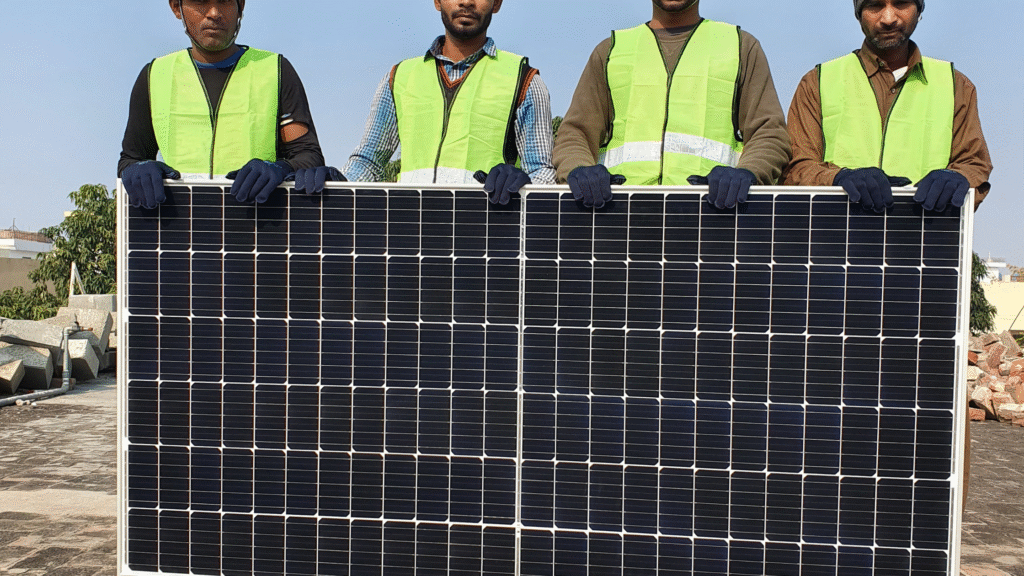
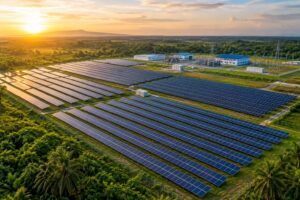
An engineering case study of utility-scale solar PV, battery storage, electrical infrastructure and long-term asset management at the Federal University of Technology, Owerri.
Introduction
A university power plant is more than a collection of solar panels. It is an integrated electrical asset that must convert a variable renewable resource into dependable power for classrooms, laboratories, offices, ICT infrastructure, workshops, campus services and other loads. Its success depends on engineering design, construction quality, safe commissioning and consistent operations and maintenance.
At the Federal University of Technology, Owerri (FUTO) in Imo State, the Rural Electrification Agency’s Energizing Education Programme (EEP) Phase III has delivered an 8.546 MWp solar hybrid power plant backed by battery storage. The system is built around 12,852 PV modules rated at 665 Wp each, feeding 24 smart string inverters of 300 kW each. Eight smart transformer stations and two 11 kV medium-voltage panels.
Storage and backup complete the picture: a 17 MWh battery energy storage system (BESS) paired with a 6.0 MW power conversion system (PCS), plus 3.75 MVA of diesel generation as a last line of reserve.
Project overview
| Parameter | Value | Engineering note |
|---|---|---|
| PV nameplate capacity | 8.546 MWp DC | Peak DC rating |
| PV modules | 12,852 × 665 Wp | Arithmetic total is 8,546,580 Wp |
| String inverters | 24 × 300 kW | Aggregate rating 7.2 MW. |
| Smart transformer stations | 8 | Varied ratings |
| Injection substation | 1 × 7.5 MVA | Apparent power rating. |
| Dedicated feeder | 20 km at 33 kV | Energized |
| Campus distribution | 11 kV reticulation | |
| BESS | 17 MWh | |
| PCS | 6.0 MW | |
| Diesel backup |
1. Concept development and feasibility
A sound project begins with a load study, not a panel count. Engineers establish how much electricity the campus consumes, when it consumes it, which loads are critical, how demand changes during term time and holidays, and which facilities require uninterrupted or tightly controlled supply.
Feasibility also examines solar resource, usable land, shading, topography, soil conditions, drainage, access, security, environmental and social constraints, distribution topology and the condition of existing electrical infrastructure. Construction must be coordinated with teaching, research, traffic, accommodation and emergency access.
A hybrid plant is designed around complementary resources. Solar PV typically supplies daytime energy. A battery can absorb surplus energy and discharge when PV output falls, depending on its usable capacity and control philosophy. Diesel generators provide dispatchable backup where required. The actual sequence must be defined in approved controls documentation and verified during commissioning.
2. System architecture: how the components work together
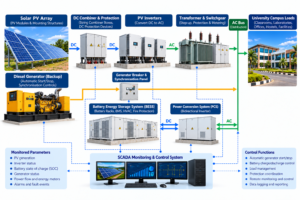
The principal blocks are PV modules and mounting structures; DC strings and protection; inverters; AC collection and transformers; switchgear and protection; battery storage and PCS; diesel generators; SCADA and metering; and campus distribution. The approved single-line diagram, protection study and control philosophy—not a generic illustration—must define the final topology.
| Component | Function | Key checks |
|---|---|---|
| PV modules and mounting | Convert sunlight to DC and support modules. | Ratings, wind loads, clamps, torque, shading and earthing. |
| PV strings | Combine modules within inverter limits. | Voltage at temperature extremes, current, polarity and connectors. |
| Inverters | Convert DC to controlled AC. | MPPT range, protection, thermal derating and communications. |
| Transformers and switchgear | Transform voltage, isolate and protect circuits. | Ratio, impedance, relay settings, interlocks and test certificates. |
| BESS | Store energy and support power management. | Usable capacity, BMS, HVAC, fire safety and emergency isolation. |
| PCS | Provide a bidirectional battery power interface. | Charge/discharge limits, modes, ramp rates and efficiency boundary. |
| Generators | Provide dispatchable backup power. | Starting, load acceptance, fuel, protection and synchronisation. |
| SCADA and metering | Monitor operations, alarms, trends and events. | Time synchronisation, point-to-point tests, meter boundaries and access. |
| Campus distribution | Deliver power to connected loads. | Load flow, protection coordination, feeder capacity and switching plans. |
3. Engineering design
Engineering Design
The engineering design of an 8.5 MWp solar hybrid power plant involves planning and integrating solar PV modules, inverters, battery energy storage, diesel generators, transformers, and protection systems to ensure safe, reliable, and efficient power supply.
PV Sizing and String Design
PV sizing involves determining the number of solar modules required to achieve the target capacity. String design ensures that modules are connected in suitable series and parallel configurations, taking into account inverter voltage limits, current ratings, temperature variations, and maximum power requirements.
AC Collection and Protection
The AC collection system transfers power from the PV inverters to the transformers and main distribution bus. Proper cable sizing, switchgear selection, earthing, circuit breakers, and protection coordination are essential for safe operation and reliable power distribution.
Battery and Generator Integration
Battery energy storage enables excess solar energy to be stored and used when solar generation is low or demand increases. Diesel generators provide backup power when required. Integrating the battery system, power conversion system, and generators through a coordinated control system supports load management, stable operation, and efficient energy utilisation.
4. Procurement and construction readiness
Procurement and construction readiness involves ensuring that all required equipment, materials, approved drawings, technical specifications, and construction resources are available before work begins. This includes PV modules, mounting structures, inverters, battery storage systems, transformers, cables, and protection equipment. Proper planning, supplier coordination, quality inspections, and delivery scheduling help minimise delays, ensure compliance with project specifications, and support safe and timely project execution.
Procurement should translate the design into traceable equipment schedules, datasheets, approved suppliers, quality plans, inspection and test plans, delivery schedules, warranties, spares and documentation. Technical submittals should be reviewed before purchase or installation; substitutions require formal engineering review.
At delivery, check quantities, serial numbers, visible damage, packaging, preservation requirements and transport restraints. Batteries, electronics, cables and switchgear must be stored within manufacturer limits. A delivered item is not automatically accepted: inspection records, certificates, test results and traceability remain necessary.
5. Civil and structural construction
Ground-mounted PV construction normally progresses through survey and setting out, clearing and grading, drainage, foundations or driven piles, mounting structures, equipment bases, trenches, roads, fencing and ancillary buildings. The actual FUTO construction method should be described from site records; this article does not assume a particular foundation type.
Civil quality control is linked to electrical performance. Poor drainage can undermine foundations or flood cable routes; incorrect pile alignment can create module-fit problems; inadequate trench bedding can damage cables; and insufficient equipment clearances can compromise maintenance and fire response.
| Work package | Quality evidence | Hold point |
|---|---|---|
| Survey and setting out | Coordinates, benchmarks and inspection records. | Before earthworks. |
| Earthworks and drainage | Levels, compaction, gradients and erosion checks. | Before foundation/trench closure. |
| Foundations / piles | Location, depth, alignment and specified tests. | Before structure erection. |
| Mounting structures | Material certificates, alignment, corrosion protection and torque. | Before module installation. |
| Cable trenches | Separation, bedding, bend radius and photos before backfill. | Before trench closure. |
| Equipment pads | Dimensions, level, access, ventilation and drainage. | Before equipment placement. |
6. Electrical installation and quality assurance
Installation should follow approved-for-construction drawings, method statements, risk assessments and inspection plans. DC wiring must preserve string identity and polarity. Connectors must be compatible, properly crimped with approved tools and protected from tensile stress and water ingress. Improvised repairs and mixed connector types can create high-resistance joints and overheating.
Inverters, transformers, batteries, generators and switchgear must be installed to OEM instructions and the approved layout. Terminations require correct glands, lugs, crimping, torque and phase identification. Earthing and bonding must be continuous and tested. Working at height, lifting, electrical isolation and stored battery energy require task-specific safety controls.
| Test / inspection | Purpose | Evidence |
|---|---|---|
| Visual / torque inspection | Detect damage and loose connections. | Signed checklists and torque records. |
| PV polarity / string checks | Confirm correct wiring. | String register and test results. |
| Insulation / continuity | Check circuit integrity. | Instrument details and readings. |
| Earthing / bonding | Verify continuity and earth-system performance. | Test reports and acceptance criteria. |
| Cable / transformer tests | Confirm integrity before energisation. | Approved test certificates. |
| Relay / breaker tests | Prove protection and interlocks. | Settings and functional reports. |
| BESS / PCS tests | Prove BMS, charge/discharge and emergency isolation. | OEM commissioning records. |
| SCADA point-to-point | Verify alarms, meters, commands and timestamps. | Tested point list and issue log. |
7. Commissioning: from mechanical completion to handover
Commissioning is a controlled process, not a single switch-on event. Before energization, confirm mechanical completion, approved drawings, closed safety-critical defects, test certificates, protection settings, switching schedules, permits, emergency arrangements and readiness of the receiving network.
- Mechanical completion: confirm installation against drawings, equipment schedules and punch lists.
- Pre-commissioning: complete applicable cable, insulation, continuity, polarity, earthing, protection and equipment checks.
- Energization: use an approved switching programme, authorised personnel, permits and communication protocols.
- Functional testing: test operating modes, interlocks, alarms, emergency shutdown, generator logic, battery controls and loss-of-supply responses.
- Integrated testing: verify PV, PCS/BESS, generators, transformers, switchgear, SCADA and campus loads across expected operating states.
- Performance testing: establish an agreed baseline for energy, availability, PV performance and battery efficiency.
- Handover: provide as-built drawings, O&M manuals, warranties, training, spares, asset registers, test reports and outstanding-item status.
8. Measuring performance responsibly
| KPI | Definition | Caution |
|---|---|---|
| PV energy yield | Metered PV energy over a period (kWh). | Define meter boundary. |
| Specific yield | PV energy (kWh) ÷ DC capacity (kWp). | State period and units. |
| Performance ratio | Final yield ÷ reference yield. | Requires valid irradiation data over the period. |
| Availability | Available time ÷ scheduled time × 100%. | Define exclusions and boundary. |
| BESS round-trip efficiency | Discharged energy ÷ charged energy × 100% over a matched cycle. | Align timing, SOC and meter boundaries. |
| Diesel contribution | Metered generator energy. | Separate generation from delivered load. |
| Unserved energy | Demand not supplied in a defined interval. | Requires a defensible load estimate. |
A battery round-trip efficiency above 100% usually indicates mismatched time windows, changing state of charge, meter boundaries, unit errors or data-quality problems. It should trigger validation rather than be reported as energy creation.
For example: At a nominal PCS output of 6 MW, 17MWh ÷ 6 MW = 2.54 hours before accounting for usable SOC limits, losses, auxiliary loads and degradation. This is not a guaranteed discharge duration.
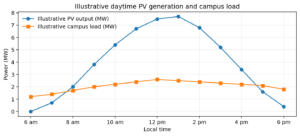
Illustrative daily energy-flow example
The following table is a teaching example only. It is not FUTO operating data. Real energy accounting should be performed in kWh over matched intervals, with charging/discharging losses and auxiliary consumption represented explicitly.
| Illustrative interval | PV energy | Campus load | Battery charge | Battery discharge | Diesel energy |
|---|---|---|---|---|---|
| Morning ramp | 18 kWh | 24 kWh | 0 kWh | 4 kWh | 6 kWh |
| High-solar period | 62 kWh | 38 kWh | 18 kWh | 0 kWh | 0 kWh |
| Evening | 0 kWh | 32 kWh | 0 kWh | 20 kWh | 12 kWh |
These rows are simplified examples and are not a complete conservation-of-energy ledger; they do not model conversion losses or state-of-charge change in detail. A formal report should reconcile all meters and account for every source, sink, auxiliary load and loss.
9. Operations and maintenance
| Frequency | Typical activities | Records |
|---|---|---|
| Daily | Review SCADA alarms, PV output, inverter status, battery SOC/temperature, generator status and security. | Daily log, alarms and energy report. |
| Weekly | Inspect accessible equipment, drainage, vegetation, fences/CCTV and work orders. | Inspection and defect register. |
| Monthly | Trend analysis, meter reconciliation, battery/PCS review, inverter/transformer checks and scheduled generator servicing. | KPI report and maintenance logs. |
| Quarterly | Thermography where appropriate, controls/protection review, cable checks under safe isolation and emergency-drill review. | Test records and corrective actions. |
| Annual / OEM interval | Preventive maintenance, specified electrical tests, battery health assessment, generator servicing and cybersecurity review. | Asset register, warranty tracker and annual review. |
Cleaning frequency should reflect measured soiling, rainfall, water quality, safety and cost-benefit—not a rigid calendar alone. Inverter cooling, battery HVAC, fire detection, emergency stops, lightning protection, switchgear and transformers require maintenance to their own OEM schedules.
10. Safety, environment and security
A utility-scale site contains DC circuits that can remain energized in daylight, high-fault-energy AC systems, stored battery energy, rotating machinery, fuel and work-at-height hazards. Safe work requires permit-to-work controls, lockout/tagout, proving-dead procedures, PPE, emergency response and trained authorised personnel.
Environmental and social management includes housekeeping, waste segregation, responsible battery and electronic-waste handling, drainage and erosion control, vegetation management, spill prevention, community communication and incident reporting. Fencing, lighting, CCTV, access control and cable inspections should be risk-based.
11. Lessons for future university solar projects
- Measure the load before sizing the plant.
- Design the complete system, including feeders, protection, communications, distribution and O&M access.
- Resolve interfaces between PV inverters, PCS/BESS, generators, switchgear and SCADA early.
- Keep inspection records, serial numbers, approved drawings, test results and defect close-out traceable.
- Treat commissioning as formal acceptance with defined boundaries and signed evidence.
- Validate data before calculating PR, availability, battery efficiency or savings.
- Budget for maintenance, spares, training, security, software support and battery lifecycle planning from the start.
Frequently asked questions
What is the capacity of the FUTO solar hybrid power project?
The project design references a total PV capacity of 8.546 MWp DC, comprising 12,852 solar modules rated at 665 Wp each and 24 string inverters rated at 300 kW each. Final installed capacities should be verified against the approved as-built documentation.
What does MWp mean?
MWp stands for megawatt-peak. It represents the combined rated power of solar PV modules under standard test conditions. Actual power output varies with sunlight, temperature, shading, and system losses.
Why does the project include battery energy storage?
Battery energy storage allows excess solar energy to be stored and used later. It supports energy management, helps balance supply and demand, and can improve power availability, depending on battery capacity, state of charge, control settings, and system design.
What is the role of a Power Conversion System (PCS)?
The PCS provides a controlled, bidirectional interface between the battery and the AC electrical system, enabling battery charging and discharging within the equipment’s rated capacity and permitted operating modes.
How is a solar hybrid power plant commissioned?
Commissioning involves verifying mechanical completion, conducting pre-commissioning inspections and electrical tests, carrying out authorised energisation, performing functional and integrated system tests, assessing performance, and completing formal handover documentation.
What does the SCADA system monitor?
Depending on the installed instrumentation and configured points list, the Supervisory Control and Data Acquisition (SCADA) system can monitor PV generation, inverter status, battery state of charge, generator operation, energy meters, alarms, faults, and performance trends.
How is solar plant performance measured?
Common performance indicators include energy yield, specific energy yield, performance ratio (PR), plant availability, battery round-trip efficiency (RTE), and diesel generator energy contribution. These indicators help assess operational reliability and energy efficiency.
What maintenance does a utility-scale solar plant require?
Maintenance typically includes system monitoring, PV module inspections and cleaning when necessary, electrical and thermal inspections, inverter and transformer servicing, battery health assessments, generator maintenance, security checks, and accurate maintenance recordkeeping.
Has the FUTO solar hybrid power plant been commissioned?
An inspection request dated 14 November 2025 indicated that statutory inspection, testing, and certification were being requested, with commissioning anticipated. The current commissioning status should be confirmed through a subsequent signed commissioning certificate or an official project announcement.
Conclusion
The FUTO solar hybrid project demonstrates the engineering, construction, commissioning, and operational requirements of delivering utility-scale renewable energy for a university campus. Its reported 8.546 MWp solar PV capacity is only one part of the system; battery storage, power conversion, protection, distribution, SCADA monitoring, and long-term maintenance are equally important.
The real measure of success is not installed capacity alone, but reliable power delivery, verified performance, safe operation, and sustainable asset management.