The Federal Government is rolling out new grant schemes, zero-interest loans and installation subsidies for homeowners, SMEs and rural communities. If you’ve been thinking of reducing your diesel or NEPA expenses, this is one of the most promising moments.
Many people miss out because they don’t understand how these programs work or how to apply.
You’re about to get a clear breakdown of everything you need.
This guide covers
• Who qualifies
• How much funding is available
• Step-by-step application
• Required documents
• Timelines
• What improves your approval chances
• Mistakes that lead to rejection
• FAQs with structured data markup
Let’s go straight into what matters.
What the New FG Solar Grants Cover in 2025
The programs for 2025 target three major groups.
Each block has its own funding limit and requirements.
1. Residential Solar Support Grant
Designed for households struggling with rising energy bills.
You can apply whether you stay in a rented apartment or your own building.
Funding covers
• Solar panels
• Inverter
• Batteries
• Installation
• Basic wiring upgrades
Typical grant value: N120,000 – N250,000
Top-up loan: Zero-interest, payable in 18–24 months.
2. SME Solar Fund
Targeted at small and medium businesses.
If constant power affects your operations, you fall under this category.
Use cases
• Tailoring shops
• Cold rooms
• Clinics
• Restaurants
• ICT hubs
• Printing shops
Grant value: N300,000 – N500,000
Optional low-interest loan available for systems above 5 kW.
3. Rural Mini-grid Support Program
Focused on villages and semi-urban areas without stable grid supply.
Funding covers
• Community mini-grid projects
• Metering
• Distribution upgrades
• Village-level solar lighting
Grant value: Up to N1.2 million per cluster
Communities can apply through recognized cooperatives.
Eligibility Requirements
The application process is strict because of previous fraud cases.
Before applying, confirm you meet these points.
For households
- Valid NIN
• Proof of address
• Recent electricity bill
• Stable monthly income
• Bank Verification Number
• Photo of roof or installation area
For SMEs
- Registered business (CAC)
• TIN
• Last 3–6 months bank statement
• Evidence of business location
• Load requirement sheet
• Existing power challenge
For communities
- Registered cooperative
• Population data
• Proof of land or installation site
• Community energy needs
• Security clearance from local council
Documents You Must Upload
You speed up your approval when your documents are complete and clear.
- NIN Slip
• Utility bill
• Installation site photo
• Quotation from an approved solar vendor
• Passport photograph
• Bank statement
• CAC certificate for businesses
• Cooperative registration certificate for communities
Table: Required Documents by Category
| Document | Homeowners | SMEs | Communities |
| NIN | Yes | Yes | Yes |
| Bank Statement | Yes (3 months) | Yes (6 months) | Treasurer’s statement |
| CAC | No | Yes | Yes |
| Installation Photos | Yes | Yes | Yes |
| Vendor Quotation | Yes | Yes | Yes |
| Proof of Address | Yes | Yes | Yes |
| Community Approval | No | No | Required |
How to Apply for Any FG Solar Grant in 2025
The official application portals vary by program, but the process follows the same structure.
1. Visit the approved application portal
This is where you create your profile, fill your details and upload your documents.
Watch out for unofficial websites during peak application periods.
2. Confirm your eligibility category
Household, SME or Community.
Your category determines your funding limit.
3. Fill the energy assessment form
You’ll answer questions such as
• How many hours of power you receive daily
• Your average monthly energy cost
• Your preferred system size
• Intended installation location
4. Upload your documents
Clear uploads improve approval speed.
Blurry documents create verification delays.
5. Select an approved solar vendor
You’ll be shown a list of vetted installers.
This prevents substandard installations.
6. Schedule verification
Officials may visit your home or business to inspect the site.
7. Approval and grant disbursement
Funds are not given directly to you.
They go to the approved vendor handling your installation.
This eliminates misuse of grants.
8. Installation and final inspection
Your vendor installs the system.
The agency conducts a final inspection before marking your application complete.
Factors That Improve Your Approval Chances
These small steps make your application stand out.
- Upload clear documents
• Give accurate load requirements
• Choose a vendor with successful installations
• Provide a reachable phone number
• Show proof of consistent income
• Use the same details across NIN, BVN and bank account
• Respond fast during verification
• Apply early before funding rounds fill up
Common Mistakes That Lead to Rejection
You avoid delays when you stay away from these errors.
- Wrong name details between NIN, BVN and bank account
• Fake electricity bills
• Duplicate entries
• Unregistered business applying under SME category
• Insufficient bank balance
• No proof of address
• No valid photo of the installation site
How Funding Is Disbursed
Grant money does not enter any applicant’s account.
It is paid directly to the installer after verification.
You only pay the difference if your system exceeds the approved amount.
Example
If your selected system is N950,000
And your approved grant is N250,000
You pay N700,000, either upfront or via top-up loan.
Expected Timeline
- Application: 10–20 minutes
• Document review: 1–3 weeks
• Verification: 2–10 days
• Approval: 1–3 weeks
• Installation: 3–14 days
Delays happen when documents don’t match.
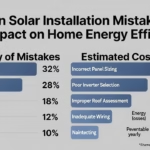
Estimated Costs and Grant Impact
| System Size | Average Market Cost | Potential Grant | Your Balance |
| 1.5 kW | N650,000 | N120,000 | N530,000 |
| 3 kW | N1,200,000 | N250,000 | N950,000 |
| 5 kW | N2,000,000 | N500,000 | N1,500,000 |
| Community Mini-grid | N6,000,000+ | N1.2 million | Project dependent |
Where These Grants Are Mostly Used
- Homes with high fuel expenses
• Stores running freezers
• Clinics with vaccine refrigerators
• Schools with ICT labs
• Farms with irrigation pumps
• Rural communities with no grid supply
You can decide where you fit and apply under the correct category.
Why the FG Is Expanding Solar Programs in 2025
Energy costs are rising.
Grid reliability is declining.
Demand for cheaper alternatives is increasing.
Solar helps households save money, reduces dependency on fuel and supports Nigeria’s renewable energy goals.
More Nigerians are now choosing solar because it offers
• Lower long-term cost
• Cleaner energy
• Stable power for homes and businesses
• Reduced pressure on the national grid
Frequently Asked Questions (FAQ)
Below are answers to the most common questions people ask before applying.
1. Who can apply for the 2025 solar grant?
Any Nigerian with valid identification can apply.
Households, SMEs and communities have separate categories.
2. Do I need to pay money to apply?
Application is free.
You only pay the balance if your system costs more than the approved grant.
3. Can tenants apply?
Yes.
You only need proof of residence and permission to install.
4. How long does approval take?
Between 3–6 weeks depending on verification speed.
5. Can I choose my own installer?
You must choose from the approved installer list.
6. Will the government credit my bank account?
No.
Money is paid to the installer after verification.