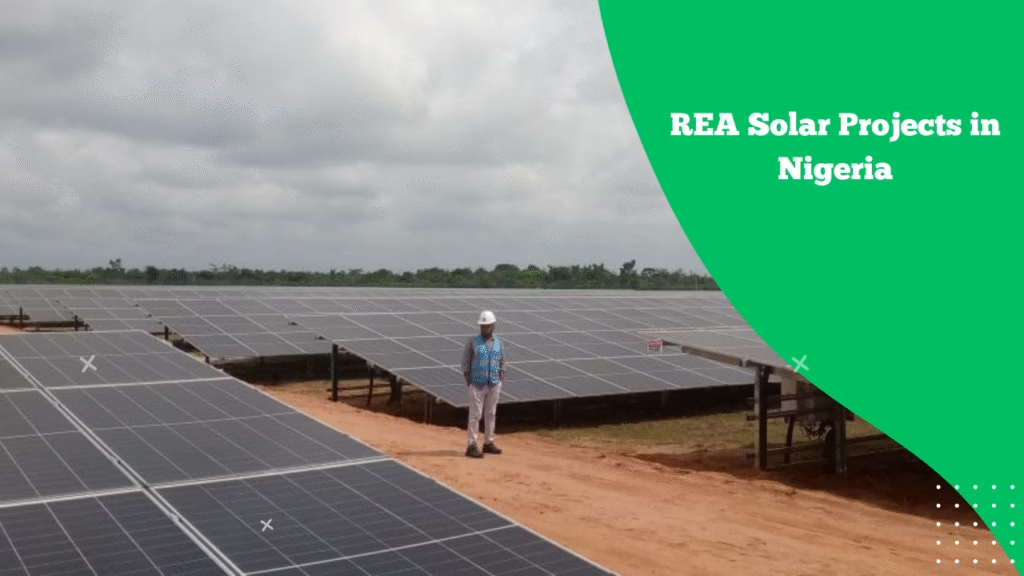
For years, the narrative around Nigeria’s power sector has been dominated by challenges: an unreliable national grid, widespread use of expensive and polluting petrol generators, and a significant energy deficit that hinders economic growth. However, a quiet revolution is underway, spearheaded by the Rural Electrification Agency (REA) and its ambitious solar energy projects. As we move through 2025, these initiatives are no longer just pilot programs; they are becoming a core part of Nigeria’s energy solution.
This comprehensive update dives deep into the current progress of the REA’s solar projects. We will explore the data, analyze the impact of key programs like Solar Power Naija, and provide a clear-eyed view of the successes, challenges, and future trajectory of solar energy in Nigeria.
The Bedrock: Understanding the REA’s Mandate
The Rural Electrification Agency (REA) is the implementing agency of the Federal Government of Nigeria tasked with electrifying the nation’s unserved and underserved communities. While its mandate is broad, its recent focus has sharply pivoted towards leveraging renewable energy sources, particularly solar power, due to their scalability, decreasing costs, and suitability for a country blessed with abundant sunshine.
The REA’s strategy is multifaceted, operating through several key programs and funding windows, which we will explore in detail.
Key REA Solar Programs: A 2025 Status Check
The REA’s solar strategy is delivered through several flagship initiatives. Here’s a breakdown of their current status as of 2025.
-
The Solar Power Naija Initiative
Launched under the Economic Sustainability Plan (ESP), Solar Power Naija is the REA’s most ambitious program. Its goal is to facilitate the addition of 5 million new solar-based connections, impacting over 25 million Nigerians. The program targets both off-grid and on-grid solutions through various models.
2025 Progress Update:
Progress: The initiative has gained significant momentum. As of Q1 2025, over 2.8 million connections have been successfully deployed, bringing power to an estimated 14 million Nigerians.
Funding: The program has successfully unlocked over ₦150 billion in private sector investments through its counterpart funding structure. The Central Bank of Nigeria (CBN) window for the program remains active, providing low-interest loans to qualified developers.
Focus Areas: The program has seen the highest penetration in the North-West and North-East regions, which have some of the country’s lowest grid connectivity rates. However, projects are active across all six geo-political zones.
-
Nigeria Electrification Project (NEP)
Funded by the World Bank and the African Development Bank (AfDB), the NEP is a critical pillar of the REA’s efforts. It provides results-based grants and performance-based grants to private sector developers to deploy off-grid solutions.
The NEP comprises four core components:
Solar Hybrid Mini-Grids: For unserved and underserved communities.
Standalone Solar Home Systems (SHS): For households and small businesses.
Energizing Education Program (EEP): Providing solar power to federal universities and teaching hospitals.
Energy Efficient Equipment: Promoting productive use appliances to stimulate economic activity.
2025 Progress Update:
Mini-Grids: Over 130 solar hybrid mini-grids are now operational, providing stable, 24/7 power to businesses and households. These mini-grids have a combined capacity of over 35 MW.
Standalone SHS: The NEP has facilitated the sale and distribution of over 1.1 million certified Solar Home Systems, empowering households and small businesses.
Energizing Education: Phase 1 is fully complete, providing reliable power to 7 federal universities and 2 teaching hospitals. Phase 2 is underway, with 5 additional sites in advanced stages of commissioning.
-
Performance-Based Grant (PBG) Fund
This fund under the NEP is a game-changer. It de-risks investments for mini-grid developers by providing a grant that covers a portion of the capital expenditure, but only after the mini-grid is built and has met all performance metrics. This ensures value for money and project success.
Quantifying the Impact: Data and Statistics (2025)
Let’s look at the numbers to understand the scale of progress.
Table 1: REA Solar Projects – Cumulative Impact (2021 – 2025)
| Metric | 2021 (Baseline) | 2023 (Mid-Point) | 2025 (Current) |
| Solar Connections Deployed | ~400,000 | 1.5 Million | 2.8+ Million |
| People Impacted | ~2 Million | 7.5 Million | 14+ Million |
| Operational Mini-Grids | ~50 | 90 | 130+ |
| Mini-Grid Capacity (MW) | ~12 MW | 25 MW | 35+ MW |
| Private Investment Mobilized | ~₦50 Billion | ₦100 Billion | ₦150+ Billion |
This data shows a clear and accelerating upward trajectory, particularly in the last two years.
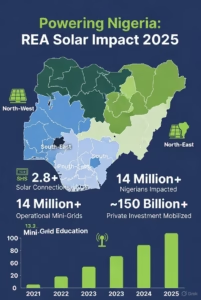
Powering Nigeria: REA Solar Impact 2025
Challenges and Hurdles in 2025
Despite the impressive progress, the path forward is not without obstacles. Acknowledging these challenges is crucial for sustained growth.
Foreign Exchange Volatility: The fluctuating Naira-to-Dollar exchange rate remains a significant headwind for developers who need to import solar components.
Supply Chain Delays: Global and local logistics can still cause delays in the delivery of critical equipment like batteries and solar panels.
Community Engagement and Tariff Collection: Establishing sustainable tariff structures and managing community expectations require skilled local presence and continuous effort.
Grid Encroachment Risk: There is a persistent fear that the main grid might eventually reach a mini-grid community, potentially undermining the private investment. Clear policies on compensation and integration are needed.
The Road Ahead: Future Outlook for REA Solar Projects
The momentum in 2025 sets a strong foundation for the future. Here’s what to expect:
Deepening of Mini-Grid Clusters: The focus will shift from single mini-grids to developing interconnected mini-grid clusters, creating larger, more resilient power pools for entire regions.
Focus on Productive Use: More emphasis will be placed on promoting agricultural processing, cold storage, and other income-generating activities to ensure communities can afford and fully utilize the power.
Battery Energy Storage Systems (BESS): As costs decline, integrating larger BESS will become more common, enhancing reliability and allowing for more solar energy to be stored and used at night.
Scaling Solar Home Systems: The SHS market will continue to grow, with a focus on Pay-As-You-Go (PAYGo) models to make systems affordable for low-income households.
Conclusion: A Brighter, Solar-Powered Future
The REA’s solar projects in Nigeria have moved from promising experiments to a central component of the national electrification strategy. The 2025 progress report is overwhelmingly positive, demonstrating tangible impact on millions of lives and mobilizing unprecedented levels of private investment.
While challenges around forex, supply chains, and policy remain, the framework for success is firmly in place. The continued commitment to public-private partnerships, coupled with the relentless innovation of local solar developers, paints a bright picture for the future. Nigeria is steadily, and surely, harnessing the power of its sun to light up homes, power businesses, and fuel its economy.
Frequently Asked Questions (FAQ)
Q1: What is the main goal of the REA’s solar projects?
The primary goal is to provide affordable, reliable, and clean electricity to the millions of Nigerians in unserved and underserved rural communities, thereby reducing energy poverty, stimulating economic growth, and improving quality of life.
Q2: How can a community apply to get a solar mini-grid from the REA?
Communities do not typically “apply” directly. The REA, through its programs like the NEP, issues calls for proposals to pre-qualified private sector developers. Developers then identify viable sites based on technical and commercial feasibility. However, communities can make themselves attractive to developers by demonstrating willingness to pay for power and ensuring security for the infrastructure.
Q3: What is the difference between a Solar Home System (SHS) and a Mini-Grid?
A Solar Home System (SHS) is a small-scale system designed for a single household or small business, typically powering lights, phones, and a TV or fan. A Mini-Grid is a larger, centralized solar power plant that generates electricity for an entire community, distributing it via a small local grid, similar to a miniature version of the national grid.
Q4: Are these solar systems given for free?
No, the model is not primarily based on free distribution. The REA’s strategy is to create a sustainable market. This involves providing grants or subsidies to private companies to lower the initial capital cost, which in turn allows them to offer systems to end-users at affordable prices, often through flexible payment plans like PAYGo for SHS or monthly tariffs for mini-grids.
Q5: How has the Solar Power Naija initiative impacted the average Nigerian?
It has impacted the average Nigerian by:
Providing cleaner and cheaper alternatives to petrol generators.
Enabling children to study at night and improving home comfort.
Powering small businesses, leading to extended operating hours and increased productivity.
Creating direct and indirect jobs in sales, installation, and maintenance of solar systems.
Q6: What is being done about the challenge of maintaining and repairing these systems?
A key part of all REA programs is building local capacity. Developers are often required to train local technicians for basic maintenance and repairs. Furthermore, the supply chains for solar components are expanding across Nigeria, making it easier to source replacements, and many SHS come with long-term warranties and service agreements.