Nigeria’s power reality is simple: you need a reliable backup that can handle sudden outages, unstable voltage, and the daily “NEPA took light” rhythm. But the “best solar inverter” is not one brand for everyone. The best choice depends on your load (what you want to power), your budget, your battery type, and whether you want to run heavy appliances like ACs, pumping machines, pressing irons, or multiple fridges.
This guide explains exactly what to buy for a typical Nigerian home, how to size it correctly, what specs actually matter (and which ones are marketing), and how to avoid common installation mistakes that make inverters fail early.
Quick answer: what is the best inverter type for most Nigerian homes?
For most Nigerian homes, the best all-round choice is a pure sine wave hybrid inverter paired with LiFePO₄ (lithium) batteries and enough solar panel capacity to recharge daily. Hybrid matters because it can take solar + battery + grid (and sometimes generator) intelligently, and it reduces the stress Nigerians typically put on batteries when PHCN/Disco supply is poor.
If you already have stable generator usage and you mainly want battery backup at night, a high-quality inverter/charger (non-hybrid) can work, but hybrid still wins in efficiency and long-term convenience.
What “best” means in Nigeria
In Nigeria, “best inverter” means:
Your inverter can survive high ambient temperatures, frequent battery deep discharge, and heavy surge loads (fridge compressors, pumps, AC startup). It must also have strong protections because many homes see voltage fluctuations, poor earthing, and sometimes weak wiring practices.
So instead of chasing the biggest kVA rating only, you want a system that is:
- correctly sized for your loads,
- compatible with your battery chemistry,
- protected against surges and wiring faults,
- supported with warranty and service access.
Step 1: Choose the right inverter class for your home
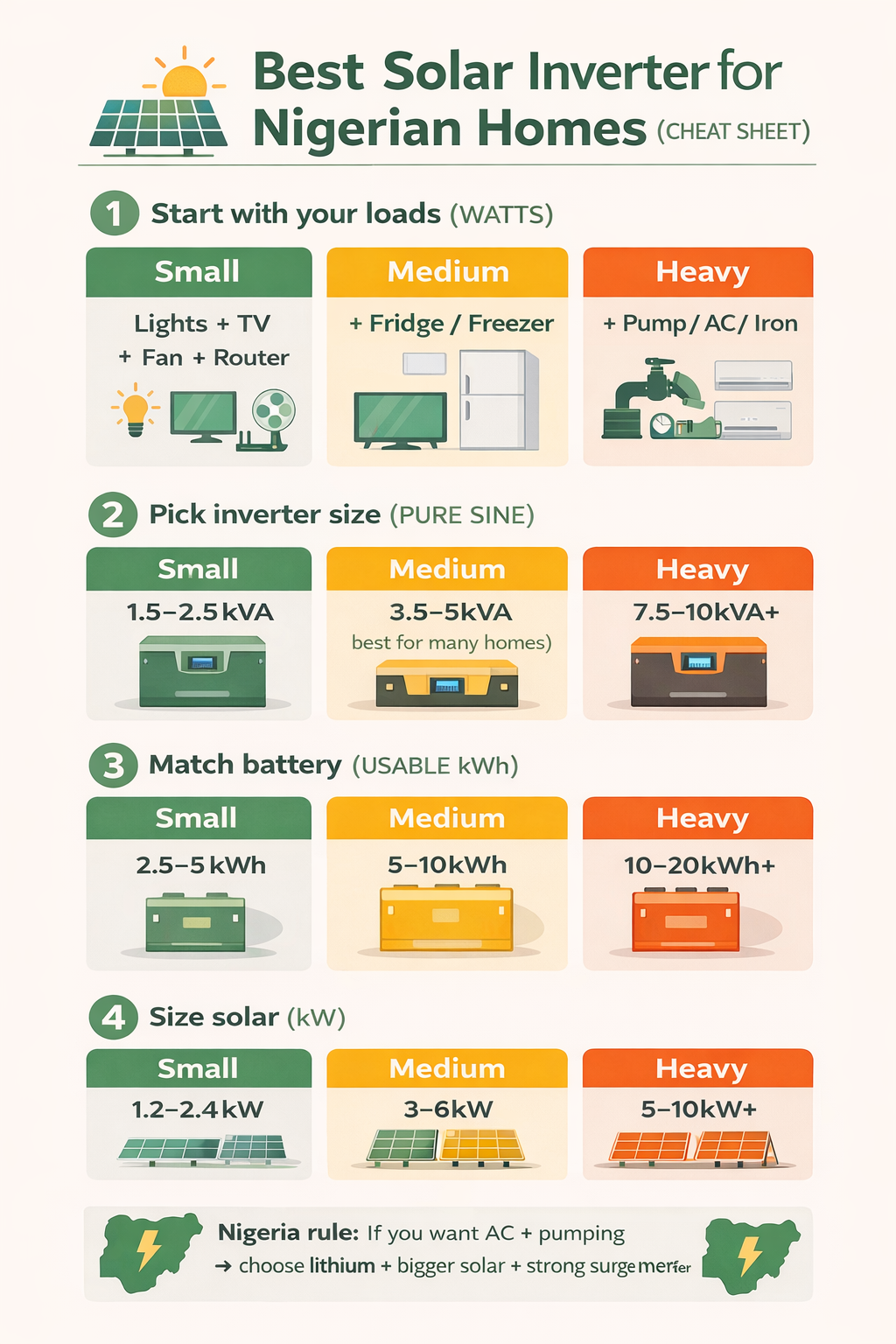
1) Hybrid inverter (recommended for most homes)
A hybrid inverter can use solar power directly, charge batteries, and also accept grid or generator input. Many models include MPPT solar charge controllers inside.
Best for: homes that want solar to do most of the work, reduce generator fuel, and keep batteries healthy.
Why Nigerians prefer it: it can prioritize solar in the day, charge batteries faster, and smoothly switch when the grid fails.
2) Inverter/charger (non-hybrid)
This type mainly converts battery DC to AC and charges batteries from grid/generator using an AC charger. Solar charge controller is usually separate.
Best for: homes where solar is minimal or you already have a good generator routine and want cleaner backup.
3) “Modified sine wave” inverters (avoid for modern homes)
They’re cheaper, but they can cause noise, overheating, and shortened lifespan for sensitive electronics and some appliances.
Best for: very basic loads only (and even then, pure sine is safer).
Step 2: Understand kVA vs kW (this is where many Nigerians make mistakes)
Many Nigerians buy “5kVA” and assume it will run everything. But you must check the kW rating (real power) and surge capability.
A typical pure sine inverter might be rated like this:
- 5kVA with power factor 1.0 → roughly 5kW usable
- 5kVA with power factor 0.8 → roughly 4kW usable
Always confirm the continuous output in watts (W), not only kVA.
A simple rule for Nigerian homes
If you want to run fridges, TVs, fans, lighting, decoder, laptop, and one small pumping machine occasionally, you’re often in the 3.5kVA–5kVA territory (if you manage loads well). If you want AC(s), more fridges/freezers, heavier pumping, or a busy household, you’re often in the 7.5kVA–10kVA+ territory.
Step 3: The 5 features that matter most (real “best inverter” checklist)
1) Pure sine wave output
This is non-negotiable for modern Nigerian homes with TVs, sound systems, laptops, Starlink routers, smart appliances, and efficient inverter fridges/ACs.
2) Strong surge capacity
Nigeria has many compressor loads. A fridge that runs at 200–300W can demand 800–1500W briefly at startup. Pumps and ACs can surge even higher.
Look for inverters that clearly state surge rating (for example “2× for 5 seconds” or “10kW surge”).
3) MPPT solar charging (not PWM)
MPPT controllers harvest more energy, especially with Nigeria’s heat and variable sunlight. If you are buying hybrid, prefer MPPT.
4) Battery compatibility and correct charge settings
If you use lithium (LiFePO₄), your inverter must support proper lithium charging voltages and ideally have BMS communication (optional but helpful). If you use tubular/AGM, it must support lead-acid profiles.
5) Protection and monitoring
In Nigeria, protections are life. Prioritize:
- Overload and short-circuit protection
- Over-temperature protection
- Low battery cut-off (LVD) and recovery settings
- AC input protection (surge, under/over voltage if available)
- Remote monitoring (Wi-Fi/app) is a plus, not compulsory, but very useful.
Step 4: Match the inverter to your house size
Below are practical “best-fit” recommendations by household type. The inverter rating alone is not enough; battery and solar must match.
Scenario A: Single room / self-contained / mini flat
If your goal is lights, TV, fan, decoder, laptop, and charging, then a 1.5kVA–2.5kVA pure sine inverter can be enough, especially with lithium.
Typical good fit:
- Inverter: 1.5–2.5kVA (24V system often)
- Battery: 2.5–5kWh LiFePO₄ (or 200Ah tubular at 24V equivalent)
- Solar: 1.2–2.4kW
Scenario B: 2–3 bedroom home (average Nigerian household)
This is the sweet spot where many people choose 3.5kVA or 5kVA. If you want to add a medium pumping machine or keep two fridges, 5kVA is usually safer.
Typical good fit:
- Inverter: 3.5–5kVA (48V preferred for efficiency)
- Battery: 5–10kWh LiFePO₄
- Solar: 3–6kW depending on your daily usage
Scenario C: 3–5 bedroom home with pumping + multiple fridges/freezers
If you want fewer restrictions and less “load management stress,” go for 7.5kVA–10kVA with a proper 48V battery bank.
Typical good fit:
- Inverter: 7.5–10kVA (48V)
- Battery: 10–20kWh LiFePO₄
- Solar: 5–10kW+
Scenario D: Homes that want to run ACs
AC is the biggest divider. The “best inverter for AC” is not only high kVA; it’s high surge, stable battery voltage, and adequate solar.
Practical guidance:
If you want to run a 1HP–1.5HP inverter AC reliably, most homes do better with at least 5kVA–7.5kVA, lithium batteries, and a solar array sized so the AC doesn’t drain batteries too fast. For multiple ACs, plan 10kVA+ and serious battery capacity.
Table 1: Typical Nigerian home loads and what they mean for inverter sizing
| Appliance / Load | Typical Running Power (W) | Startup Surge Risk | Notes for Nigeria |
| LED TV + decoder | 80–200 | Low | Easy load |
| Standing fan | 45–120 | Low | Easy load |
| Lighting (LED) | 30–200 total | Low | Easy load |
| Laptop + router | 50–120 | Low | Prefer pure sine |
| Fridge (inverter type) | 80–250 | Medium | Still has startup |
| Fridge (non-inverter) | 150–400 | High | Compressor surge is real |
| Freezer | 200–500 | High | Needs surge headroom |
| Pumping machine | 500–1500+ | Very high | Often causes tripping |
| Washing machine | 300–800 | Medium | Heating models can be higher |
| Iron | 1000–2000 | Low surge but heavy | Drains batteries fast |
| Microwave | 800–1500 | Medium | High draw |
| 1HP AC (inverter AC) | 600–1200+ | Medium | Better with lithium + solar |
| 1.5HP AC | 900–1800+ | High | Plan bigger inverter & battery |
These values vary widely by brand and condition. In Nigeria, older appliances often draw more power.
Step 5: Battery choice affects what inverter is “best”
Lithium (LiFePO₄): the best battery option for most homes
If your budget allows, LiFePO₄ is usually the best match in Nigeria because it handles deep cycling better, delivers higher current with less voltage drop, and lasts longer when correctly installed.
Tubular lead-acid: still common, but requires discipline
Tubular batteries can work well, especially for budget builds, but they hate deep discharge and they need more maintenance planning. They also sag in voltage under load, which makes inverters trip faster when you add pumps or compressors.
Bottom line: a “best inverter” paired with the wrong battery will still disappoint you.
Table 2: Battery and inverter pairing guide
| Battery Type | Best For | Main Advantage | Main Risk in Nigeria | Best Inverter Match |
| LiFePO₄ (Lithium) | Daily cycling, heavy loads, AC | Long lifespan, stable voltage | Fake cells / poor BMS in market | Hybrid pure sine, 48V preferred |
| Tubular (Flooded) | Budget builds | Affordable, widely available | Deep discharge kills lifespan | Pure sine inverter, strong LVD settings |
| AGM/GEL | Light-to-medium backup | Low maintenance | Heat and deep cycling reduce life | Pure sine, conservative discharge |
Step 6: Solar panel sizing (because inverter alone is not the system)
A common Nigerian mistake is buying a big inverter with small solar and expecting magic. If your solar is too small, you will be charging mostly from grid/generator, and batteries will suffer.
A practical solar sizing method
Estimate your daily energy use in kWh, then size solar to cover it.
If your home uses about 8kWh/day, then a reasonable solar array might be 3–5kW depending on your location, roof direction, shading, and how much daytime usage you have.
Nigeria has strong sun, but heat reduces panel output and many roofs have partial shading. Oversizing panels slightly is often smarter than under-sizing.
Table 3: Simple system sizing examples (realistic Nigeria setups)
| Home Type | Inverter Range | Battery (usable) | Solar Range | What it comfortably runs |
| Self-contained | 1.5–2.5kVA | 2.5–5kWh | 1.2–2.4kW | TV, fan, lights, laptop, router |
| 2–3 bedroom (managed) | 3.5–5kVA | 5–10kWh | 3–6kW | 1–2 fridges, fans, lights, TV, small pump occasionally |
| 3–5 bedroom (comfort) | 7.5–10kVA | 10–20kWh | 5–10kW | multiple cold loads, pumping, busy household loads |
| AC-focused | 5–10kVA+ | 10–30kWh | 6–15kW | 1–3 ACs depending on size + other loads |
Cost reality in Nigeria (ranges, not promises)
Prices move fast in Nigeria due to FX, logistics, and brand availability. Use these as planning ranges, then confirm in your market (Lagos, Abuja, Port Harcourt, Owerri, Kano, etc.).
Typical cost ranges (inverter only)
- 1.5–2.5kVA pure sine: ₦150k–₦450k
- 3.5–5kVA hybrid: ₦350k–₦1.2m
- 7.5–10kVA hybrid: ₦900k–₦3.5m+
Battery costs (very dependent)
- 5kWh LiFePO₄: often ₦1.2m–₦3m+
- 10kWh LiFePO₄: often ₦2.5m–₦6m+
- Tubular banks: wide range depending on brand and capacity
Installation and protection
Budget for proper BOS (balance of system): breakers, surge protection, isolators, trunking, good cable sizes, and earthing. These are not “extras” in Nigeria; they are how systems survive.
What to check before you buy (avoid fake and wrong specs)
The Nigerian market has genuine products and also “looks original” products. To protect yourself, verify these items:
- Manufacturer label and serial number, and whether the seller can show warranty terms
- Output waveform: must state pure sine wave
- Real continuous power in watts (not only kVA)
- MPPT voltage window and max PV input (so you don’t wire panels wrongly)
- Supported battery voltage: 12V/24V/48V (48V is usually best for larger systems)
- Availability of parts/service in your area
- Cooling design: Nigerian heat is not friendly to weak inverters
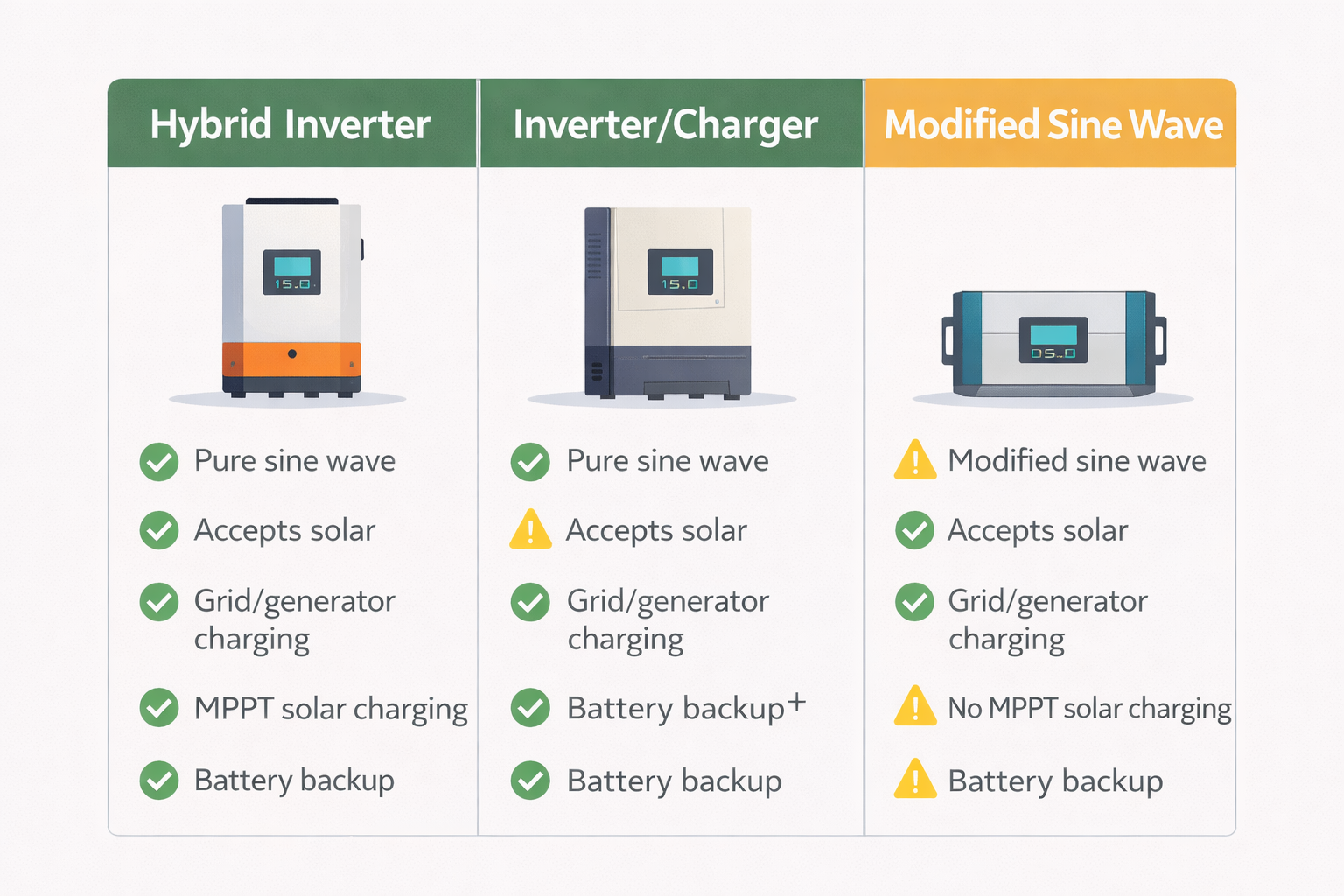
Chart: Choosing the best inverter size by your priority
Below is a simple “decision chart” you can use before you buy.
If your priority is:
– Lowest budget + basic loads → 1.5–2.5kVA pure sine (24V)
– Average family + 1–2 fridges → 3.5–5kVA hybrid (48V preferred)
– Comfort + pumping + busy home → 7.5–10kVA hybrid (48V)
– Running AC(s) reliably → 5kVA–10kVA+ hybrid + lithium + strong solar
“Best solar inverter” recommendations by category (without locking you to one brand)
Because availability and authenticity vary by city and time, the smartest approach is picking by category/specs first, then choosing a reputable brand that meets the category.
Best overall for most Nigerian homes
A 48V pure sine hybrid inverter in the 3.5kVA–5kVA range with MPPT and good surge rating.
Best for small budgets (still safe)
A pure sine inverter/charger (or entry hybrid) in 1.5kVA–2.5kVA, paired with a modest lithium battery and enough panels.
Best for large homes and heavy appliances
A 7.5kVA–10kVA (or higher) 48V hybrid inverter, preferably with remote monitoring and strong surge capability.
Best if you plan to upgrade later
A hybrid inverter that supports parallel operation (so you can add another inverter later) and can accept larger PV input.
BEST SOLAR INVERTER FOR NIGERIAN HOMES (CHEAT SHEET)
1) Start with your loads (WATTS)
Lights + TV + Fan + Router → Small
+ Fridge/Freezer → Medium
+ Pump/AC/Iron → Heavy
2) Pick inverter size (PURE SINE)
Small → 1.5–2.5kVA
Medium → 3.5–5kVA (best for many homes)
Heavy → 7.5–10kVA+
3) Match battery (USABLE kWh)
Small → 2.5–5kWh
Medium → 5–10kWh
Heavy → 10–20kWh+
4) Size solar (kW)
Small → 1.2–2.4kW
Medium → 3–6kW
Heavy → 5–10kW+
Nigeria rule:
If you want AC + pumping → choose lithium + bigger solar + strong surge inverter.
FAQs
What solar inverter size is best for a 2-bedroom flat in Nigeria?
For most 2-bedroom flats, a 3.5kVA to 5kVA pure sine hybrid inverter is a strong choice, especially if you have at least one fridge and you want fewer restrictions. Your final size should depend on whether you’ll run pumping machines or an AC.
Is 3.5kVA inverter enough for Nigerian homes?
It can be enough for many homes if loads are managed, especially with lithium batteries. It may struggle if you run a freezer, pumping machine, iron, or multiple compressor loads at the same time.
Should I buy a hybrid inverter or a normal inverter?
If you plan to use solar seriously, a hybrid inverter is usually the better long-term choice because it manages solar + battery + grid intelligently and often includes MPPT charging.
Which is better for Nigeria: lithium or tubular battery?
Lithium (LiFePO₄) is typically better for daily cycling, heavy loads, and longer lifespan. Tubular batteries can work for budgets, but they require stricter discharge discipline and may trip the inverter faster under heavy loads due to voltage drop.
Can a 5kVA inverter run an AC in Nigeria?
Sometimes, yes—especially an inverter AC—if the inverter has strong surge capability, your battery bank is large enough, and your solar can support daytime running. If you want reliable AC use without frequent low-battery shutdown, consider 7.5kVA+ and adequate battery capacity.
How many solar panels do I need for a 5kVA inverter in Nigeria?
It depends on the inverter’s PV input limit and your daily energy usage. Many homes pair 5kVA systems with roughly 3kW to 6kW of solar panels, depending on how much they want solar to carry the load.
What causes inverter overload trips in Nigerian homes?
Common causes include starting surge from fridges/freezers, pumping machines, undersized inverter, weak batteries, wrong cable sizes, poor connections, and running too many high-watt appliances at the same time.
Is it safe to run an inverter without surge protection?
It’s risky. In Nigeria, surge protection, correct breakers, proper earthing, and correct cable sizing are key to protecting your inverter, batteries, and home wiring.
Final buying advice
If you want the safest “best solar inverter” decision for a Nigerian home, prioritize pure sine wave + strong surge + MPPT + correct battery settings + proper protection. Then size your inverter to your real loads, not your hopes. Most disappointments come from under-sized batteries, too-small solar arrays, and poor wiring—more than from the inverter brand itself.
If you tell me your exact appliances (fridge count, pump HP, whether you want AC, and your daily power hours), I’ll calculate a Nigeria-realistic recommended inverter size, battery kWh, and solar kW—without oversizing you into unnecessary cost. Contact us here