If you’re building a solar/inverter setup in Nigeria, the battery is the heart of the system. Panels can be oversized later, and inverters can be upgraded, but a wrong battery choice will show up daily: short backup time, fast battery “weakness,” constant beeping, generator dependence, and money spent twice.
In Nigeria’s reality—high heat, frequent deep discharges during outages, voltage fluctuations, and long recharge windows—the “best battery” is not simply the most popular one. It’s the one that matches your load profile, your inverter type, your budget, your charging sources (PHCN + solar + gen), and your tolerance for maintenance.
This guide breaks it down in plain Nigeria-specific terms, with practical sizing examples, comparison tables, and a quick decision framework you can use before you pay any vendor.
What’s the best battery type for solar in Nigeria?
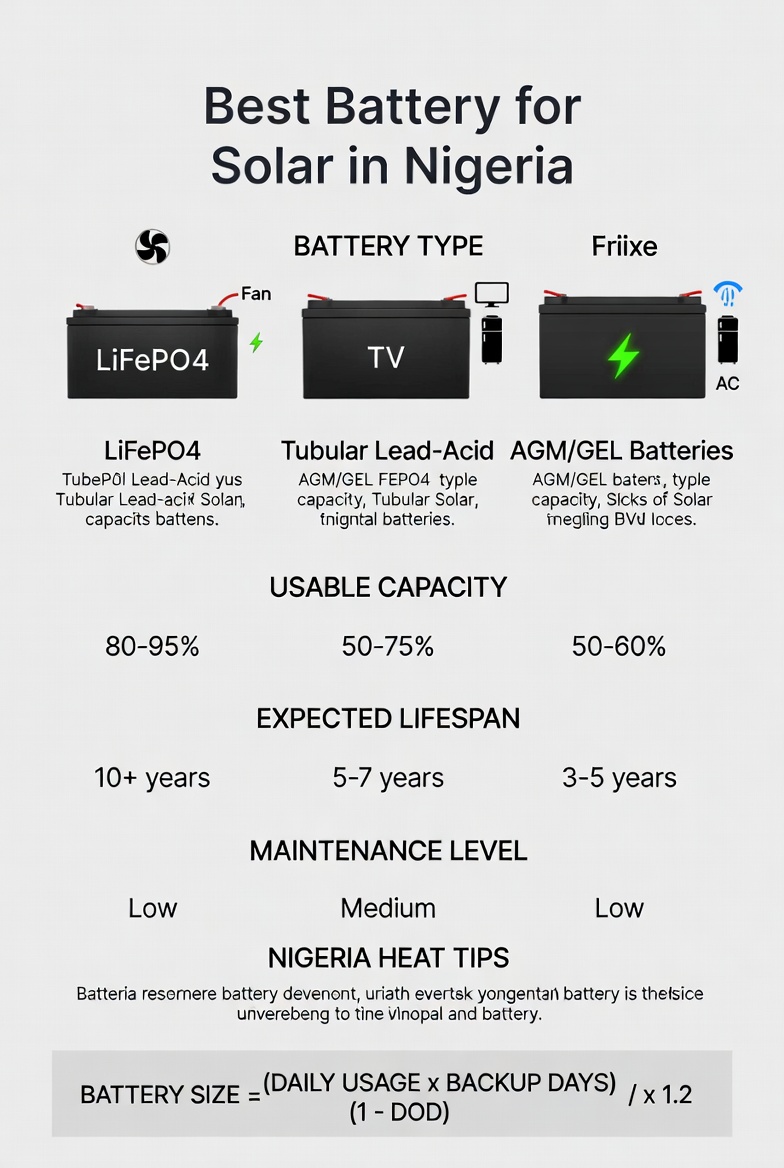
For most homes that want long life, fast charging, and reliable backup: LiFePO₄ (Lithium Iron Phosphate) is the best all-round battery for solar in Nigeria—especially if you can afford the higher upfront cost.
For tight budgets where you can maintain battery water and avoid deep discharge: Tubular flooded lead-acid can still be a decent “value” option, but it needs discipline and ventilation.
For smaller systems or short backup needs: AGM/GEL can work, but in Nigeria they often disappoint if used like deep-cycle batteries during long outages.
The biggest mistake Nigerians make when buying solar batteries
Most people shop by Ah (amp-hour) alone—“200Ah,” “220Ah,” “600Ah bank”—without translating it into usable energy (kWh).
- Your appliances consume watts (W) and kWh, not Ah.
- A “big Ah” battery can still give you short backup if the system voltage is wrong or if the battery chemistry can’t handle deep discharge repeatedly.
You’ll get a better purchase if you shop by:
- Daily energy need (kWh)
- Peak load (W)
- Battery usable capacity (kWh usable, not just total)
- Cycle life and warranty
Step 1: Know what you’re powering (Nigeria-style load reality)
Before you choose battery type, list your “must-run” appliances during outage. In Nigeria, the most common essentials are:
- Fans, TV, decoder, lights
- Wi-Fi, laptops, phone charging
- Fridge/freezer (big one)
- Pump (short bursts)
- Small AC (optional, expensive on batteries)
Table 1: Typical Nigerian appliance power guide (practical ranges)
| Appliance | Typical Power (W) | Notes in Nigerian homes |
| LED bulb (1) | 7–12W | Count how many you actually use |
| Standing fan | 45–90W | Older fans can be higher |
| TV (LED) | 60–150W | Bigger screens draw more |
| Decoder | 10–25W | Usually small |
| Wi-Fi router | 8–20W | Add ONU if fiber |
| Laptop | 40–90W | Depends on charging load |
| Fridge (average) | 80–200W | Startup surge is much higher |
| Freezer | 150–300W | Often runs longer than fridge |
| Water pump (0.5–1hp) | 370–750W+ | High surge; use short pumping windows |
| 1hp AC | 800–1200W+ | Can overwhelm small battery banks |
Step 2: Convert your needs to battery size (the kWh method)
The simple formula
Battery usable energy (kWh) = (Battery voltage × Battery Ah ÷ 1000) × Usable fraction
Where usable fraction depends on chemistry:
- LiFePO₄: often 80–95% usable (depending on BMS settings)
- Lead-acid (tubular/flooded): ideally 50% usable if you want long life
- AGM/GEL: often best treated like 50% usable in real Nigerian cycling
Table 2: Usable energy cheat sheet (common banks)
| Bank | Total Energy (kWh) | Typical Usable (Lead-acid @50%) | Typical Usable (LiFePO₄ @90%) |
| 12V 200Ah | 2.4 kWh | 1.2 kWh | 2.16 kWh |
| 24V 200Ah | 4.8 kWh | 2.4 kWh | 4.32 kWh |
| 48V 100Ah | 4.8 kWh | 2.4 kWh | 4.32 kWh |
| 48V 200Ah | 9.6 kWh | 4.8 kWh | 8.64 kWh |
Key takeaway: a 48V battery bank is not “luxury”—it’s often smarter for Nigerian homes because it reduces current, heat, and cable losses.
Step 3: Choose the best battery chemistry for Nigeria
1) LiFePO₄ (Lithium Iron Phosphate) — Best overall
Why it wins in Nigeria
- Handles deeper discharge daily (long NEPA outages) without dying quickly
- Charges faster when sun or generator windows are short
- Stable chemistry (safer than some other lithium types)
- Higher efficiency: more of your solar energy becomes usable power
What to watch
- Must have a proper BMS (Battery Management System)
- Needs correct inverter/charger settings (voltage and current limits)
- Quality varies wildly—avoid “mystery cells” without warranty support in Nigeria
Best for: homes that want 3–10+ years lifespan, frequent outages, and low maintenance.
2) Tubular flooded lead-acid — Best “budget with discipline”
Why Nigerians still buy it
- Lower upfront cost
- Widely available (and many installers understand it)
- Can work well if treated gently
What to watch
- Heat + deep discharge kills it fast
- Needs maintenance (water topping, ventilation, terminal cleaning)
- If you regularly drain it below ~50% and recharge late, lifespan drops sharply
Best for: users with tight budgets who can maintain batteries and avoid deep cycling.
3) AGM / GEL — Okay for light duty, risky for heavy Nigeria cycling
AGM and GEL are “sealed” lead-acid types. Many people assume they’re maintenance-free magic. They’re not.
Pros
- No water topping
- Can be neat indoors (still needs airflow and safe placement)
Cons
- Sensitive to wrong charging voltages
- Often short lifespan in Nigerian conditions if used like deep-cycle daily backup
- Some cheap “GEL” batteries are just rebranded and fail early
Best for: small backup loads, short outage coverage, or systems that rarely deep discharge.
Comparison table: which battery is best for your use case?
Table 3: Nigeria-focused battery comparison (what matters in real life)
| Factor | LiFePO₄ | Tubular Flooded Lead-acid | AGM/GEL |
| Upfront cost | High | Low–Medium | Medium |
| Usable capacity | High (80–95%) | Low (≈50% ideal) | Low–Medium |
| Cycle life (typical) | Very high | Medium | Low–Medium |
| Performs well with frequent outages | Excellent | Fair (needs care) | Often poor |
| Charging speed | Fast | Slow–Medium | Medium |
| Maintenance | Low | High | Low |
| Heat tolerance | Good (with ventilation) | Poor–Fair | Poor–Fair |
| Best for Nigeria | ✅ Yes | ✅ If budget + discipline | ⚠️ Only light duty |
How to pick the best battery for your exact system
1) Match battery voltage to your inverter size
As systems get bigger, moving to higher voltage becomes more efficient.
Table 4: Recommended system voltage by inverter size
| Inverter size | Recommended battery bank |
| 1kVA – 2.5kVA | 12V or 24V (24V preferred) |
| 3kVA – 5kVA | 24V or 48V (48V preferred if budget allows) |
| 7.5kVA – 10kVA | 48V (strongly recommended) |
| 12kW+ hybrid | 48V (standard) |
If a vendor proposes a large inverter with a low-voltage bank, ask questions. In Nigeria, that setup often leads to hot cables, losses, and batteries aging faster.
2) Size by backup hours, not vibes
Pick how many hours you want to cover and what you’ll run.
Here’s a simple approach:
- Estimate your average load during outage (W)
- Multiply by backup hours to get energy (Wh)
- Add 20–30% buffer
Example:
If your essentials average 500W and you want 8 hours:
500W × 8h = 4,000Wh = 4kWh
Add buffer → aim for 5kWh usable
That could be:
- 48V 100Ah LiFePO₄ (≈4.3kWh usable) + small buffer from load management
- or 48V 150Ah LiFePO₄ (safer)
- or a larger lead-acid bank (because only ~50% usable if you want lifespan)
Realistic Nigeria home sizing examples
Table 5: Battery sizing examples for common Nigerian setups
| Home profile | Typical essentials load | Desired backup | Recommended usable battery | Best chemistry |
| Single room / mini-flat | 200–400W | 6–10 hrs | 2–4 kWh usable | LiFePO₄ (or tubular budget) |
| 2–3 bedroom (no AC) | 400–900W | 6–10 hrs | 4–8 kWh usable | LiFePO₄ strongly |
| 3–4 bedroom (fridge + pump) | 700–1500W | 6–10 hrs | 8–15 kWh usable | LiFePO₄ |
| Small office/shop | 300–1200W | 4–8 hrs | 3–10 kWh usable | LiFePO₄ |
Nigeria tip: If your pump is heavy, don’t size batteries to run the pump “anytime.” Instead, pump water during strong sun or generator time and store water. Your battery bank will thank you.
Cost reality: how to think about battery value in Nigeria
Prices swing with FX rates and supply, so instead of chasing “cheapest,” compare cost per usable kWh and cost per cycle.
Table 6: Better value metric than price tags
| Battery type | Typical usable fraction | Value metric to ask vendors |
| LiFePO₄ | 80–95% | “What’s the usable kWh and warranty terms?” |
| Lead-acid tubular | ~50% (for lifespan) | “At 50% DoD, how many cycles?” |
| AGM/GEL | ~50% | “What charging voltage and warranty support in Nigeria?” |
If a lithium battery has no credible warranty, no local support, and unclear cell/BMS quality, it can become “expensive lead-acid.”
What “good lithium” looks like (quick checklist)
When buying LiFePO₄ in Nigeria, insist on these:
- A proper BMS with protection (over/under-voltage, over-current, temperature)
- Clear warranty and who honors it locally
- A rated capacity that’s realistic (ask for datasheet)
- Compatibility with your inverter/charger (48V lithium settings, charge current limits)
- Safe installation: correct fusing, DC isolator, proper cable size, ventilation
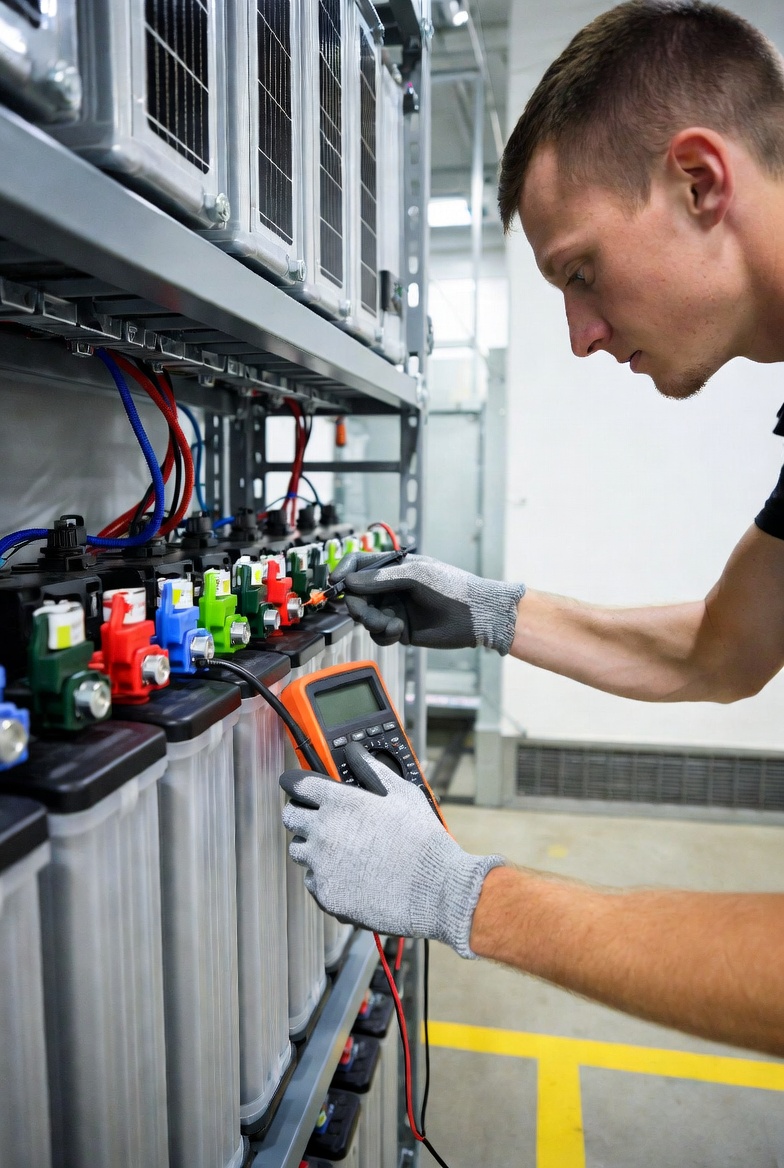
Installation matters: even the best battery can fail early
Nigeria has common install problems that reduce battery life:
- Undersized cables causing voltage drop and heat
- No DC fuse/isolator (dangerous and damages equipment during faults)
- Wrong charging settings (especially for GEL and lithium)
- Batteries placed in hot, sealed rooms
- No surge protection / poor earthing
A “best battery” paired with a poor installation becomes a “bad battery.”
Maintenance tips (Nigeria-specific)
For LiFePO₄
- Keep in a cool, ventilated area (avoid direct sun or hot ceiling spaces)
- Don’t set charging currents higher than manufacturer recommendation
- If you won’t use the system for long, store around mid-charge (installer can advise)
For tubular lead-acid
- Check water level regularly (use distilled water only)
- Avoid deep discharge; try not to go below ~50% frequently
- Clean terminals and ensure tight connections
- Provide ventilation (hydrogen gas risk) and keep away from sparks
For AGM/GEL
- Use correct charge voltage (too high kills them)
- Avoid heavy deep cycling daily
- Ensure temperature compensation if your charger supports it
Best battery recommendations by budget tier
If your priority is long-term performance and minimal headaches: LiFePO₄ wins.
If your budget is limited today but you can manage maintenance and load discipline: Tubular lead-acid can work short-to-medium term.
If you only need short backup for light loads: AGM/GEL can be acceptable, but be strict with charging settings and expectations.
FAQs
What is the best battery for solar in Nigeria?
For most Nigerian homes, the best battery is LiFePO₄ (lithium iron phosphate) because it supports deep daily discharge during outages, charges faster, and lasts significantly longer when properly installed and configured.
Is lithium battery better than tubular battery for solar?
Yes for most people. Lithium (LiFePO₄) typically gives more usable energy per purchase, longer cycle life, and lower maintenance. Tubular can still work if you maintain it and avoid deep discharge, but it often wears out faster under Nigeria’s outage patterns.
How many batteries do I need for a 5kVA inverter in Nigeria?
It depends on your system voltage (24V or 48V), your load, and desired backup hours. A common modern setup is 48V with enough battery usable kWh to match your needs (often 5–10kWh usable for many homes running essentials). The best approach is to calculate your average outage load and multiply by backup hours.
Can I run a fridge on solar batteries?
Yes, but you must plan for compressor surge and daily energy use. Fridges can work well on properly sized systems, especially with 48V setups and LiFePO₄ batteries, plus an inverter that handles surge.
Why do solar batteries fail quickly in Nigeria?
The top reasons are deep discharge, heat, wrong charging settings, undersized cables, poor ventilation, and unrealistic expectations (running heavy loads like AC on small banks). Installation quality and settings matter as much as battery type.
Is 12V battery okay for a home solar system?
For very small systems, yes. But as your load grows, 24V or 48V is usually better because it reduces current, heat, and losses. Many Nigerian homes upgrading beyond basic loads benefit from moving to 48V.
What battery capacity is good for a 2-bedroom flat in Nigeria?
Many 2-bedroom flats running essentials (fans, lights, TV, Wi-Fi, fridge) often land in the 4–8kWh usable range depending on backup hours and appliance efficiency. A detailed load estimate will give a more accurate target.
Should I mix old and new batteries in one bank?
It’s not recommended. Mixing different ages, capacities, or chemistries reduces performance and can shorten the life of the newer batteries. If you must expand, do it carefully and ideally with matched batteries and proper balancing.
Conclusion
If you want the simplest “buy once, cry once” path, LiFePO₄ is the best battery for solar in Nigeria for most households—especially where outages are frequent and long. If your budget is tighter, tubular lead-acid can work, but only if you manage depth of discharge and maintain it consistently. Whichever you choose, insist on proper protection, correct settings, and clean installation—because that’s what separates a 2-year battery story from a 7–10 year success.