Nigeria’s unreliable grid power and soaring electricity tariffs have made inverters essential for every home and office that relies on air conditioners. With temperatures regularly exceeding 35°C and humidity making life uncomfortable, an AC is no longer a luxury—it’s a health necessity. But running your AC on diesel generators costs a fortune in fuel and maintenance while polluting the environment. A high-quality inverter, especially a hybrid solar model, solves this by providing clean, silent backup power and integrating seamlessly with solar panels to slash bills by up to 70%.
We’ll break down technical requirements, recommend proven models popular across Lagos, Abuja, Port Harcourt, and Kano, show exact sizing calculations, and reveal Nigeria-specific tips for heat, dust, and voltage fluctuations. Whether you need a 5kVA inverter for one 1.5HP AC or a 10kVA system for multiple units, you’ll leave with clear, actionable advice.
Why Every Nigerian Home Needs a Good Inverter for AC
Power outages in Nigeria average 8–20 hours daily depending on your DISCO. During the dry season, demand spikes and the grid fails more often. Generators offer instant power but consume ₦1,500–₦4,000 daily in diesel for a 5kVA unit—plus noise and carbon monoxide risks, especially dangerous in enclosed compounds common in Port Harcourt and Warri.
Inverters paired with batteries (or solar) deliver instant, silent power. Modern hybrid inverters automatically switch between grid, solar, and battery without interruption. For AC users, this means uninterrupted cooling even during peak afternoon blackouts when temperatures hit 40°C.
Inverter AC units (variable-speed models from LG, Hisense, Carrier) are already popular because they use 30–50% less power than fixed-speed units. Pairing an inverter AC with a good power inverter creates a double-efficiency system that runs longer on batteries and solar.
Users in Nigeria report saving ₦25,000–₦60,000 monthly on electricity and fuel after installing a properly sized hybrid system. That ROI typically pays back in 18–36 months—making it one of the smartest home investments in 2026.
Understanding Power Requirements: How Much Inverter Do You Really Need for Your AC?
Air conditioners are inductive loads with high starting surge (2–3 times running watts for fixed-speed; much lower for inverter ACs with soft start). Never undersize.
Typical power consumption (2026 models):
- 1HP Inverter AC: 700–950W running, surge ~1,800W
- 1.5HP Inverter AC: 950–1,350W running, surge ~2,500W
- 2HP Inverter AC: 1,400–1,900W running, surge ~3,500W
Add other loads (fridge 150W, fans 60W each, TV 100W, lights 200W, router 20W) and apply safety factors.
Recommended minimum inverter ratings (pure sine wave hybrid):
- One 1HP inverter AC + basic loads → 3.5–5kVA
- One 1.5HP inverter AC + full home → 5–7.5kVA
- Two 1.5HP or one 2HP + heavy loads → 10kVA+
Always choose at least 30–50% headroom above total running watts and verify surge capacity (many good models offer 200–300% surge for 5–30 seconds).
Types of Inverters Suitable for Running AC in Nigeria
Pure Sine Wave vs Modified Sine Wave AC compressors and electronics require pure sine wave (THD <3%). Modified sine wave causes humming, overheating, and premature compressor failure—avoid completely for AC.
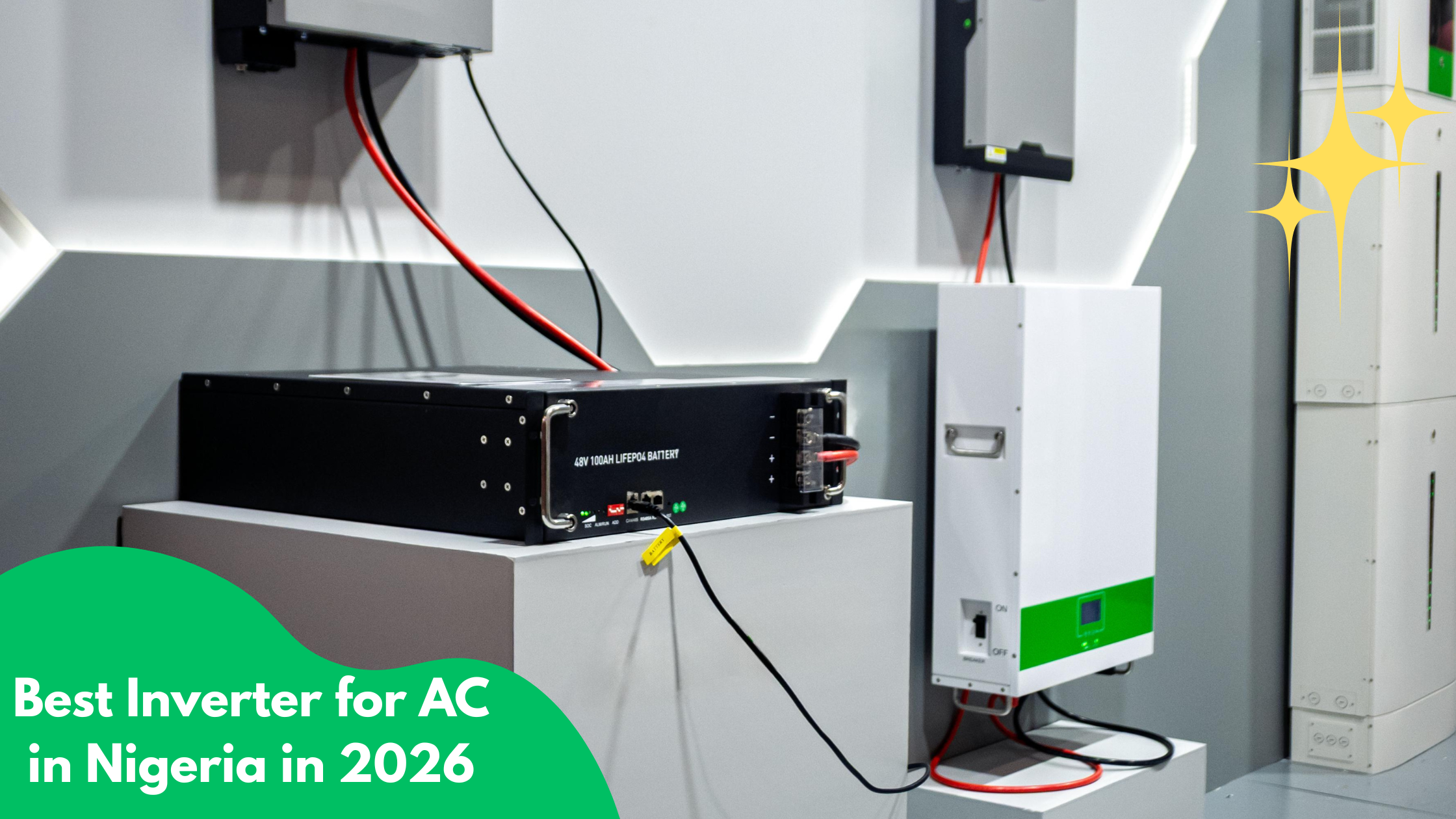
Hybrid (Solar) Inverters Most recommended for Nigeria in 2026. They charge from grid, solar, and generator while powering loads. Built-in MPPT solar charge controllers maximize free solar energy. Dual-output models let you prioritize critical loads (fridge, lights) when batteries are low.
Off-Grid Inverters Ideal for remote areas or full solar homes but more expensive batteries needed.
Grid-Tie Inverters Feed excess solar back to grid (if your DISCO allows net metering) but still need hybrid for backup.
Key Factors to Consider When Buying the Best Inverter for AC in Nigeria
- Capacity & Surge Handling – As detailed above.
- Efficiency (90%+ preferred) – Higher efficiency means longer runtime on batteries.
- Input Voltage Range – Wide range (120–280V) handles NEPA fluctuations common everywhere.
- Heat & Dust Resistance – Nigeria’s climate kills electronics. Look for IP21+ rating, smart fans, and dust filters. Install in shaded, ventilated rooms.
- Battery Compatibility – 48V systems preferred for larger setups (less current, thinner cables). Supports LiFePO4 (long life, low maintenance) or tubular lead-acid.
- Warranty & After-Sales Service – 2–5 years. Brands with service centers in major cities win.
- Monitoring & Smart Features – WiFi/app control (Growatt, Deye) lets you check from anywhere.
- Price vs Value – Budget ₦400,000–₦1,200,000 for a complete 5–7.5kVA hybrid system (inverter only; batteries and panels extra).
Top 5 Best Inverters for AC in Nigeria 2026 (Tested & Popular Choices)
- Luminous Solar Hybrid 5kVA/48V (Cruze or Optimus series) Popular in Lagos and Abuja for reliability. Excellent surge handling. Built-in protections against overload, short circuit, and deep discharge. Wide service network. Price: ₦420,000 – ₦620,000 Best for: Homes with one 1.5HP AC + full lighting/fans/fridge. Pros: User-friendly LCD, strong local support, 2–3 year warranty. Cons: Slightly lower efficiency than premium imports.
- Felicity Solar 5.5kVA/48V Hybrid Top seller on Jumia and solar shops. High PV input voltage accepts more panels. Robust build for dusty environments. Price: ₦480,000 – ₦680,000 Best for: Solar-heavy setups powering 1–2 ACs daytime. Pros: Excellent MPPT, parallel capability, good heat dissipation. Cons: Service slightly less widespread than Luminous.
- Growatt SPF 5000 ES or MIN series (5kW) Global brand with strong Nigerian presence. 97%+ efficiency, WiFi monitoring standard. Price: ₦520,000 – ₦750,000 Best for: Tech-savvy users wanting app control and maximum solar harvest. Pros: Scalable, quiet, superb efficiency. Cons: Premium pricing.
- Deye/Sunsynk 5–8kW Hybrid Often called the “hybrid king” in 2026 Nigerian solar groups. Zero-export function, battery agnostic, 10-year warranty on some models. Price: ₦650,000 – ₦950,000 Best for: Larger homes or small offices with 2+ ACs. Pros: Most advanced features, future-proof. Cons: Higher cost, installation needs certified technician.
- Prag 5kVA/48V Solar Inverter Budget-friendly yet reliable. Very popular in Northern Nigeria for dust resistance. Price: ₦380,000 – ₦520,000 Best for: Cost-conscious buyers wanting basic hybrid functionality. Pros: Affordable, strong local availability. Cons: Fewer smart features.
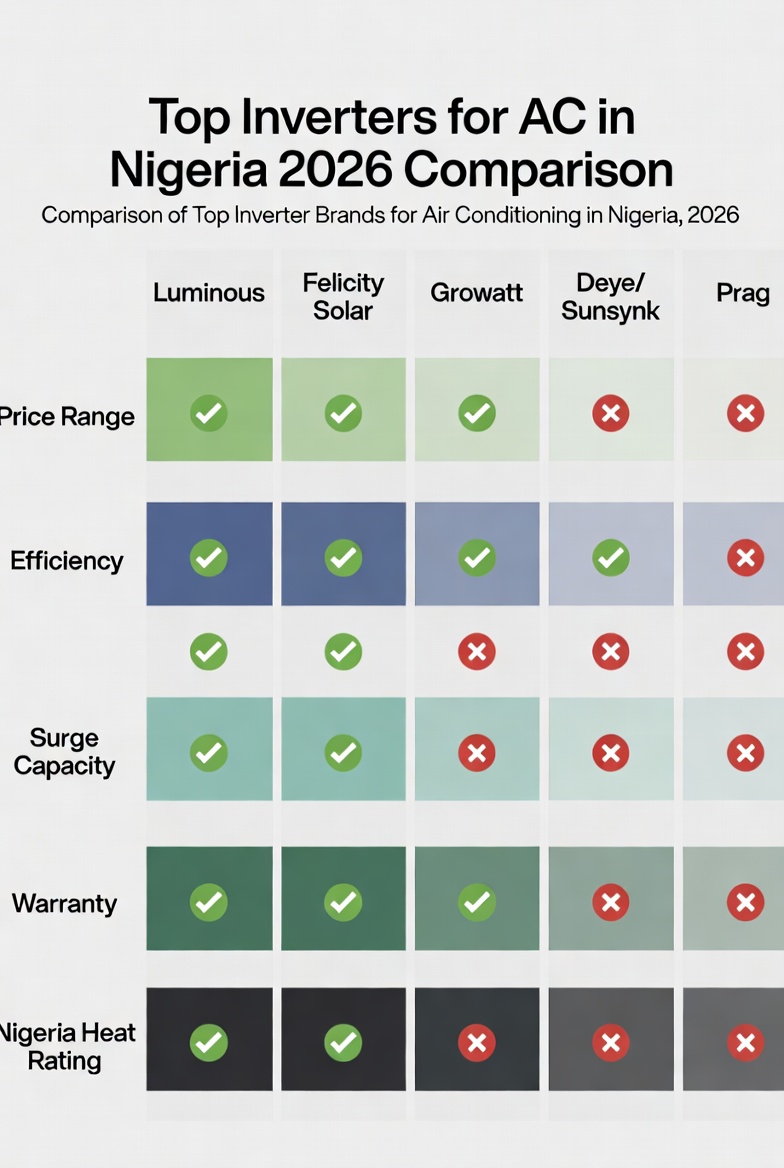
Comparison Table: Best Inverters for AC in Nigeria 2026
| Brand/Model | Capacity | Approx. Price (NGN) | Efficiency | Surge | Warranty | Best For | Nigeria Heat Rating |
| Luminous 5kVA Hybrid | 5kVA | 420k–620k | 90–93% | 200% | 2–3 yrs | 1.5HP AC + home loads | Excellent |
| Felicity 5.5kVA | 5.5kVA | 480k–680k | 94–96% | 250% | 3 yrs | Solar + 1–2 ACs | Very Good |
| Growatt SPF 5kW | 5kW | 520k–750k | 97%+ | 200% | 5 yrs | Smart monitoring users | Excellent |
| Deye/Sunsynk 8kW | 8kW | 650k–950k | 97.5% | 300% | 5–10 yrs | Multiple ACs | Outstanding |
| Prag 5kVA | 5kVA | 380k–520k | 92% | 180% | 2 yrs | Budget solar setups | Good |
(Prices as of early 2026; fluctuate with exchange rate and dealer. Always verify.)
How to Size Your Inverter Correctly – Step-by-Step Formula
Total Running Watts × 1.5 (safety factor) = Minimum Inverter VA needed.
Example for typical 3-bedroom home with 1.5HP inverter AC: AC 1,200W + Fridge 150W + 4 Fans 240W + Lights/TV 300W + Router/Misc 100W = 1,990W running. 1,990 × 1.5 = 2,985W → Choose 5kVA (4,000W continuous typical) for headroom.
Add solar panels (1.5–2× inverter capacity in watts) and batteries (at least 200Ah × 4 for 48V system for 4–6 hours backup).
Solar Integration: The Smart Way to Power AC in Nigeria
Pair any of the above with 4–8 × 550W solar panels and LiFePO4 batteries for daytime free AC running and nighttime backup. In Port Harcourt’s rainy season, oversize panels 20% for cloudy days.
Installation Tips & Common Mistakes to Avoid
- Hire certified technicians (COREN or NABTEB).
- Place inverter in shaded, well-ventilated room (not direct sun).
- Use appropriate cable sizes (10–25mm²).
- Install surge protectors and proper earthing. Common mistake: Undersizing or using modified sine wave—leads to AC compressor burnout within months.
Maintenance for Longevity in Nigerian Climate
Clean dust filters monthly. Check battery water (tubular) or connections (lithium). Update firmware via app. Annual professional service.
Cost Breakdown & ROI Calculation
Complete 5kVA hybrid system (inverter + 4 × 200Ah batteries + 6 × 550W panels) ≈ ₦1.8M–₦2.8M installed. Monthly savings ₦35,000–₦70,000 vs generator/grid. Payback 24–36 months.
Frequently Asked Questions (FAQs)
- Can a 3.5kVA inverter run a 1.5HP air conditioner in Nigeria? Technically possible but not recommended for daily use. A modern 1.5HP inverter AC (variable-speed) runs at about 950–1,350W. A 3.5kVA inverter (roughly 2,800W continuous output) can handle the running load with very little headroom, but the starting surge (even if reduced in inverter ACs) plus other household loads (fridge, fans, lights) quickly exceeds safe limits. In Nigeria’s high ambient temperatures (35–40°C), compressors work harder and draw more current. Users in Lagos and Abuja who tried this report frequent overload shutdowns and reduced AC cooling performance. For reliable, uninterrupted cooling, choose at least 5kVA (preferably 5.5–7.5kVA) to give 30–50% safety margin. This also extends inverter and compressor lifespan.
- Which is the best inverter brand for running AC in Nigeria in 2026? There is no single “best” brand — it depends on your budget and priorities.
- Luminous wins for widest service network and reliability in humid areas (Port Harcourt, Calabar).
- Felicity Solar is the solar-performance champion with excellent MPPT efficiency.
- Growatt and Deye/Sunsynk are the premium choices for smart features, highest efficiency (97%+), and longest warranties (5–10 years). For most Nigerian homes with 1–2 ACs, the Felicity 5.5kVA or Luminous 5kVA hybrid offer the best value. Deye/Sunsynk is unbeatable for larger homes or commercial setups. Always buy from authorised dealers to get genuine warranty.
- How many batteries do I need to run my AC on inverter backup? For a 5kVA system with one 1.5HP inverter AC + lights/fans/fridge (total ~2,500W load), you need minimum 4 × 200Ah 48V tubular or LiFePO4 batteries for 4–5 hours backup. For 8+ hours (full night), go for 8–12 batteries or higher-capacity 300–400Ah units. LiFePO4 batteries are strongly recommended in 2026 because they give 80–95% usable capacity, last 10–15 years, require zero maintenance, and handle Nigeria’s heat far better than lead-acid. A 48V system is more efficient than 12V or 24V for AC loads.
- Do I need solar panels with my inverter for AC? Not mandatory, but highly recommended. Without solar, you rely only on grid + batteries, and diesel/generator charging becomes expensive. With 6–8 × 550W panels, your AC can run almost free during the day (the hottest period). In most Nigerian cities, a well-sized solar-hybrid system cuts electricity + fuel bills by 60–80%. Even in the rainy season, oversizing panels by 20–30% still delivers significant savings. Solar also reduces battery cycling and extends system life.
- How long will my AC run on inverter during blackout? It depends on battery bank size and total load. Example: 4 × 200Ah 48V LiFePO4 (19.2kWh total, ~15kWh usable) running a 1.5HP inverter AC + 500W other loads = approximately 5–6 hours of full cooling. With 8 batteries (38.4kWh), you get 10–12 hours. Adding solar extends runtime indefinitely during daylight. Real-world tests in Abuja and Ibadan confirm these figures when ambient temperature is 32–38°C.
- What is the difference between hybrid and off-grid inverters for AC use? Hybrid inverters connect to the grid, solar, batteries, and generator. They automatically switch sources and can sell excess solar back to the grid (where allowed). Ideal for Nigeria because NEPA power is available sometimes. Off-grid inverters are for locations with no grid at all. They are simpler but require much larger battery banks and are more expensive for the same AC runtime. 95% of Nigerian homes with AC should choose hybrid solar inverters.
- Can I connect my existing generator to a hybrid inverter? Yes! Most quality hybrid inverters (Luminous, Felicity, Growatt, Deye) have a dedicated generator input. The inverter charges batteries from the generator during blackout and automatically shuts off the generator when batteries are full or grid returns. This saves huge amounts of diesel because the generator runs only when needed and at optimal load.
- How much does a complete inverter + battery system for AC cost in Nigeria in 2026?
- Basic 5kVA hybrid (inverter only): ₦420,000 – ₦680,000
- Complete system for 1.5HP AC (5kVA inverter + 4×200Ah LiFePO4 + installation): ₦1.9M – ₦2.6M
- Premium solar-ready system (7.5kVA Deye + 8 batteries + 8 panels): ₦3.8M – ₦5.2M Prices include professional installation. Expect 18–36 months payback through electricity and generator fuel savings.
- What maintenance does an inverter for AC need in Nigeria’s climate?
- Dust the inverter and filters every 2–4 weeks (critical in Kano, Maiduguri, Sokoto).
- Keep the installation room well-ventilated and below 35°C.
- Check battery terminals every 3 months (LiFePO4 needs almost none).
- Update firmware via WiFi/app once or twice a year.
- Annual professional service (₦25,000–₦45,000). Proper maintenance easily gives 8–12 years of trouble-free operation.
- Which inverter is best for a 2HP air conditioner? Go for 7.5kVA to 10kVA hybrid (Growatt SPF 8000, Deye 8kW, or Felicity 8kVA). A 2HP inverter AC draws 1,400–1,900W running but can surge higher in extreme heat. 10kVA gives comfortable headroom for a full 3–4 bedroom house. Users in Asaba and Enugu report excellent performance with the Deye 8kW model.
- Do I need a special inverter for inverter-type AC units? No. Any pure sine wave hybrid inverter works perfectly with inverter ACs. In fact, inverter ACs are gentler on the inverter because they have built-in soft-start and variable speed. Just ensure the inverter is pure sine wave (THD <3%) — never use modified sine wave.
- How do I choose between Luminous and Felicity for my AC inverter? Choose Luminous if you want the easiest after-sales service and widest technician network across Nigeria. Choose Felicity Solar if you plan heavy solar usage and want higher efficiency and better MPPT performance. Both are excellent and widely used in 2026. Many installers recommend Felicity for new solar-first installations and Luminous for quick grid-backup upgrades.
- Will my inverter damage my AC compressor? Only if you buy a cheap modified sine wave inverter. All the recommended pure sine wave hybrids in this guide are completely safe and actually extend compressor life because they provide stable voltage and frequency, unlike unstable NEPA power or generators.
- Can one inverter power multiple air conditioners? Yes. A single 10kVA hybrid can comfortably run two 1.5HP or one 2HP + one 1HP simultaneously, plus all other home loads, provided the battery bank and solar array are sized correctly. For three or more ACs, consider 15kVA or parallel multiple inverters.
Bonus Tip: Always ask your installer for a load audit before buying. A proper calculation prevents 90% of the problems people face with inverter AC systems in Nigeria.
Conclusion
The best inverter for AC in Nigeria in 2026 depends on your budget and load, but Luminous, Felicity, and Growatt/Deye consistently top user satisfaction for performance and support. Invest in pure sine wave hybrid with proper sizing and professional installation—you’ll enjoy cool comfort, massive savings, and energy independence for years.
Ready to buy? Visit trusted dealers in your city or check current prices on Jumia, Jiji, or authorized solar shops. For custom system design, consult a certified installer.
Disclaimer: All prices are approximate as of February 2026 and subject to market changes, exchange rates, and dealer pricing. This article is for educational and informational purposes only. Always consult a licensed electrician or solar professional before purchase and installation. Individual results vary based on usage, location, and maintenance.