Nigeria’s solar market isn’t “coming” anymore—it’s already here. From residential inverter systems to mini-grids and commercial rooftops, the demand for trained solar technicians, installers, designers, and O&M personnel is rising fast. The challenge is not finding “a solar training,” but finding a reputable institute that teaches real skills, uses proper safety practices, and issues a certificate that employers (and serious clients) respect.
This guide breaks down some of the most credible solar training institutes and pathways in Nigeria, including typical fees, duration, and what certification you’ll actually walk away with—plus a simple framework to choose the best option for your goals.
What “Certification” Really Means in Nigerian Solar Training
Before picking any training, it helps to understand the difference between training certificates and professional/industry certifications.
1) Training Certificate (Completion Certificate)
Most private academies issue a certificate of completion after training. This can be useful for confidence and client marketing, but it’s only strong if the training is hands-on, structured, and recognized in the industry.
2) Competency or Professional Certification (More Valuable)
Some programs include (or align with) external competency assessment by recognized bodies. For example, a course may prepare you for a competency exam administered by a regulator or professional council.
- COREN-linked competency exams appear in some structured PV installer training programs (meaning the training includes a competency examination and issues a certificate of competence on success).
- ECREEE regional certification exams exist for off-grid residential solar PV technicians (Level 1), conducted in Nigeria (Lagos/Abuja in late 2025).
- Power-sector training calendars (like NAPTIN’s) publish standardized renewable energy course listings and fees, which can be important for credibility—especially if you want to work around utilities, large projects, or formal sector roles.
3) University/Institutional Certificate (Academic-Branded Short Courses)
Some universities offer certificate programs (often through entrepreneurship or distance learning institutes). This can boost credibility, especially for corporate clients or structured employment.
Example: LASU ODLRI lists a “Certificate Course: Solar Inverter Installation and Repair” among its available programs.
Quick Shortlist: Best Options by Career Goal
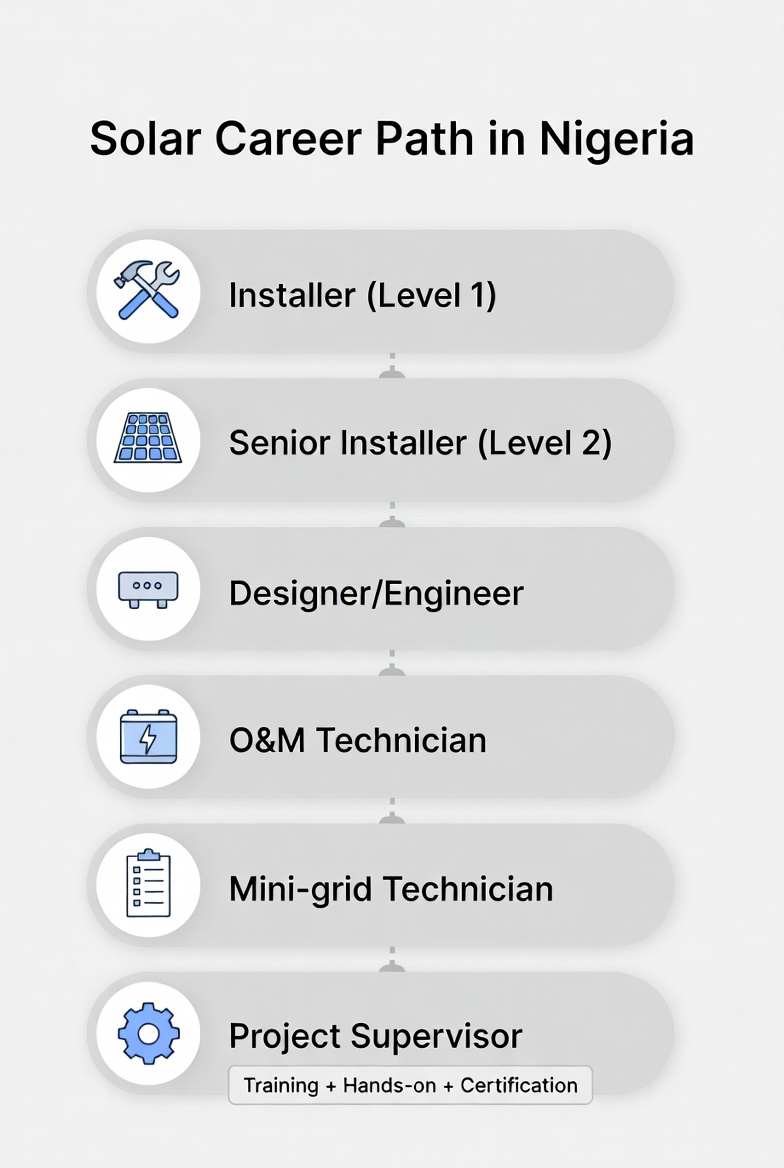
If you’re choosing fast, use this decision shortcut:
If you want to become a field installer fast: pick a program with hands-on installation, tools, and real wiring practice (not just classroom theory).
If you want credibility for bigger contracts: prioritize recognized institutions + structured assessment (e.g., NAPTIN-style programs, COREN-linked competency pathways, or university certificates).
If you want to become a designer/engineer-level professional: choose training that includes system sizing, load estimation, design documentation, and ideally hybrid systems + troubleshooting.
Comparison Table: Solar Training Institutes in Nigeria (Fees, Duration, Certification)
Fees and schedules can change by cohort. Always confirm the current intake cost on the institute’s official page before paying.
| Institute / Program | Location / Delivery | Typical Duration | Published Fee (as seen) | Certification / Outcome | Best For |
| NAPTIN (National Power Training Institute of Nigeria) | Centers include Kainji / Ijora / Abuja (varies by calendar) | ~20 days (example listing) | ₦350,000 for Solar PV Installation (example course listing) | Power-sector-branded training (institutional credibility) | Serious technical pathway, formal sector credibility |
| Asteven Energy Institute – Solar Photovoltaic Installation (COREN Certification track) | Blended (virtual + hands-on) | Listed as ~6 weeks | ₦100,000 (listed price on course page) | Mentions competency exam conducted by COREN and certificate of competence on success | Installers who want a structured PV installer pathway |
| Rubitec Solar – Training/Academy | Nigeria (programs vary) | Varies by course | Examples published: ₦70,000 (4 weeks) in one announcement ; also ₦250,000 tuition for a specific course announcement | Completion certificates (varies by course); also references COREN-certified track info | Mini-grid / PV + structured corporate-style training options |
| Gennex Solar Academy | Online + in-class (varies by cohort) | Varies (some weekend cohorts) | Examples published: ₦75,000 regular fee on academy site ; cohort listing shows ₦120,000 for a specific schedule | “Certified Solar Power Designer/Installer” (training certificate) | Beginners to intermediate designers/installers |
| LASU ODLRI – Certificate Course: Solar Inverter Installation & Repair | Blended learning structure (ODLRI programs) | Certificate programs often ~3 months (varies by session) | Payment pages show application fee structures; confirm tuition per session | University-branded certificate program listing | People who want academic-branded certificate + inverter repair niche |
| Solar Power Centre (Nigeria) – Training Calendar (PDF) | Abuja training center (as referenced) | Varies by course | Training calendar lists course titles & fees (e.g., PV supervision pricing shown) | Completion certificates depending on course | Abuja-based learners seeking structured short courses |
| REA-supported programs (periodic) | Linked to project sites/universities (varies) | Example: 8-week program reported | Often sponsored / cohort-based (not regular retail pricing) | Project-backed training exposure | People targeting subsidized opportunities & project experience |
| ECREEE Certification Exam (Regional) | Nigeria (Lagos/Abuja exams reported in 2025) | Exam window-based | Exam/certification costs vary by intake | Regional certification exam for Off-Grid Residential PV Technicians (L1) | Installers seeking recognized competency validation |
A Practical Fee Reality Check Chart
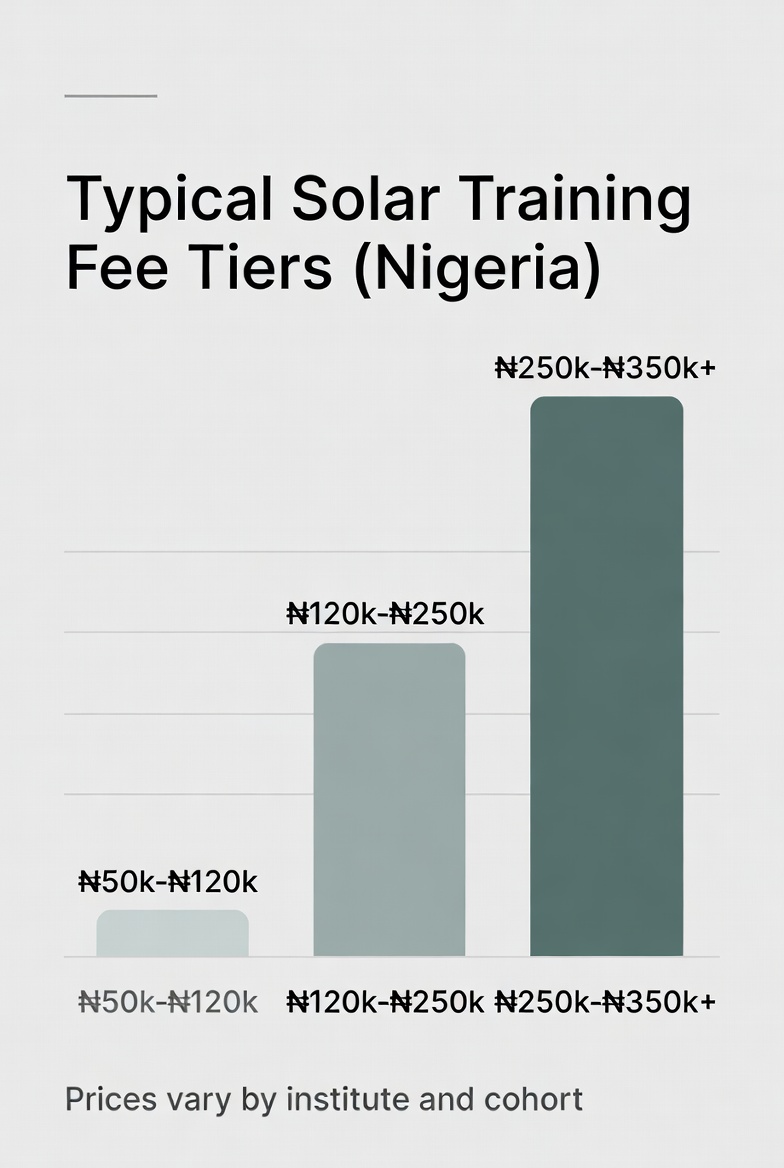
Solar training in Nigeria typically clusters into 3 pricing tiers (based on published examples above):
Entry / promo training: ₦50k – ₦120k
Mid-range structured cohorts: ₦120k – ₦250k
Institutional / power-sector training: ₦250k – ₦350k+
Text-only chart (approximate tiers):
- ₦50k–₦120k: ██████████
- ₦120k–₦250k: ████████████████
- ₦250k–₦350k+: ████████████████████
These tiers show why your decision shouldn’t be based on price alone. A cheap class with no practical lab can cost you more later through failed installations, callbacks, or damaged equipment.
The Best Solar Training Institutes in Nigeria
1) NAPTIN (National Power Training Institute of Nigeria)
If you want training that looks credible on a CV—especially for roles around power systems, utilities, EPCs, or government-linked energy projects—NAPTIN is one of the most recognizable names in Nigeria’s power training ecosystem. Their calendar listings include renewable energy courses such as Solar PV Installation, including a published example fee of ₦350,000 for a 20-day program.
Why it’s strong:
NAPTIN is positioned as a premier power-sector training institution, which can matter when you’re applying for structured roles.
Who should choose it:
If your goal is formal employability, supervisory competence, or you want your training brand to signal seriousness, this is a strong option.
2) Asteven Energy Institute (COREN-linked PV Installer Track)
Asteven’s Solar Photovoltaic Installation course is presented as a structured program with both virtual and hands-on components, listed around 6 weeks and priced at ₦100,000 on the course page.
A key differentiator is that the course description explicitly mentions a competency examination conducted by COREN and a certificate of competence upon successful completion.
Why it’s strong:
Any pathway that includes competency assessment (not just attendance) tends to produce better technicians and more trusted proof of skill.
Who should choose it:
If you want to become a professional installer and you care about validation beyond “I attended a class,” this is worth considering.
3) Rubitec Solar (Rubitec Academy / Training)
Rubitec appears to run multiple training types with different pricing. For example, one published announcement mentions a 4-week duration and ₦70,000 fee (with certificate of completion).
Another published post references a course with ₦250,000 tuition (with inclusions like meals).
Rubitec also maintains pages referencing COREN-certified training tracks.
Why it’s strong:
Rubitec is active in the industry and their training offerings may match real market needs (mini-grid, PV, installation, project context).
Who should choose it:
If you want training connected to practical industry application—and you’re willing to pick the right course tier.
4) Gennex Solar Academy (Designer/Installer Path)
Gennex positions itself as a solar design/installer training platform. Their materials describe a “Certified Solar Power Designer/Installer” track.
Published fee examples vary by cohort and promo: the site shows ₦75,000 as a regular course fee in one listing, while a registration page shows ₦120,000 for a specific schedule.
Why it’s strong:
If you’re balancing work and learning, cohort-based or weekend training structures can be easier to complete.
Who should choose it:
Beginners and intermediate learners who want a guided path into design + installation fundamentals.
5) LASU ODLRI (Solar Inverter Installation & Repair Certificate)
For people who want a university-branded certificate and prefer the inverter repair niche (a real money-maker in Nigeria), LASU ODLRI lists a Certificate Course: Solar Inverter Installation and Repair among its available programs.
Their application process details show certificate program application fee guidance (for example, application fee references appear on LASU ODLRI pages).
Why it’s strong:
“Inverter repair + troubleshooting” is one of the fastest ways to start earning: diagnostics, battery issues, inverter configuration, and after-sales support.
Who should choose it:
Anyone aiming to monetize quickly through repairs/maintenance, while also building credibility with a university program name.
6) Solar Power Centre (Abuja) – Training Calendar Programs
A published training calendar PDF (Solar Power Centre Nigeria) shows course titles and fees for multiple renewable/solar trainings (including PV supervision listings).
Why it’s strong:
Calendar-based institutes can be easier to plan around, especially if you want Abuja-based training.
Who should choose it:
Learners in Abuja (or nearby) who prefer a scheduled training center format.
7) REA-Supported Renewable Energy Training Opportunities (Periodic)
If you’re looking for subsidized training, keep your eye on REA-linked programs. One REA news item describes an 8-week training program designed to equip participants with foundational skills, launched at a university site tied to a solar hybrid power plant project.
Why it’s strong:
Project-backed exposure often includes real systems, real stakeholders, and better employability signals.
Who should choose it:
Anyone willing to apply and compete for limited cohort slots.
8) ECREEE Regional Certification Exam (For PV Technicians)
Even if you train privately, consider getting certified through a recognized exam pathway. ECREEE reported conducting a regional certification examination for Off-Grid Residential Solar PV Technicians (Level 1) in Nigeria (Lagos and Abuja in November 2025).
Why it’s strong:
External exams help separate “I watched YouTube” from “I’m verified.”
Who should choose it:
Technicians who want credential value beyond a training center’s internal certificate.
How to Choose the Right Solar Institute
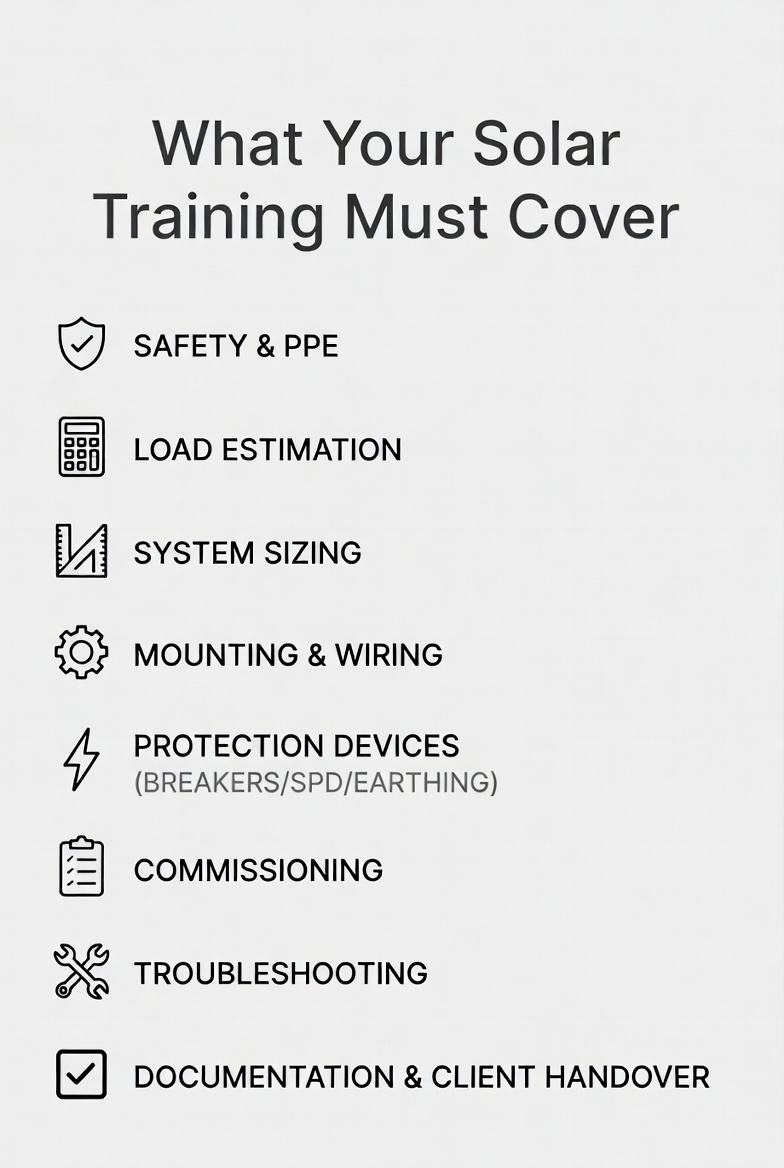
When you contact any training center, ask these exact questions:
1) How much of the training is hands-on?
A good answer includes wiring, protection devices, mounting, commissioning steps, troubleshooting drills, and safety.
2) What systems will I work on?
You want exposure to hybrid inverters, battery banks (especially LiFePO₄ + tubular), breakers/SPD, earthing, and common Nigerian load realities.
3) What certificate do I get—and who issues it?
Is it just a completion certificate, a university certificate, or linked to an external competency exam? (Examples of external validation exist in COREN-linked competency descriptions and ECREEE exams.)
4) Do you teach business + documentation?
In Nigeria, many installers fail not because they can’t wire, but because they can’t write quotations, size systems properly, or document installations.
5) Do you teach safety and standards?
Electrical safety, isolation, fusing, cable sizing, and protection are non-negotiable.
Frequently Asked Questions (FAQ)
Which solar training certificate is best in Nigeria?
The “best” depends on your goal. If you want formal credibility, institutional training (e.g., power-sector training calendars like NAPTIN) can help. If you want competency validation, look for pathways mentioning external assessment (e.g., COREN-linked competency descriptions or ECREEE certification exams).
How much is solar training in Nigeria?
Published examples range from ~₦70,000 (some short courses) to ~₦350,000 (institutional solar PV installation listing). Many academies fall between ₦75,000–₦120,000 depending on cohort format.
How long does solar PV training take?
It varies. Some structured PV programs list around 6 weeks while some institutional courses list around 20 days. University certificate programs can run for months depending on the session structure.
Is inverter repair training worth it in Nigeria?
Yes—because inverter troubleshooting and after-sales support are continuous needs. Programs like university-listed inverter installation/repair certificates can position you strongly in this niche.
Can I get internationally recognized solar certification from Nigeria?
You can take internationally recognized exams depending on availability, but even within West Africa, ECREEE has run regional certification exams for PV technicians in Nigeria (Lagos/Abuja reported in 2025).
Final Advice: Pick Training That Matches How You Want to Earn
If your plan is to start making money fast, prioritize hands-on installation + troubleshooting and begin with small residential systems. If your plan is to work in larger projects (mini-grids, commercial, government), prioritize institutional credibility + competency assessment.
If you tell me your location (e.g., Lagos/Abuja/Owerri) and whether you want to become an installer, designer, or O&M technician, I’ll recommend the best 2–3 options from this list