Many homeowners in Nigeria are turning to solar energy to escape rising fuel costs, unreliable grid power, and generator noise. A common question we receive is:
“I have a ₦3,000,000 budget. Can I run my whole house on solar?”
Let’s break this down realistically using a typical home scenario.
Typical Household Power Needs
A homeowner recently requested a solar system to power:
- Whole house appliances
- Water pumping machine
- 4 freezers
- TV, lighting, fans, and general sockets
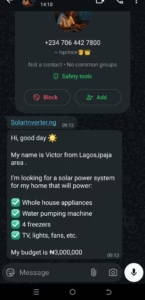
On the surface, this sounds reasonable. In practice, these loads—especially freezers and pumping machines—place significant demand on a solar system.
The Reality of a “Whole House” Solar System
A true whole-house solar system implies:
- High inverter capacity to handle surge loads
- Large battery storage to support night-time and cloudy periods
- Sufficient solar panels to recharge batteries daily
- Quality protection, cabling, and professional installation
In Nigeria’s market today, ₦3,000,000 is not sufficient for a fully independent 24/7 solar-only system that reliably powers heavy loads like multiple freezers and water pumps without any backup source.
This is not a marketing opinion—it’s an engineering reality.
What ₦3,000,000 Can Realistically Achieve
With proper system design, ₦3,000,000 can deliver a well-performing hybrid solar system that:
- Powers 4 freezers reliably
- Runs TV, lights, fans, and sockets comfortably
- Operates the water pumping machine with controlled usage
- Significantly reduces generator and fuel consumption
- Uses PHCN or generator only as backup
This setup offers stability, efficiency, and long-term cost savings, even though it is not 100% off-grid.
Typical System Size Within This Budget
While exact sizing depends on appliance ratings, a realistic configuration often includes:
- A 5–6kVA hybrid inverter
- 8–12 solar panels
- Lithium battery (5–10kWh) or multiple high-quality tubular batteries
- Proper DC/AC protections and professional installation
Load management is critical. High-power appliances must be scheduled properly to avoid overloading the system.
The Importance of Proper Load Assessment
Statements like “whole house” can be misleading without details. Appliances such as:
- Air conditioners
- Pressing irons
- Microwaves
- Large water pumps
can dramatically change system size and cost. This is why professional solar design always begins with a detailed load assessment, not guesswork.
Final Verdict
A ₦3,000,000 budget cannot deliver a full 24/7, no-backup whole house solar system for homes running heavy loads. However, it can deliver a robust hybrid system that meets most daily energy needs while drastically cutting fuel costs and improving power reliability.
The best solar investments are built on realistic expectations, sound engineering, and quality components.
If you’re considering a solar installation, the right first step is a proper load analysis and an honest discussion about usage patterns and priorities. That is how solar systems last—and perform—as intended.