
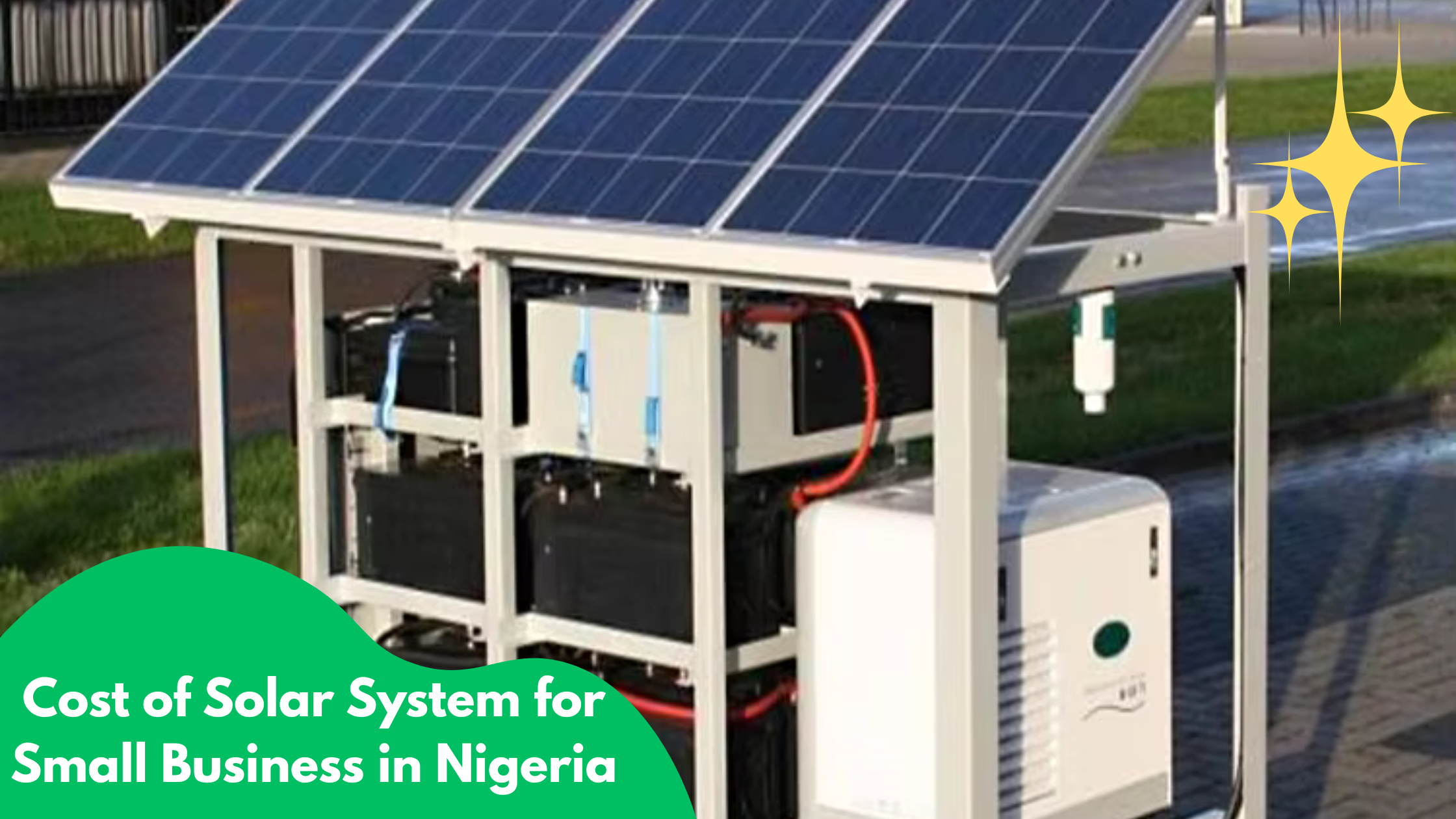
Executive Summary
- Small business solar systems in Nigeria range from ₦1.2 million for basic setups to ₦15 million+ for commercial-scale installations
- Average payback period: 5–4 years based on diesel/generator fuel savings
- Battery storage accounts for 35–45% of total system cost
- Lithium batteries dominate premium installations despite higher upfront costs
- Government and private financing options now available through multiple channels
-
Why Solar Is No Longer Optional for Nigerian SMEs
Small and medium-scale enterprises (SMEs) contribute approximately 48% of Nigeria’s GDP and account for nearly 90% of manufacturing sector employment . Yet these businesses face an existential threat: unreliable electricity.
The national grid collapsed more than ten times in 2024 alone, and roughly 40% of Nigeria’s 230 million people remain entirely off-grid . For businesses, this translates to lost productivity, spoiled inventory, and crippling fuel costs.
Consider the mathematics of generator dependency. A typical small business running a 5kVA generator for 8 hours daily consumes roughly 10–12 litres of petrol or diesel. At current pump prices (following subsidy removal), this represents ₦1.2–1.5 million annually in fuel alone—before maintenance, repairs, and generator replacement costs.
This is why Nigeria installed 803 megawatts of new solar capacity in 2025, a 141% increase over the previous year, making it Africa’s second-fastest growing solar market . Approximately 96% of this capacity is off-grid—rooftop panels, home solar kits, and commercial installations—reflecting how severely unreliable the national grid has become .
Table 1: Nigeria Solar Market Growth (2024–2026)
| Metric | 2024 | 2025 | 2026 (Projected) |
| Annual new capacity | 333 MW | 803 MW | 1.1 GW |
| Cumulative capacity | 385 MW | 1.19 GW | 2.29 GW |
| Battery storage growth | 10 MWh | 40.6 MWh | 95 MWh |
| Market size | — | — | $4.51B (2026) |
Source: Global Solar Council Africa Market Outlook 2026–2029
For small business owners, the question is no longer whether to install solar, but which system offers the best value and what the true cost entails.
-
Complete Cost Breakdown by System Size
Solar installation prices in Nigeria span a wide range depending on system size, component quality, and location. Because approximately 95% of panels are imported (mostly from China), prices move with the naira’s exchange rate and global raw material costs .
Table 2: Solar System Costs for Nigerian Small Businesses (2026)
| System Size | Business Type | What It Powers | Cost Range (₦) |
| 1–2 kVA | POS agents, small kiosks, barbers | Lights, fans, phone charging, payment terminals | 850k – 1.2M |
| 3–4 kVA | Salons, small restaurants, retail shops | Above + refrigerators, water pumps, small AC | 2M – 3M |
| 5–8 kVA | Larger shops, clinics, workshops | Multiple ACs, heavy appliances, full duplex | 3.5M – 5.5M |
| 10 kW+ | Manufacturing, logistics, large offices | Commercial operations, machinery | 10M – 50M+ |
Source: Nairametrics , BusinessDay
Real-World Installation Example
Lagos-based business owner Juwon Adesanya installed a solar system in August 2025 for approximately ₦1 million. The system now powers his entire operation—television, lighting, charging stations—with only his refrigerator and outdoor security lights remaining on the grid .
“I spend more time fixing the generator than fixing phones,” one small business owner in northern Nigeria noted after making a similar switch, capturing the frustration driving solar adoption nationwide .
-
Component-by-Component Cost Analysis
Understanding where your investment goes helps avoid overcharging and enables smarter decisions about where to economize.
3.1 Solar Panels (25–30% of Total Cost)
Individual panel prices range from ₦45,000 to ₦250,000 depending on wattage and technology .
| Panel Type | Price Range | Efficiency | Best For |
| Polycrystalline | ₦25k–₦150k | Standard | Budget-conscious installations |
| Monocrystalline | ₦60k–₦250k | High | Most residential/commercial |
| N-Type TOPCon | 20% premium over mono | Very high | Hot climates, premium installations |
In 2026, N-Type TOPCon panels have become the preferred choice for professional installations. While costing about 20% more than older monocrystalline models, they produce approximately 30% more energy in hot conditions—a meaningful advantage in Nigeria’s climate .
Dominant brands in the Nigerian market include Jinko, Canadian Solar, Trina, and LonGi, all carrying 25-year performance warranties .
3.2 Inverter (20–25% of Total Cost)
The inverter is arguably the most critical single component. Premium brands command higher prices but offer superior reliability.
| Inverter Type | Price Range | Lifespan | Notes |
| Standard string | ₦150k–₦400k | 5–8 years | Basic, suitable for simple setups |
| Premium (Growatt/SMA/Fronius) | ₦400k–₦1.2M | 10+ years | Higher efficiency, better reliability |
| Hybrid inverter | ₦500k–₦1.5M | 10+ years | Built-in battery connectivity |
3.3 Battery Storage (35–45% of Total Cost)
Batteries represent the largest cost driver and the most important decision for long-term value.
Table 3: Battery Technology Comparison
| Battery Type | Upfront Cost | Lifespan | Maintenance | Best Application |
| Tubular Lead-Acid | Low (₦150k–₦400k) | 3–5 years | Regular (water topping) | Budget installations, infrequent use |
| Dry Cell/AGM | Medium (₦250k–₦600k) | 4–6 years | Low | Mid-range systems |
| Lithium-Ion | High (₦1.15M–₦6M) | 8–10+ years | None | Round-the-clock power, commercial use |
“Lithium looks like a very good option now, because it’s the latest technology in the market. But that doesn’t mean that the other options are not working fine,” explains Wale Kassim, solar energy expert and CEO of AA&O Solutions .
Though lithium batteries cost three to four times more upfront, most solar professionals now recommend them as the more economical long-term choice, particularly for businesses requiring 24/7 power .
3.4 Balance of System & Installation (₦330k–₦1.55M)
This category includes:
- Charge controllers
- Mounting systems (roof type affects cost—concrete cheapest, corrugated iron requires reinforcement)
- Wiring and safety equipment
- Professional installation labor (₦150k–₦800k)
-
Best Solar Product Options for Small Businesses
Several companies offer tailored solutions for Nigerian SMEs. Here are leading options in 2026.
4.1 Arnergy Solar Solutions
Arnergy, a Nigerian renewable energy company, offers scalable products specifically designed for the SME sector .
Table 4: Arnergy Product Line for SMEs
| Product | Capacity | Storage | Best For | Key Features |
| PSG 1200 LFP | 1.2kVA | 612Wh | Barbers, POS agents, traders | Portable, mobile operation |
| PSG 2200 LFP | 2.2kVA | 1536Wh | Salons, small retail stores | Longer operating hours |
| Arnergy 10kWh | 10kWh daily | Varies | Restaurants, clinics, workshops | Smart energy management |
| Arnergy 15kWh | 15kWh daily | Varies | Manufacturing, logistics | Scalable (up to 16 units) |
Source: BusinessDay
Arnergy’s systems include smart energy management software allowing users to monitor consumption, set priorities, and optimize output—maximizing return on investment .
4.2 itel Energy All-in-One Systems
itel Energy launched two new systems in 2025 targeting homes and small businesses .
Power Tank 500W AIO
- 1 kWh lithium battery
- Two-hour full recharge
- Wall-mounted, compact design
- Ideal for micro-businesses
3.6kW + 8kWh AIO System
- Designed for family homes and small businesses
- Automatic load management
- Two-year replacement warranty
- Up to 50% savings on installation costs
“We are democratising energy access, reducing dependence on erratic power supply, and empowering every household and business with smart, clean, affordable energy solutions,” said Olaotan Fawehinmi, PR Manager at itel Energy .
4.3 Hybrid Solutions
For businesses not ready to fully commit to solar, hybrid options combine solar with generator backup.
Arnergy’s AGEN (Arnergy Generator) series blends solar and generator power, allowing gradual transition while maintaining reliability—particularly valuable in areas with poor grid supply or unpredictable weather .
-
Hidden Costs and Financial Considerations
5.1 Beyond the Initial Quote
When budgeting, consider:
| Cost Factor | Typical Impact | Notes |
| Roof reinforcement | +₦50k–₦200k | Corrugated iron roofs may need strengthening |
| Wiring upgrades | +₦30k–₦150k | Older buildings may need rewiring |
| Generator retention | Varies | Many keep generator as backup |
| Maintenance | 1–2% of cost annually | Panel cleaning, system checks |
| Insurance | 0.5–1% annually | Recommended for commercial systems |
5.2 Financing Options
The upfront cost remains the biggest barrier, but financing options are expanding.
| Financing Source | Type | Details |
| Commercial banks | Loans | Interest rates 20–28% |
| Microfinance banks | SME loans | Smaller amounts, higher rates |
| Pay-as-you-go (PAYG) | Lease-to-own | Monthly payments, common for smaller systems |
| World Bank programs | Subsidized | $50M approved for solar agriculture |
| Nigerian Electrification Project | Grants/subsidies | Targeted at underserved areas |
5.3 Return on Investment (ROI) Analysis
Academic research confirms solar adoption significantly improves business performance. A study of 700 MSMEs in Lagos, Kano, and Ondo states found:
- Solar adoption associated with 23–27% increase in monthly earnings
- Businesses cut average monthly energy expenditure by 64%by switching from grid/generator to solar
- Adoption decisions driven by reliability and affordability trade-offs
Sample ROI Calculation: Medium Restaurant (5kVA System)
| Metric | Value |
| System cost (installed) | ₦4.5 million |
| Monthly generator fuel savings | ₦120,000 |
| Monthly maintenance savings | ₦15,000 |
| Annual savings | ₦1.62 million |
| Payback period | 2.8 years |
| 10-year net savings (after replacement batteries) | ₦11.2 million |
-
Step-by-Step Guide to Choosing the Right System
Step 1: Conduct an Energy Audit
List every appliance and device:
- Wattage (check labels)
- Hours of operation daily
- Starting vs. running watts (motors need 3–5x starting power)
Table 5: Sample Business Energy Audit
| Appliance | Quantity | Watts Each | Hours/Day | Daily Wh |
| LED lights | 10 | 10 | 12 | 1,200 |
| Ceiling fans | 4 | 75 | 10 | 3,000 |
| Refrigerator | 2 | 150 | 24 | 7,200 |
| TV | 2 | 100 | 8 | 1,600 |
| Laptops | 3 | 65 | 8 | 1,560 |
| TOTAL | 14,560 Wh |
This business needs roughly 3.5–4 kW of solar capacity and 12–15 kWh of battery storage.
Step 2: Decide on Autonomy Days
How many days should the system run without sun?
- 1 day: Minimum, risk during rainy season
- 2 days: Recommended for most businesses
- 3+ days: Essential for critical operations
Step 3: Choose Quality Components
| Component | Don’t Compromise On | Can Save On |
| Panels | Tier-1 brand, warranty | Absolute highest efficiency |
| Inverter | Reliable brand | Extra features |
| Battery | Cycle life, depth of discharge | Brand premium |
| Installation | Qualified electrician | Fancy mounting |
Step 4: Get Multiple Quotes
Request itemized quotes from at least three reputable installers. Compare:
- Component brands and specifications
- Warranties (panels: 25 years, inverter: 2–5 years, batteries: 2–10 years)
- Installation timeline
- Payment terms
Step 5: Verify Installer Credentials
- Check completed installations (ask for referrals)
- Verify certifications (NAED, COREN, or industry bodies)
- Read online reviews
- Confirm after-sales support availability
-
Future-Proofing Your Investment
7.1 Scalability Considerations
Choose systems that can expand:
- Hybrid inverters accept future battery additions
- Modular batteries (like Arnergy’s 15kWh) allow capacity increase
- Panel-ready structures accommodate more panels later
7.2 E-Waste and Sustainability
Nigeria lacks adequate infrastructure for solar panel and battery recycling, creating future environmental challenges . When purchasing:
- Ask manufacturers about take-back programs
- Choose batteries with recyclable components
- Work with installers who properly dispose of old equipment
7.3 Technology Trends
- N-Type TOPCon panels gaining market share
- Lithium iron phosphate (LFP)becoming battery standard
- Smart monitoring increasingly included
- Mini-grid connections expanding in commercial areas
-
Conclusion: Making the Decision
Solar energy has transformed from a luxury to a business necessity in Nigeria. With diesel prices volatile and grid reliability deteriorating, solar offers the only path to predictable energy costs.
The data is compelling: businesses using solar reduce energy expenditure by over one-third and increase monthly earnings by nearly one-quarter . While upfront costs remain significant—typically ₦2–5 million for a serious small business system—payback periods of 2.5–4 years deliver strong returns.
For most Nigerian small businesses in 2026, the optimal choice is:
- Lithium batteries despite higher upfront cost (better long-term value)
- Premium inverter (Growatt, SMA, or equivalent)
- Tier-1 panels (Jinko, Canadian, Trina, LonGi)
- Professional installation with warranty
The sun is free. The equipment costs real money. But for Nigerian small businesses, solar isn’t just an environmental choice—it’s a competitive advantage.
Frequently Asked Questions
Q: Can I finance a solar system for my small business?
A: Yes. Options include bank loans, microfinance, PAYG models, and government programs through the Nigerian Electrification Project.
Q: How long do solar systems last?
A: Panels: 25+ years (performance warranty), Inverters: 5–10 years, Lithium batteries: 8–10+ years, Lead-acid batteries: 3–5 years.
Q: What size system do I need for a standard shop?
A: A small shop with lights, fans, and a refrigerator typically needs 3–4 kVA (₦2–3 million). Add air conditioning or heavy equipment increases requirements.
Q: Is solar cheaper than generator?
A: Over 3–5 years, yes. Generator fuel costs ₦1.2–1.5 million annually for medium businesses—solar pays for itself within this period.
Q: Do I need planning permission?
A: Rooftop solar typically doesn’t require permits, but commercial installations should verify with local authorities.

I am interested in the training
I am interested
I am very interested because I have been looking for were to learn it for free because I don’t have but this is a big opportunity for me from your platform
I am interested in training
I’m interested in the training
Very educational
To learn
I’m interested
I’m interested
I am interested
Am interested
Very helpful
Am intrested
Solar installation training