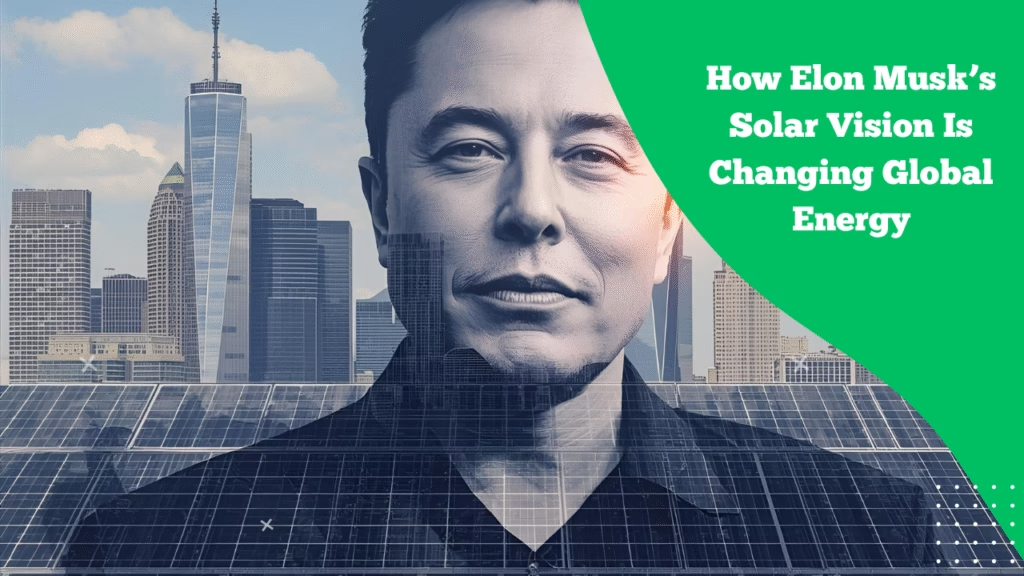
Elon Musk has always thought in terms of civilization-scale problems. While the world fixates on Tesla’s electric vehicles and autonomous driving, the quietest — and arguably most important — part of his empire is Tesla Energy. In 2025, Tesla Energy is no longer the overlooked stepchild; it has become the company’s most profitable division and one of the fastest-growing energy businesses on the planet.
This is the story of how Musk’s solar vision, first articulated nearly two decades ago, is finally materializing at global scale — and why 2025 marks the inflection point where solar + storage stops being “alternative” and becomes the default energy infrastructure of the future.
From PayPal to Powering the Planet
Most people forget that Elon Musk’s first fortune came from PayPal, but his first passion was always energy. In 2004, he invested in Tesla when it was just two guys in a garage. In 2006, he co-founded SolarCity with his cousins Peter and Lyndon Rive. The bet was simple but radical: solar power would eventually become the cheapest form of energy on Earth, and the only thing standing in the way was installation cost and energy storage.
Musk famously said in 2006:
“The point of SolarCity and Tesla is to accelerate the transition to sustainable energy. We want to show that it can be done profitably.”
In 2016, Tesla acquired SolarCity for $2.6 billion — a move heavily criticized at the time as a bailout. Today, that acquisition looks prophetic. The combined entity created the world’s first vertically integrated sustainable energy company: making the cars, the batteries, the solar roofs, and the grid-scale storage that ties it all together.
Master Plan Part 3: The Math That Changed Everything
Released in April 2023, Tesla’s Master Plan Part 3 is the most comprehensive roadmap ever published for a fully sustainable global energy economy. The document lays out, in meticulous detail:
- 30 TW of new renewable capacity needed (mostly solar + wind)
- 240 TWh of battery storage required globally
- Total investment: ~$10 trillion (less than the fossil fuel industry spends in a decade)
- Land requirement: less than 0.2% of Earth’s surface
Crucially, the plan proved that a 100% renewable grid is not just possible — it’s cheaper than continuing with fossil fuels.
In 2025, we are finally seeing the physical manifestation of that math.
Tesla Energy in 2025, The Numbers Tell the Story
Tesla Energy is now growing faster than Tesla’s automotive division. Here are the actual deployment figures through Q3 2025:
| Quarter | Energy Storage Deployed (GWh) | YoY Growth | Solar Deployed (MW) | Notes |
| Q1 2025 | 10.4 | +156% | ~100 | Strong Megapack ramp |
| Q2 2025 | 9.6 | +108% | ~110 | Record Powerwall shipments |
| Q3 2025 | 12.5 | +115% | ~130 | New quarterly record for storage |
| YTD Total | 32.5 GWh | +125% | ~340 MW | On track for >50 GWh annual storage |
Sources: Tesla Q1-Q3 2025 Shareholder Reports, Oct-Nov 2025
Tesla is on pace to deploy more than 50 GWh of energy storage in 2025 alone — equivalent to the entire global battery storage capacity installed before 2020.
Meanwhile, after years of stagnation, the Solar Roof program is showing signs of a major comeback. In October 2025, Tesla VP Rohan Patel hinted at a significant production ramp at Gigafactory New York, with new V3.5 solar tiles that are cheaper to manufacture and easier to install.
Why Solar + Storage Is the Real Revolution
Solar panels alone are now the cheapest form of electricity in most of the world. But without storage, solar is intermittent. Elon Musk’s key insight was that the falling cost of batteries would solve this problem permanently.
The proof is in real-world projects:
- The Hornsdale Power Reserve in Australia (built by Tesla in 2017) has saved consumers over $150 million in grid stabilization costs and remains the most profitable battery in the world.
- In California, Tesla Megapacks are now the primary tool used by utilities to prevent blackouts during heat waves.
- In Texas, Tesla’s virtual power plants (VPPs) — networks of Powerwalls in homes — provided over 100 MW of emergency power during Summer 2025 storms.
Every Megapack and Powerwall sold makes the grid more resilient and accelerates coal and gas plant retirements.
Global Impact: How Musk’s Vision Is Reshaping Entire Countries
The ripple effects are now visible at national scale:
| Country/Region | Tesla Energy Influence in 2025 | Outcome |
| Australia | 1+ GW of Megapack projects under construction | Expected to save $1.2 billion in grid costs over 10 years |
| California, USA | Over 100,000 Powerwalls enrolled in VPP programs | Provided 500+ MWh during Sept 2025 heat wave, prevented rolling blackouts |
| Germany | Multiple 300+ MWh Megapack installations | Helping achieve 80% renewable electricity in Q3 2025 |
| China | LFP Megapack factory in Shanghai at full production | Supplying Asia-Pacific grid projects |
According to the International Energy Agency (IEA) Renewables 2025 report, solar PV capacity will grow by nearly 800 GW in 2025 alone — more new solar in one year than the entire world had in 2018.
Tesla didn’t build most of those panels, but it is building the batteries that make all that solar actually usable 24/7.
Why 2026 Could Trigger a Major Surge in Solar Roof Adoption
After years of painfully slow ramp, multiple sources inside Tesla indicate 2026 will be the true breakout year for Solar Roof.
Improvements include:
- New automated installation process (cutting install time by 60%)
- Higher efficiency cells (23.5% vs previous 22.5%)
- Seamless integration with Powerwall 3 and Tesla Electric retail plans
Analysts now project Tesla could deploy 1 GW+ of Solar Roof annually by 2027 — making it one of the largest roofing companies in America by revenue, not just a car company with a solar side hustle.
The Challenges That Still Stand
No revolution is without setbacks.
Tesla’s solar panel deployment (non-roof) has actually declined since 2017, from over 500 MW per year to around 400 MW in 2025. The company deliberately de-emphasized traditional solar panels to focus on the higher-margin, higher-impact Solar Roof and storage products.
Critics also point out that Tesla’s energy business still represents only ~10% of total revenue. But profit margins tell a different story: Tesla Energy’s gross margins reached 34% in Q3 2025 — higher than the automotive business.
In the Grand Scheme, We’re Only at the Start
Here’s the most important chart you won’t see in most media coverage:
Global Battery Storage vs Tesla’s Share (2020–2025)
| Year | Global Annual Deployment (GWh) | Tesla Deployment (GWh) | Tesla Market Share |
| 2020 | ~10 | 3.9 | ~39% |
| 2021 | ~18 | 4.0 | ~22% |
| 2022 | ~35 | 6.5 | ~19% |
| 2023 | ~70 | 14.7 | ~21% |
| 2024 | ~140 | 31.4 | ~22% |
| 2025 | ~300 (projected) | 50+ | ~17–20% |
Even as the market explodes, Tesla maintains roughly 20% global share — while being the most profitable player by far.
This is what exponential growth looks like when you’re the cost leader.
Conclusion: The Sun Is Rising Faster Than Anyone Expected
Elon Musk’s solar vision is no longer a prediction — it’s infrastructure being deployed at gigawatt scale every quarter.
In 2025, we crossed an invisible threshold: sustainable energy stopped being more expensive than fossil fuels in almost every major market. The only question left is speed.
Musk’s bet — made when solar was 10× more expensive than today — is paying off at exactly the moment humanity needs it most.
The age of abundance is beginning. And it’s powered by the sun.
Frequently Asked Questions (FAQ)
Q: Is Tesla still in the solar business in 2025? A: Yes, very much so. While traditional solar panel deployments have been deprioritized, the Solar Roof program is ramping significantly, with major production improvements at Giga New York in late 2025.
Q: How much energy storage has Tesla deployed in total? A: As of Q3 2025, Tesla has deployed over 100 GWh of energy storage products cumulatively since 2015 — more than any other company in history.
Q: What is Tesla Master Plan Part 3? A: Published in 2023, it is a detailed engineering and economic plan showing how the world can reach a fully sustainable energy economy using existing technology, requiring only $10 trillion in investment — less than global fossil fuel subsidies over the same period.
Q: Are Tesla Powerwalls and Megapacks profitable? A: Yes. Tesla Energy achieved its highest-ever gross margins in 2025 (over 30%), making it currently the company’s most profitable division.
Q: Will solar ever power the entire world? A: According to Master Plan Part 3 calculations (validated by multiple independent studies), yes — with less than 0.2% of Earth’s land area devoted to solar panels and approximately 240 TWh of storage.
Q: When will Tesla Solar Roof become widely available? A: Significant availability improvements began in Q4 2025, with analysts expecting nationwide U.S. coverage and major international expansion in 2026–2027.