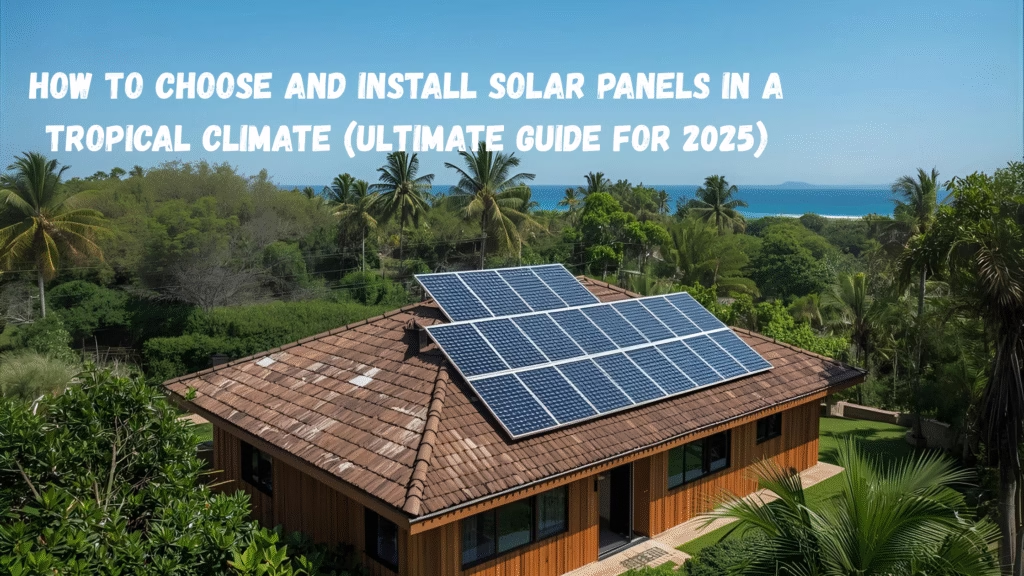
Why Solar Power Matters in Tropical Regions
If you live in a tropical country, you’ve probably felt two things every day — intense sunlight and unreliable electricity. From Nigeria to the Philippines, tropical regions receive an abundance of solar energy, often exceeding 5–6 kWh/m² per day. That’s more than enough to power homes and businesses sustainably.
But here’s the truth: not every solar panel performs well in tropical heat and humidity. High temperatures can reduce efficiency, moisture can damage connections, and dust or salt air can slowly degrade panels.
That’s why this ultimate guide is designed to help you:
✅ Choose the best solar panels for tropical conditions
✅ Understand installation techniques that boost efficiency
✅ Learn maintenance habits that extend panel life
✅ Get insights into costs, payback, and energy savings
Let’s dive into how to make solar energy work perfectly in a tropical climate.
1. Understanding the Tropical Climate Challenge
Tropical regions are sunny — but also hot, humid, and unpredictable. This unique combination affects how solar panels perform.
| Climate Factor | Effect on Solar Panels | Recommended Action |
| High temperature (30–40°C) | Reduces voltage and output efficiency | Choose low temperature-coefficient panels |
| Humidity & salt air | Causes corrosion and wiring faults | Use corrosion-resistant frames (aluminum alloy) |
| Dust, sand, and bird droppings | Block sunlight and reduce yield | Regular cleaning and anti-soiling coating |
| Heavy rains and windstorms | Risk of mounting damage or leaks | Strong mounting with waterproof sealing |
Why Temperature Matters
Solar panel efficiency drops by about 0.3–0.5% per °C above 25°C.
That means in a 35°C environment, you could lose 3–5% output. Choosing panels with a low temperature coefficient is critical.
2. Types of Solar Panels — Which Is Best for Hot and Humid Climates?
The three main types of solar panels are monocrystalline, polycrystalline, and thin-film. Here’s how they perform in the tropics:
| Panel Type | Efficiency | Heat Tolerance | Cost | Ideal Use |
| Monocrystalline | 18–22% | Excellent | High | Homes, commercial roofs |
| Polycrystalline | 15–17% | Moderate | Medium | Large rural installations |
| Thin-film (amorphous) | 10–13% | Very high (low heat loss) | Low | Hot industrial zones, curved surfaces |
Expert Pick:
Monocrystalline panels remain the best all-round choice due to their high power output and compact size. However, thin-film panels are gaining popularity in extremely hot zones because they perform better at higher temperatures despite lower efficiency.
3. Key Features to Look for When Buying Solar Panels
✅ a. Temperature Coefficient
Choose panels with ≤ −0.35%/°C temperature coefficient. This means less power loss as the sun heats up the surface.
✅ b. Corrosion Resistance
Ensure the frame is marine-grade anodized aluminum and junction boxes are IP67 or higher to resist water and salt.
✅ c. Warranty
Go for panels offering at least 12-year product warranty and 25-year performance warranty. In humid climates, long warranties protect your investment.
✅ d. Certifications
Check for international certifications like IEC 61215, IEC 61730, and Salt Mist Corrosion Resistance (IEC 61701) for coastal regions.
4. System Sizing and Power Needs
Before installing solar, calculate your daily energy consumption. Add up the wattage of all appliances and multiply by their daily usage hours.
Example calculation:
| Appliance | Power (W) | Hours/Day | Daily Wh |
| Refrigerator | 200 | 24 | 4,800 |
| TV | 100 | 4 | 400 |
| Lighting (LED × 6) | 60 | 6 | 360 |
| Fan (× 2) | 150 | 8 | 1,200 |
| Total | — | — | 6,760 Wh ≈ 6.8 kWh/day |
If you get 5 sun hours/day, divide total energy by 5:
6.8 kWh ÷ 5 = 1.36 kW system
Add 30–40% buffer for losses → 1.8 kW recommended.
-
Best Mounting
Angle and Direction in the Tropics
- Facing: Always face panels toward the equator (north in Southern Hemisphere, south in Northern Hemisphere).
- Tilt: Use a tilt angle ≈ latitude × 0.9 (for equatorial regions, typically 10–15°).
- Elevation: Elevate panels at least 30 cm above the roof to promote cooling airflow.
Tip: Avoid flat installations. Even a slight tilt improves drainage and reduces soiling from dust and rainwater.
6. Mounting Materials & Corrosion Protection
In humid or coastal environments, corrosion is a silent enemy. Choose materials wisely:
- Mounting frame: Hot-dip galvanized steel or anodized aluminum
- Bolts and fasteners: Stainless steel (Grade 304 or 316)
- Sealants: UV-resistant silicone for waterproofing
- Cables: UV-resistant and double-insulated DC cables (6 mm²+ recommended)
Regularly check for rust stains or loose bolts, especially after the rainy season.
7. Cleaning & Maintenance in Dusty or Humid Environments
Dust, pollen, or salt can reduce performance by up to 15%. Create a simple maintenance plan:
Cleaning Tips
- Use soft cloths or mild detergent with water (avoid harsh chemicals).
- Clean early morning or late evening when panels are cool.
- Inspect once every 2 weeks in dusty areas; once monthly elsewhere.
- Consider anti-soiling coatings or self-cleaning sprays.
Pro Tip
Track your energy output. A sudden 10–20% drop often signals dirty or shaded panels.
8. Batteries and Backup Solutions
Tropical regions often face unstable grids, so pairing solar with storage is smart.
| Battery Type | Best Feature | Drawback | Lifespan |
| Lithium-ion | High efficiency, compact | Costlier | 10–15 yrs |
| Lead-acid (AGM/GEL) | Low cost | Short life, maintenance | 3–5 yrs |
| LiFePO₄ | Stable in heat, long life | Moderate cost | 10+ yrs |
🔌 Inverter & Hybrid Systems
Hybrid inverters allow your system to draw from both solar and grid power seamlessly.
Choose: Pure sine-wave inverters rated for tropical temperatures (−10 °C to +60 °C).
9. Cost Breakdown and Payback Estimation
| Component | Percentage of Total Cost | Typical Range (₦ / USD) |
| Panels | 45–50% | ₦ 1.5–2.5 million ($1,200–$1,800) |
| Inverter | 20–25% | ₦ 700k–1.2 million ($500–$900) |
| Batteries | 20–30% | ₦ 1–2 million ($800–$1,500) |
| Mounting & Wiring | 10% | ₦ 300k ($250) |
Total average: ₦ 3.5–5.5 million ($2,500–$4,000) for a 2–3 kW home system.
Payback: 3–5 years depending on electricity tariffs and sunlight hours.
After that, energy becomes virtually free for 20+ years.
10. Step-by-Step Installation Guide
7 Steps to Solar Installation Success
- Site Assessment: Measure available roof area, shading, and direction.
- Load Audit: Calculate daily energy demand.
- System Design: Choose capacity, panel layout, and inverter specs.
- Procurement: Buy certified components from trusted suppliers.
- Mounting & Wiring: Install frames, connect panels in series/parallel.
- Testing: Check voltage, polarity, grounding, and output.
- Commissioning: Document setup, label breakers, and start monitoring.
11. Safety and Compliance Tips
- Always include earthing and surge protection
- Label all PV strings clearly to meet electrical code standards.
- Use MC4 connectors to prevent moisture entry.
- Keep batteries in cool, ventilated areas (away from direct sunlight).
- Ensure installers are certified by local energy authorities (e.g., NEMSA in Nigeria).
12. Tropical Case Study: Residential Solar in Nigeria
Location: Owerri, Imo State
System: 3 kW monocrystalline + 4 × 200 Ah LiFePO₄ batteries
Outcome:
- Generates ~15 kWh/day
- Covers 90% of home usage
- Saved ₦ 22,000/month in electricity cost
- Payback achieved in 4 years
Maintenance: monthly cleaning + surge protection = 99% uptime.
13. Tips for Extending Solar Panel Lifespan
- Avoid trees or bird nests above the array.
- Tighten bolts every 6 months.
- Use monitoring apps (Growatt, Victron, etc.) to track performance.
- Clean inverter filters regularly.
- Inspect cables after heavy rainfall or storms.
With proper care, panels last 25+ years, batteries 10+, and inverters 8–10.
14. Environmental Impact and Long-Term Benefits
Installing solar in the tropics is not only an economic move — it’s ecological.
| Impact | Description | Benefit |
| Reduced emissions | Cuts CO₂ by ~1.5 tons/year for 2 kW system | Cleaner air |
| Energy independence | Less reliance on unstable grid | Reliable power |
| Job creation | Solar installers, maintenance, logistics | Local employment |
| Community resilience | Power during blackouts or disasters | Increased safety |
15. Frequently Asked Questions
Q1: Can solar panels work during rainy seasons?
Yes. Cloudy weather reduces output but panels still generate 30–60% of normal power.
Q2: Do high temperatures damage panels?
Not directly, but they reduce efficiency. Ensure adequate airflow under the panels.
Q3: Is it safe to clean panels yourself?
Yes, with mild soap and soft cloths — never use abrasive cleaners or stand on panels.
Q4: Can I install solar myself?
DIY is possible for small systems, but professional installation is strongly recommended for safety and warranty protection.
Q5: What happens at night?
Solar stops producing power; you’ll rely on stored battery energy or grid backup.
16. Conclusion — Making Solar Work for the Tropics
Solar energy is the future of power in tropical nations. With abundant sunshine and rising energy costs, now is the best time to invest.
The secret lies in:
✅ Choosing heat-resistant, high-efficiency panels
✅ Using proper mounting and ventilation
✅ Scheduling regular cleaning
✅ Investing in reliable batteries and inverters
With the right setup, your solar system can deliver 20+ years of clean, reliable power — and pay for itself in just a few years.