
If you live with unstable grid power, you already know the drill. Light goes. Fan dies. Router drops. Fuel generator coughs to life, neighbours complain, and your wallet takes another hit.
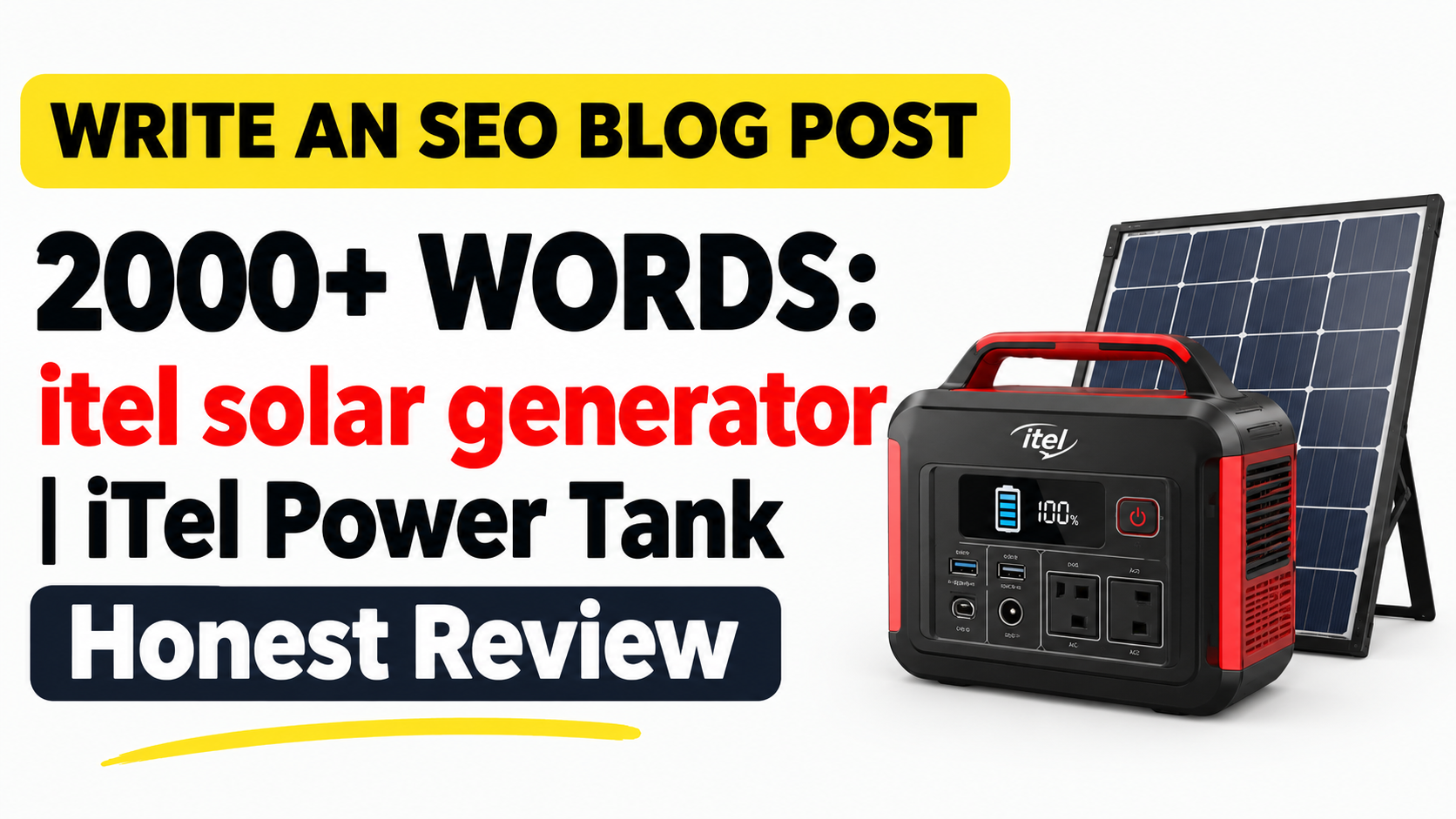
That is why compact solar generators exploded in popularity. The iTel Power Tank — also sold as the itel solar generator, model IESS-05K10N / IESS-05K10P — is one of the most talked-about 1kWh units in Nigeria, Pakistan, and other markets with frequent outages.
This review is not a sales page. It explains what the box actually is, what it can run, where people get disappointed, and who should skip it.
What the iTel Power Tank actually is
The Power Tank is an all-in-one portable power station. One box contains:
- A 500W pure sine wave inverter (about 1000W surge)
- A 1000Wh (1kWh) LiFePO4 lithium battery
- A built-in MPPT solar charge controller (listed max about 400W)
You do not mount a separate inverter on the wall. You do not wire a bank of lead-acid batteries. You unbox it, charge it from the wall, plug devices into the AC sockets, and later add a solar panel if you want.
Think of it as a silent mini backup plant for essentials, not a whole-house solar system.
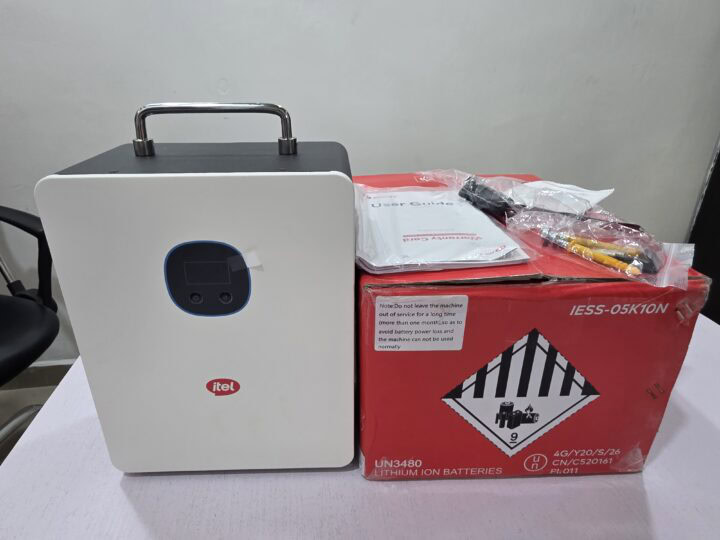
Typical size is roughly 40 × 25 × 30 cm. Weight reports range from about 10 kg to 15 kg. One adult can carry it by the metal handle, but it is not a pocket gadget.
Warranty on genuine units is commonly 2 years, often serviced through Carlcare / authorised itel energy channels.
Quick specs at a glance
| Item | Typical figure on the 500W / 1kWh model |
|---|---|
| Model | IESS-05K10N / IESS-05K10P |
| Inverter | 500W continuous, ~1000W surge, pure sine wave |
| Battery | 1000Wh LiFePO4 |
| Claimed cycle life | 6,000+ cycles |
| Solar input | Up to ~400W MPPT |
| Dual charge (grid + solar) | About 2 hours empty to full (best case) |
| Grid-only charge | Often closer to 2–4 hours |
| UPS switch | Under ~20 ms on many listings |
| Noise | Under ~45 dB |
| AC output | Usually 2 wall sockets (220–240V) |
| Extra ports | USB-A and a DC port on many units |
| App | No dedicated app on the common model |
Important spec warning: seller pages do not all agree on solar voltage. Some official pages list a high MPPT window (around 60–150V). Other listings say 11–60V. That is not a small difference. A panel that works on one listing may not wake the MPPT on another. Confirm the exact voltage range printed on your unit and in the manual before you buy a panel.
Design: simple box, few surprises
The look is a white (sometimes grey) metal case, carry handle on top, small display on the front, vents and ports on the side.
The display usually shows battery percentage. That matters more than people think. Cheap power stations hide remaining energy; this one lets you plan the night.
What you will not get:
- A fancy phone app
- Load scheduling
- A wall of USB-C PD ports like premium EcoFlow / Bluetti units
- Whole-house automatic transfer unless you add extra wiring yourself
That is not automatically bad. Many buyers want “plug in and work,” not a smart-home project.
Cooling fans exist. They are not silent like a library, but they are far quieter than a petrol generator. Listings put noise under 45 dB.
Build quality is generally described as solid for the price. A few long-term notes from testers: metal bodies can mark or rust if you drag the unit outdoors in rain, and there is no IP weather rating for leaving it outside.

Why LiFePO4 matters (in plain language)
Marketing loves the phrase “lithium battery.” Chemistry still matters.
LiFePO4 (lithium iron phosphate) is the safer, longer-life chemistry used in many modern home batteries. Compared with older lithium-ion or lead-acid packs, it usually:
- Handles heat better
- Is less likely to thermal-runaway in daily home use
- Survives far more charge cycles
- Holds usable capacity for years if you do not abuse it
itel rates this pack at 6,000+ cycles. If you cycled it once a day, that is many years on paper. Real life is messier: heat, deep daily drains, cheap panels, and overloads all shorten life.
A useful mental model:
- 500W is how hard it can push right now
- 1000Wh is how much energy is in the tank
You can run 100W for roughly 8–10 usable hours, or 500W for roughly 1.5–2 hours, after conversion losses. You cannot run a 1,200W iron no matter how full the battery is. The inverter will trip.
That single fact causes most “this thing is a scam” comments. The unit is not a scam. The buyer expected a generator.
What it can actually power
This is the honest part.
Good fit
- LED bulbs
- Standing / ceiling fans in the 40–75W range
- Laptops and monitors
- Wi-Fi / fibre routers, Starlink in many cases
- 32-inch LED TVs and decoders
- Phones, power banks, lamps
- POS machines and small CCTV
- Content-creator kits: laptop + ring light + router, if total watts stay under 500W
- Some small energy-efficient fridges if running watts stay low and surge stays under about 1000W
Bad fit
- Pressing iron
- Hot plate / electric cooker
- Microwave
- Air conditioner
- Water heater
- Most big freezers (startup surge often exceeds 1000W)
- Several “medium” appliances at once that add up over 500W
itel’s own pages say a large deep freezer can trip the inverter and point buyers to bigger hybrid kits. Listen to that.
If you need a freezer, AC, or iron on backup, this is the wrong product. Buy a larger hybrid inverter and battery, not a 500W power station.
Realistic runtime (not brochure fantasy)
Usable energy is less than 1000Wh because inverters waste some power as heat. A fair planning number is about 800–900Wh usable.
Approximate runtimes from manufacturer tables and independent write-ups:
| Load | Typical watts | Rough runtime from full |
|---|---|---|
| 32″ LED TV | 40W | 18–20+ hours |
| Laptop | 50–65W | 12–16 hours |
| Standing fan | 50W | 14–16 hours |
| Starlink / similar router | 45W | 16–18 hours |
| Wi-Fi router only | ~10W | many tens of hours |
| Work combo (laptop + fan + bulb + router) | ~150W | about 5–6 hours |
| Home combo (TV + decoder + fan + a few bulbs) | ~180W | about 4–5 hours |
| Near-max 500W load | 500W | about 1.5–2 hours |
Real nights look like this: lights + fan + phones + router from evening into early morning, if you are not also running a TV and a laptop at full brightness the whole time.
One Nigerian remote worker who bought the unit for about ₦300,000 said she ran a laptop, phones, ring light, and fibre router for months, including a 3–4 day outage stretch, as long as she did not pile on extra appliances. That matches the math: light loads last; greedy loads do not.
Charging: wall, sun, or both
From the grid (NEPA / PHCN / WAPDA)
Plug the Power Tank into a wall socket. Listings claim a full recharge in about 2 hours when conditions are ideal. Some testers see closer to 3–4 hours on grid alone.
A practical plus in weak-grid countries: several specs list a wide AC input window (around 90–280V). That helps when voltage is ugly. It does not make bad wiring safe. Use a surge protector if your line is violent.
One limitation reviewers mention: you often cannot throttle AC charging. The unit may pull a large charge load. On a weak circuit, or when you are already running a generator, that can be annoying.
From solar
Built-in MPPT is rated around 400W max. Official bundles often pair a 410W panel. Some owners use 450–625W panels and accept that the controller will clip extra watts.
Best-case solar time in strong sun with a properly matched panel is roughly 2.5–3 hours. Cloudy days stretch that a lot.
Dual charging (wall + solar together) is the fastest path to the advertised ~2-hour fill.
Do not assume any random 100W suitcase panel will work. Voltage has to sit inside the MPPT window, and a tiny 18V panel may not even start charging.
UPS behaviour
Many listings advertise under 20ms switchover. That is fast enough that routers, TVs, and laptops often stay on when grid dies — closer to a UPS than a generator that needs pull-start.
Treat that as a feature for electronics, not a promise that every cheap socket in the house is now “always on.” The unit still only has two AC outlets unless you add a strip (and then you must watch the 500W cap).
Price in 2026 (it moves)
Prices change with forex, seller, and whether a panel is in the box.
Nigeria (typical mid-2026 range):
- Unit only: about ₦280,000 – ₦335,000
- Official / reputable store listings often sit near ₦304,000 – ₦315,000
- With a ~410W panel: about ₦400,000 – ₦435,000
- Street / Alaba deals can dip lower — and that is where fakes show up
Pakistan: commonly advertised around ₨70,000 – ₨80,000 for the 500W AIO.
If a stranger on social media offers the same 1kWh unit for a joke price (tens of thousands of naira below market), walk away. Scam pages have already used other people’s review videos to sell fake or non-existent Power Tanks.
Honest pros
1. True 3-in-1 for beginners. Battery, inverter, and solar controller in one box. No electrician required for basic use.
2. Pure sine wave. Safer for laptops, TVs, decoders, and routers than modified-sine cheap inverters.
3. Fast refill compared with many 1kWh rivals. Dual input in two hours is a real lifestyle difference if power flickers several times a day.
4. Quiet. No fuel, no smoke, no 2 a.m. generator fight with the street.
5. Chemistry is the right class. LiFePO4 plus a long cycle rating is what you want if this box will work every blackout for years.
6. Local-brand service path. In Nigeria, authorised warranty / Carlcare access is a practical advantage over random imported no-name stations.
7. Good “work from home” size. One unit can cover a desk: laptop, light, fan, internet.
Honest cons
1. 500W is a hard ceiling. Cross it and the unit shuts down to protect itself. That is correct behaviour. It still ruins the evening if you plugged in the wrong appliance.
2. 1kWh is not a house. A family that wants TV + several fans + fridge + lights all night will empty this pack quickly or trip it.
3. No app, limited ports. Fine for simple use. Frustrating if you wanted remote monitoring or lots of USB-C PD.
4. Solar voltage confusion. Conflicting published ranges mean a bad panel match is a real risk.
5. You often cannot limit AC charge power. Awkward on weak household circuits.
6. Fakes exist. Popular product + high price = counterfeit and grey-market units. A fake with a weak battery looks identical in photos.
7. Not weatherproof. Indoor / covered use only.
8. Some engineers dislike the 500W inverter on a 1kWh pack. Their argument: you can drain the battery very fast at full inverter load, which is harder on lithium long term than a gentler inverter. You can protect the pack yourself by staying well under 500W most of the time. The unit will not always stop you.
9. Price is not the cheapest 1kWh box. Cola, Hithium, and other 1kWh stations sometimes undercut it. You pay extra for brand, output, and service — not for magic capacity.
iTel Power Tank vs a fuel generator
| Power Tank | Small petrol generator | |
|---|---|---|
| Noise | Quiet | Loud |
| Fuel cost | None after purchase | Every blackout |
| Fumes | None | Yes |
| What it runs | Essentials under 500W | Often higher surge loads |
| Night use | Easy indoors | Usually outdoor, neighbours hate it |
| Runtime | Limited by 1kWh tank | Limited by fuel you keep buying |
| Maintenance | Almost none | Oil, spark plug, carb issues |
If your pain is “lights, fan, internet, laptop,” the Power Tank usually wins on daily sanity.
If your pain is “freezer and pressing iron must work,” the generator (or a much larger solar hybrid) still wins.
Many households keep both: Power Tank for electronics and nights, generator for heavy jobs.
Who should buy it
Buy the itel solar generator if you:
- Work remotely and need a quiet desk backup
- Want lights, fans, TV, and Wi-Fi through typical evening outages
- Live in a rented room or small flat where you cannot install a full solar array
- Hate generator noise and fuel maths
- Will add a matched panel later and treat this as step one, not the final mansion system
Who should not buy it
Skip it if you:
- Need to run AC, iron, cooker, or a large freezer
- Want one box to carry an entire 3-bedroom flat
- Refuse to check total watts before plugging things in
- Are chasing the absolute cheapest 1kWh label with no warranty
- Think “solar generator” means unlimited free power from any small panel
How to buy without getting burned
- Buy authorised. Official itel energy / itel solar shops, known marketplaces with buyer protection, or dealers who can show warranty paperwork.
- Ignore miracle prices. If it is far below the going ₦300k-class rate in Nigeria, assume risk.
- Match the panel to the printed MPPT range, not to a WhatsApp caption.
- Add a cheap watt meter. Know what each fan and TV actually draws. Nameplate lies.
- Separate heavy loads. Some owners put the Power Tank on a dedicated socket circuit and keep heater / freezer on grid or generator. Smart.
- Keep it indoors, off the floor damp, with airflow around the vents.
- Do not flatten it to 0% every night. LiFePO4 is tough, but daily 100% depth of discharge still ages any pack faster.
Simple buying math
Ask one question: what is the total wattage of the things that must stay on together?
Example A — remote worker
Laptop 60W + router 10W + LED 10W + fan 50W = 130W.
At 130W, 1kWh usable-ish energy can cover a long work block. This is a Power Tank home.
Example B — “whole parlour”
TV 80W + decoder 20W + two standing fans 120W + six bulbs 60W + fridge compressor 120W = 400W+, plus fridge surge.
You may stay under 500W if you are careful, but runtime collapses to a few hours. One extra gadget and it trips.
Example C — iron + kettle
Do not. Wrong product.
Frequently asked questions
Does the itel Power Tank come with a solar panel?
Sometimes. Many listings sell the unit alone. Bundles with a ~410W panel cost more. Always read the package line, not the headline photo.
Can it replace NEPA completely?
No. It bridges outages for essentials. Daytime solar can refill it, but 400W of panel is not a full off-grid home.
Can I use an extension box?
Yes, if the combined load stays under 500W. The strip does not increase inverter power.
Is it safe for a laptop?
Pure sine wave plus fast UPS-style switch is the right kind of output for computers. Still use a decent surge protector on dirty grid when charging the Tank itself.
How long will the battery last in years?
Marketing says up to around 8–10 years / 6,000+ cycles. Heat, daily deep drain, and overloads decide the real number. Treat 5–8 useful years as a sober hope if you use it hard.
Is there a bigger itel option?
Yes. itel energy also sells larger hybrid inverters and bigger all-in-one generators (multi-kWh). If 500W already feels tight while you are reading this, step up now instead of “trying” the Power Tank and reselling it.
Final verdict
The iTel Power Tank is a good small solar generator for a specific job: keep the modern essentials alive without fuel and without hiring an installer.
It is not Nigeria’s (or anyone’s) cheapest 1kWh box. It is not a freezer machine. It is not a silent air conditioner. People who buy it expecting those things write angry reviews. People who buy it for lights, fans, internet, and a laptop generally keep it.
Score in plain terms
- Value for remote work / small-room backup: strong
- Value as a whole-home solar system: weak
- Ease of use: excellent
- Honesty of the 500W / 1000Wh numbers: the numbers are real — the disappointment is usually expectation
If your watt list fits, buy a genuine unit with warranty and a panel that matches the MPPT window. If your watt list does not fit, save the money for a larger hybrid system. That is the whole review.