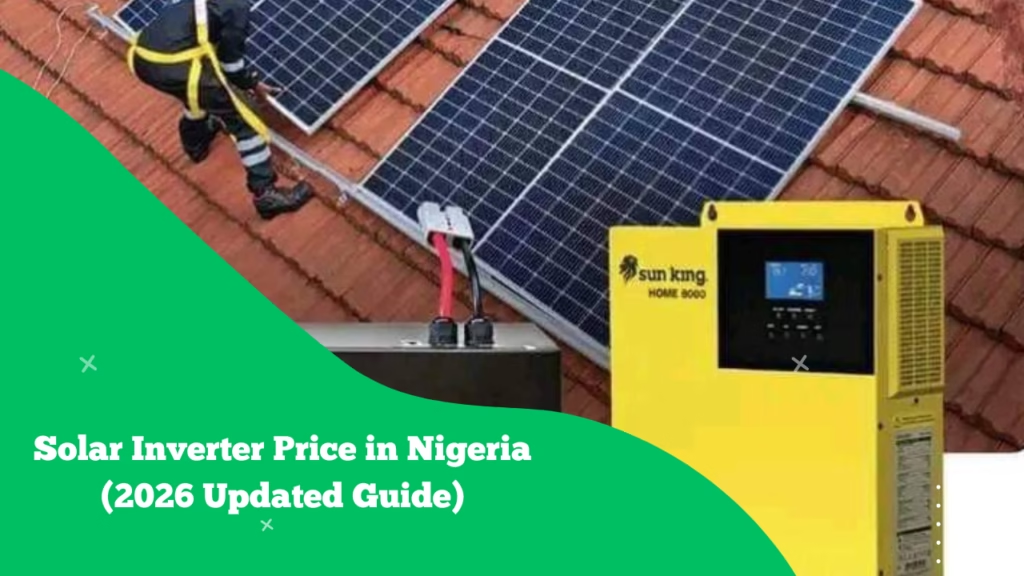
Solar inverter prices in Nigeria in November 2026 range from about ₦150,000 for a 1kVA unit to more than ₦2 million for some 15kVA models. The amount you pay depends on the inverter’s rated output, whether it is a hybrid model with a built-in MPPT solar charge controller, its battery voltage, PV input capacity, brand, monitoring functions and warranty.
This guide focuses on the price of the inverter unit itself. It does not confuse the inverter price with the cost of a complete solar installation. The prices below are based on a market review of 415 new inverter listings on Jumia and Jiji, checked on 20 October 2026 and rechecked on 9 November 2026, alongside current Nigerian retailer listings. The guide was updated on 11 November 2026.
Solar inverter prices in Nigeria: November 2026 price list
The table shows the typical asking-price range for brand-new inverters in each capacity category. These are observed Nigerian retail listing prices for the inverter unit, not package prices for panels, batteries and installation.
| Inverter capacity | Typical listed price in Nigeria | Listings in market survey |
|---|---|---|
| 1kVA | ₦150,000–₦205,000 | 41 |
| 1.5kVA | ₦205,000–₦250,000 | 34 |
| 2kVA | ₦265,000–₦300,000 | 18 |
| 2.5kVA | ₦290,000–₦350,000 | 41 |
| 3.5kVA | ₦400,000–₦600,000 | 43 |
| 4.2kVA | ₦370,000–₦450,000 | 49 |
| 5kVA | ₦495,000–₦685,000 | 40 |
| 6kVA | ₦635,000–₦750,000 | 37 |
| 7.5kVA | ₦525,000–₦1,100,000 | 33 |
| 10kVA | ₦855,000–₦1,200,000 | 39 |
| 12kVA | ₦970,000–₦1,350,000 | 27 |
| 15kVA | ₦1,300,000–₦2,070,000 | 13 |
Market source: InfraSol Research’s November 2026 Nigerian inverter price survey, which counted 415 brand-new Jumia and Jiji listings. Its typical price band is the middle half of listings in each size category, rather than the single cheapest or most expensive advert. Prices for 7.5kVA and 15kVA cover a wider range of product types and have fewer comparable listings than the most common sizes.
The figures describe asking prices advertised by sellers. They are not a government price control or a single national recommended retail price. They provide a clear market benchmark for comparing a seller’s offer with other current Nigerian listings.
How much does a 5kVA solar inverter cost in Nigeria?
A 5kVA inverter is one of the most commonly considered sizes for residential backup and solar installations. In the November 2026 market survey, brand-new 5kVA units were listed at ₦495,000 to ₦685,000, with a median asking price of ₦520,000 across 40 listings.
That range covers different product designs. A basic inverter/charger is not the same product as a 5kW hybrid inverter with an integrated MPPT controller, lithium battery communication, Wi-Fi monitoring and parallel capability. A current Nigerian comparison of 5kVA models lists Felicity IVEM at ₦550,000–₦650,000, Must PV1800 at ₦715,000–₦772,200, Luminous NXI at ₦700,000–₦800,000, Growatt SPF 5000ES at ₦800,000–₦900,000, Su-Kam Colossal at ₦930,000–₦1,100,000, Victron MultiPlus-II 48/5000 at ₦1,320,000 and a Deye 5kW hybrid listing at ₦1,896,000. The Deye figure is a single-seller observation, not a market-wide price.
These model prices are published in Finelib’s October 2026 inverter brand comparison. They illustrate why the words “5kVA inverter” are not enough to compare two products. Compare the full model number, rated output in kW, PV input specification, battery voltage, features and warranty.
Current Nigerian retailer prices for Felicity inverters
A Nigerian Felicity product catalogue currently displays the following prices for selected inverter models:
| Felicity model | Published listing price |
|---|---|
| IVEM3048-LV, 3kVA hybrid, 48V | ₦494,000 |
| IVEM6048, 6kVA hybrid, 48V | ₦637,000 |
| IVPM7548, 7.5kVA hybrid, 48V | ₦1,097,600 |
| IVEM8048, 8kVA hybrid, 48V | ₦1,225,000 |
| IVPS10048, 10kVA pure sine wave inverter, 48V | ₦1,235,000 |
| IVEM Series, 12kW off-grid inverter | ₦1,290,100 |
These are the prices displayed on the Nigerian Felicity Solar inverter product catalogue when checked for this article. They are specific model listings, not a claim that every inverter of the same capacity sells at that price. The catalogue also lists two different 8kVA models at different prices, showing why model number and product architecture matter.
What determines the price of a solar inverter?
1. Inverter type: hybrid, off-grid or grid-tied
A conventional inverter/charger converts battery DC power into AC electricity and may charge the battery from the grid or a generator. It does not necessarily accept solar panels directly.
A hybrid or solar inverter/charger usually combines the inverter with a solar charge controller, commonly MPPT, and manages energy from PV modules, batteries and an AC source. Some hybrid models can also operate in grid-interactive configurations. A grid-tied inverter is designed to synchronise with the utility supply and normally shuts down during a grid outage unless it has a specific backup architecture.
Do not assume that a product is a solar hybrid inverter because the advert uses the word “solar”. Confirm from the manufacturer’s datasheet whether it has an integrated MPPT controller and the PV input limits required for your array.
2. Rated output power: kVA and kW
Inverter capacity is commonly advertised in kilovolt-amperes (kVA), while the real power delivered to appliances is measured in kilowatts (kW). The relationship is:
Real power (kW) = Apparent power (kVA) × Power factor
For example, an inverter rated at 5kVA with a rated power factor of 0.8 delivers 4kW of real power. A model rated at 5kVA and power factor 1.0 can deliver 5kW. Always use the rated active output stated on the datasheet; do not assume all 5kVA models deliver the same kW.
3. Battery voltage and charging capacity
Small residential inverter models commonly use 12V or 24V battery systems, while larger residential models commonly use 48V battery banks. The inverter’s DC voltage must match the battery bank. A 48V inverter cannot be connected to a 24V battery bank.
Check the maximum battery charge and discharge current, supported battery chemistry, lithium BMS communication protocol and the manufacturer’s approved battery list. A model that supports lithium batteries only through a compatible BMS connection may not communicate correctly with every lithium battery brand.
4. Solar PV input and MPPT specification
For a hybrid inverter, the solar input specification determines which PV array can be connected. Check all of the following in the datasheet:
- Maximum PV array input power (W or kW).
- Maximum PV open-circuit voltage (V).
- MPPT operating voltage range (V).
- Maximum PV input current (A) for each MPPT.
- Number of independent MPPT trackers and permitted strings per tracker.
- Maximum solar charging current to the battery.
These values are not interchangeable. A panel string can exceed the inverter’s voltage limit even when its total wattage is below the stated PV input power. The array must be designed using the module’s open-circuit voltage corrected for the lowest expected cell temperature and the inverter’s permitted input current and voltage.
5. Efficiency, waveform and protection
For household and office electronics, choose a pure sine-wave inverter with published efficiency and protection specifications. Review overload, short-circuit, over-temperature, over-voltage, under-voltage and reverse-polarity protection as applicable. Peak efficiency is not the same as efficiency at every load level; the datasheet’s efficiency curve provides a more complete picture.
6. Monitoring, parallel operation and warranty
Wi-Fi monitoring, remote configuration, parallel operation, generator integration and advanced energy management can increase the price. Check whether monitoring hardware is included or sold separately. Confirm the warranty period, what it covers, where service is performed in Nigeria and whether the seller supplies genuine replacement parts.
What can different inverter sizes power?
The table below describes common applications, not a guarantee that every appliance listed can run together. The correct capacity is determined by the combined running load, motor starting current, power factor and the inverter’s continuous and surge ratings.
| Inverter size | Typical application | Important design consideration |
|---|---|---|
| 1–1.5kVA | Lighting, fans, television, router, laptop and phone charging | Usually a small 12V battery system; avoid adding high-wattage heating appliances. |
| 2–2.5kVA | Essential household loads, lighting, fans, TV and selected refrigerator loads | Check compressor starting current and whether the model is 12V or 24V. |
| 3–3.5kVA | Small home or shop with lighting, fans, television, refrigerator and selected additional loads | Confirm real output in kW and surge capability before adding an air conditioner or pump. |
| 4.2–5kVA | Moderate residential loads and selected small commercial loads | Many 5kVA systems use 48V batteries; some use 24V. Verify the exact model. |
| 6–7.5kVA | Larger household loads, selected air-conditioning loads and small offices | Assess simultaneous air-conditioner and motor loads; design battery capacity for required runtime. |
| 10–12kVA | Large homes, duplexes, offices and small commercial premises | Check single-phase or three-phase output, PV input limits and load balancing. |
| 15kVA | Large residential and commercial installations | Confirm phase configuration, maximum demand, surge loads and whether a three-phase system is required. |
How to choose the right inverter capacity
Do not select an inverter based only on the number of bedrooms or the total wattage written on a few appliances. Prepare a load schedule and calculate the maximum demand that may operate simultaneously.
- List every appliance. Record its rated input power in watts from the nameplate or datasheet.
- Identify motor loads. Refrigerators, freezers, air conditioners, pumps and compressors can draw a higher starting current than their normal running current.
- Calculate simultaneous demand. Add the real power of appliances expected to run at the same time. Apply a justified operating schedule rather than assuming every appliance runs together.
- Check the inverter’s continuous output. The inverter’s rated kW must support the simultaneous real-power demand.
- Check surge capability. Confirm the inverter can start the largest motor load while other appliances are operating. Use the manufacturer’s overload-duration curve, not only a headline peak figure.
- Size the battery separately. Inverter kW determines how much load can run at once; battery kWh determines how long it can run.
- Size the solar array separately. The PV array must supply daytime loads and provide the required battery charging energy within the available solar window.
What is the difference between an inverter price and a complete solar system price?
The inverter is only one component of a solar installation. A complete system may also require solar panels, battery storage, mounting structures, DC and AC cables, isolators, circuit breakers, surge protection devices, earthing, distribution modifications, installation labour, testing and commissioning.
For example, the inverter-only price of a 5kVA unit does not include the cost of a 48V battery bank or the PV modules. A complete 5kVA solar package can therefore cost several times the inverter-only price, depending on the battery capacity and PV array size.
For the cost of a complete installation, read our guide to solar system costs for small businesses in Nigeria and our guide to solar panel requirements for a three-bedroom house.
Where to buy a solar inverter in Nigeria
Buy from a supplier that can identify the exact model, provide a tax invoice or proper sales receipt, demonstrate the product’s serial number and explain the warranty and local repair process. Nigerian buyers can compare product listings from established solar retailers and marketplaces, but the seller’s identity and after-sales responsibility should be verified before payment.
For a specific model, compare the manufacturer’s published specifications with the product listing. Felicity’s Nigerian inverter catalogue, for example, publishes model names and listed prices for several capacities. A listing price alone does not establish that the seller is an authorised distributor or that installation is included.
Five checks to make before paying for an inverter
- Confirm the exact model number and rated output in both kVA and kW.
- Confirm whether the unit is hybrid and has a built-in MPPT solar charge controller.
- Match the inverter’s DC battery voltage and BMS protocol to the battery.
- Check PV voltage, current, power and MPPT limits against the proposed panel-string design.
- Get the warranty terms, service contact, included accessories and final selling price in writing.
Frequently asked questions
How much is a 1kVA solar inverter in Nigeria?
New 1kVA inverter listings in the November 2026 market survey were typically ₦150,000–₦205,000 for the inverter unit. Batteries, panels and installation are separate.
How much is a 3.5kVA solar inverter in Nigeria?
The typical listed price range for a new 3.5kVA inverter was ₦400,000–₦600,000. The market survey included 43 listings in this capacity category.
How much is a 5kVA solar inverter in Nigeria?
New 5kVA inverter listings were typically ₦495,000–₦685,000, with a market median of ₦520,000 across 40 listings. Premium hybrid models with additional features can be listed above this range.
How much is a 10kVA solar inverter in Nigeria?
New 10kVA inverter listings were typically ₦855,000–₦1,200,000, with a median of ₦1,000,000 across 39 listings. Premium models and different inverter architectures may cost more.
How much is a 15kVA solar inverter in Nigeria?
The typical listed price range for new 15kVA inverters was ₦1,300,000–₦2,070,000 across 13 listings in the market survey.
Does the inverter price include batteries and solar panels?
No. The prices in this guide refer to the inverter unit only. Batteries, solar panels, mounting structures, cables, protection devices and installation are separate unless a seller’s package description explicitly includes them.
Is a 5kVA inverter the same as a 5kW inverter?
No. kVA is apparent power, while kW is real power. The relationship depends on the inverter’s rated power factor. Check the manufacturer’s datasheet for the rated active output in kW.
Is a hybrid inverter more expensive than a normal inverter?
A hybrid inverter with a built-in MPPT solar charge controller and battery-management features generally costs more than a basic inverter/charger of similar capacity. The November 2026 market survey found examples where the MPPT-equipped version of the same brand and size cost about ₦145,000–₦185,000 more than its non-hybrid counterpart.
Final recommendation
For a buyer in Nigeria, the correct inverter purchase starts with the load requirement and the system architecture—not the lowest advert price. Compare the actual kW output, battery voltage, PV input limits, MPPT specification, surge capability, battery communication and warranty. Then compare the exact model across sellers.
As at 11 November 2026, the market survey places a typical new 5kVA inverter at ₦495,000–₦685,000 and a typical new 10kVA inverter at ₦855,000–₦1,200,000. These are inverter-only selling-price listings. They should not be presented as the price of a complete solar installation.
Price methodology: This article uses the middle 50% of 415 brand-new Jumia and Jiji listings counted on 20 October 2026, with a recheck on 9 November 2026. Brand-specific and retailer examples are identified separately and linked to their published listings. Prices are asking prices advertised by sellers; stock and seller prices can change after publication. Last reviewed: 11 November 2026.