
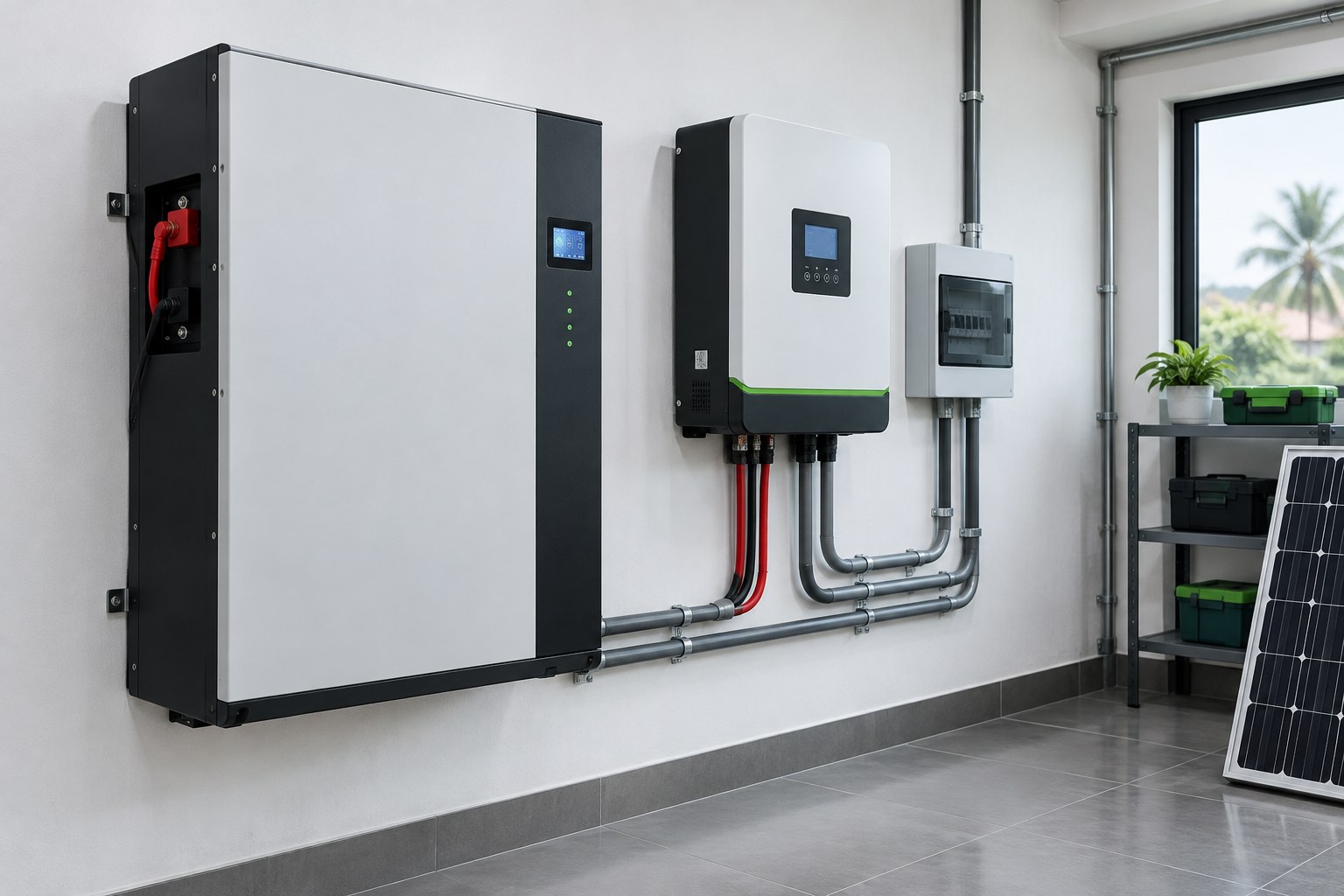
Lithium solar battery prices in Nigeria depend on the battery’s usable energy, voltage, amp-hour rating, cell quality, Battery Management System (BMS), warranty, brand and seller. A battery advertised as “5kWh” may be a 24V unit or a 51.2V unit, and products with the same headline capacity can have very different prices and specifications.
This guide compares current Nigerian seller listings for LiFePO₄ batteries in the popular 2.5kWh, 5kWh, 10kWh and 15kWh classes. The prices below are published asking prices checked on 11 November 2026, not confirmed completed transaction prices. They are battery-only prices unless a listing explicitly says otherwise; delivery, installation, inverter, solar panels, protection devices and cabling are not included.
Quick answer: lithium battery prices in Nigeria
The following are examples of listed prices for named products from Nigerian sellers. They are not a single nationwide fixed price. Compare the exact model and specification before treating two listings as equivalent.
| Battery class | Examples of listed battery-only prices | What the rating commonly represents |
|---|---|---|
| 2.5–2.56kWh | ₦335,000 (Cworth 24V 200Ah); ₦650,000 (Felicity 2.5kWh 24V); ₦778,000 (SRNE 24V 100Ah, 2.56kWh) | Usually a 24V-class battery; some 12V products are also marketed around this size |
| 5–5.12kWh | ₦932,000 (Hisense 51.2V 100Ah); ₦977,000 (Deye 5.12kWh); ₦1,018,000 (Cworth 51.2V 100Ah); ₦1,650,000 (Felicity 48V 100Ah listing) | Commonly 51.2V × 100Ah = 5.12kWh |
| 10–10.24kWh | ₦1,600,000 (Cworth 48V 10kWh); ₦1,723,950 (Felicity 51.2V 200Ah); ₦1,840,000 (Cworth 51.2V 10kWh); ₦2,350,000 (Mercury 51.2V 200Ah) | Commonly around 51.2V × 200Ah = 10.24kWh |
| 15–15.36kWh | ₦1,800,000 (Africell 15kWh); ₦2,128,000 (Cworth 51.2V 300Ah); ₦2,400,000 (Roisolar 15kWh listing); ₦2,750,000 (Mercury 51.2V 300Ah) | Commonly around 51.2V × 300Ah = 15.36kWh |
Sources: Betapawa’s Nigerian lithium battery price list, Nature Solar’s LiFePO₄ product listings, Sunsyc Energy’s Cworth battery listings, Mercury Direct’s battery listings and Roisolar’s product catalogue. Prices and stock can change; confirm the exact model and current availability with the seller before payment.
1. What does a lithium solar battery cost by capacity?
2.5kWh lithium battery price in Nigeria
Listings for batteries around 2.5kWh show a wide spread because sellers list different voltage platforms, brands and product designs. Examples include a Cworth 24V 200Ah battery listed at ₦335,000 by Nature Solar, a Cworth 12V 200Ah model marketed as 2.5kWh at ₦350,000 by Sunsyc Energy, a Felicity 2.5kWh 24V model at ₦650,000, and an SRNE 24V 100Ah battery rated 2.56kWh at ₦778,000 on Betapawa.
Do not assume that every product in this price band has the same usable energy or discharge capability. Confirm the nominal voltage, rated amp-hours, BMS current rating and the manufacturer’s usable-capacity specification. Also check whether the inverter is designed for a 12V or 24V battery bank.
5kWh lithium battery price in Nigeria
The 5kWh class is one of the most common options for residential 48V inverter systems. A typical 51.2V, 100Ah LiFePO₄ battery has a nominal energy rating of 5.12kWh. Current published examples include Hisense 5.12kWh at ₦932,000, Deye 5.12kWh at ₦977,000, Cworth 51.2V 100Ah at ₦1,018,000, Pylontech UF5000 5.12kWh at ₦1,208,000 and a Felicity 48V 100Ah 5kWh listing at ₦1,650,000.
These prices are not a direct quality ranking. A lower-priced model may have a different warranty, BMS current limit, communications protocol, enclosure, local service arrangement or product configuration. Compare the datasheets and written warranty, not only the price tag.
10kWh lithium battery price in Nigeria
A 10kWh-class battery is often specified as approximately 51.2V and 200Ah. The arithmetic gives 10.24kWh nominal energy. Published examples include a Cworth 48V 10kWh listing at ₦1,600,000 from Sunsyc Energy, a Felicity 51.2V 200Ah model at ₦1,723,950 from Roisolar, a Cworth 51.2V 10kWh model at ₦1,840,000 on Betapawa, and a Mercury 51.2V 200Ah 10kWh model at ₦2,350,000.
At this capacity, pay particular attention to continuous discharge current and the inverter’s DC input requirements. A 10kWh battery does not automatically mean it can supply 10kW of power. Energy capacity (kWh) and power capability (kW) are different specifications.
15kWh lithium battery price in Nigeria
Many 15kWh-class batteries are built around 51.2V and 300Ah, which equals 15.36kWh nominal energy. Current seller examples include an Africell 15kWh listing at ₦1,800,000 on Nature Solar, a Cworth 51.2V 300Ah 15kWh listing at ₦2,128,000 on Betapawa, a 15kWh LPBF listing at ₦2,400,000 on Roisolar and a Mercury 51.2V 300Ah model at ₦2,750,000.
Some other retailers list 15kWh products at higher prices. For example, Greco lists 15kWh Blue Carbon and Cworth products above ₦3.2 million. The difference reinforces why the exact model, warranty, battery architecture and seller support must be checked before comparing prices.
2. How to calculate the real battery capacity from volts and amp-hours
Battery capacity in kilowatt-hours is calculated from nominal voltage and amp-hour capacity:
Nominal energy (kWh) = Battery voltage (V) × Capacity (Ah) ÷ 1,000
| Battery specification | Calculation | Nominal energy |
|---|---|---|
| 12.8V, 100Ah | 12.8 × 100 ÷ 1,000 | 1.28kWh |
| 25.6V, 100Ah | 25.6 × 100 ÷ 1,000 | 2.56kWh |
| 25.6V, 200Ah | 25.6 × 200 ÷ 1,000 | 5.12kWh |
| 51.2V, 100Ah | 51.2 × 100 ÷ 1,000 | 5.12kWh |
| 51.2V, 200Ah | 51.2 × 200 ÷ 1,000 | 10.24kWh |
| 51.2V, 300Ah | 51.2 × 300 ÷ 1,000 | 15.36kWh |
This is nominal stored energy, not the amount of AC energy that will reach appliances. Usable energy depends on the battery’s permitted depth of discharge, inverter conversion losses, operating conditions and the manufacturer’s specifications. A seller’s rounded “5kWh” label may refer to a 5.12kWh nominal battery.
3. LiFePO₄ versus other lithium battery types
Most stationary lithium batteries sold for home solar storage in Nigeria are marketed as lithium iron phosphate (LiFePO₄ or LFP). LFP is a lithium-ion chemistry known for its thermal stability and suitability for repeated stationary cycling. However, the word “lithium” alone does not identify the chemistry. Ask the seller to state the cell chemistry in the datasheet.
Do not assume that every product described as “lithium-ion” is LiFePO₄. Confirm whether the exact model uses LFP cells, and check the product label and manufacturer documentation. The battery’s chemistry, BMS, operating temperature limits and installation instructions all matter.
4. What to check before buying a lithium battery in Nigeria
Battery voltage must match the inverter
A 12.8V battery is intended for a 12V-class system, a 25.6V battery for a 24V-class system, and a 51.2V battery for a 48V-class system. The inverter manufacturer’s permitted battery-voltage range must match the battery. Do not connect a 51.2V battery to a 24V inverter.
Check continuous charge and discharge current
The BMS controls the maximum current the battery can accept and deliver. A battery may have a large kWh rating but a comparatively low continuous discharge-current limit. Compare the BMS continuous current and peak-current duration with the inverter’s maximum battery current and the expected load. For parallel banks, confirm the permitted number of units and the manufacturer’s wiring and protection requirements.
Confirm inverter communication compatibility
Some batteries communicate with compatible inverters through CAN or RS485. Communication allows the inverter to receive battery information and follow the battery manufacturer’s charge and discharge limits. Confirm the exact inverter model, supported protocol, cable pinout and approved battery profile. If closed-loop communication is unavailable, use only charging settings approved by both manufacturers; do not guess the voltage settings.
Read the warranty, not just the headline
Ask for the written warranty document and check its duration, cycle or energy-throughput limits, retained-capacity threshold, exclusions, installation requirements and the Nigerian company responsible for honouring it. A seller’s verbal promise is not a substitute for the manufacturer’s warranty terms.
Verify the product and seller
- Request the exact model number and current datasheet.
- Check the battery label, serial number and stated nominal voltage and capacity.
- Ask for a tax invoice or formal receipt showing the model supplied.
- Confirm local warranty handling, service location and replacement procedure.
- Inspect the enclosure, terminals, communication ports and accessories before installation.
- Use a qualified installer and follow the manufacturer’s requirements for DC fuses, isolators, cable sizing, earthing and mounting.
5. How much usable energy will the battery deliver?
A battery’s nominal kWh rating is not the same as the energy available to AC appliances. For illustration, if a 5.12kWh battery is configured for 90% depth of discharge, the DC energy withdrawn before inverter losses is approximately:
5.12kWh × 0.90 = 4.608kWh
If the inverter operates at 92% efficiency at the relevant load, the approximate AC energy delivered is:
4.608kWh × 0.92 = 4.24kWh
This is an illustration, not a universal rating. Use the manufacturer’s permitted depth of discharge and the inverter’s efficiency at the actual operating load. Some battery models specify usable energy directly; use that value when it is documented.
6. How long can a 5kWh, 10kWh or 15kWh battery power a home?
Backup time depends on the average load, not the number of rooms or the inverter’s kVA rating. A simple first estimate is:
Runtime (hours) = usable AC energy (kWh) ÷ average load (kW)
| Battery class | Illustrative usable AC energy | At a 500W average load | At a 1,000W average load |
|---|---|---|---|
| 5.12kWh | 4.24kWh | About 8.5 hours | About 4.2 hours |
| 10.24kWh | 8.48kWh | About 17 hours | About 8.5 hours |
| 15.36kWh | 12.72kWh | About 25.4 hours | About 12.7 hours |
The table assumes 90% depth of discharge and 92% inverter efficiency for illustration. Actual runtime will be affected by load variation, inverter standby consumption, temperature, battery age, BMS limits and the manufacturer’s usable-capacity specification. Air conditioners, pumps, pressing irons, kettles and other high-power appliances can shorten backup time significantly.
7. Which battery size should you choose?
- 2.5–2.56kWh: Suitable for small backup requirements where the connected loads and runtime are modest. Confirm whether the battery is 12V or 24V before buying.
- 5–5.12kWh: A common starting point for a 48V residential system supplying essential loads. Whether it can run a refrigerator, fans, lighting and other appliances for the required hours must be calculated from their actual energy use.
- 10–10.24kWh: Provides roughly twice the nominal energy of a 5.12kWh battery. It may suit homes with longer backup requirements or a higher evening load, provided the inverter and BMS can support the power demand.
- 15–15.36kWh: Better suited to larger energy requirements or extended backup periods. It still needs correct inverter sizing, charging capacity, DC protection and a realistic load schedule.
Do not select battery capacity from house size alone. List the appliances, their measured or nameplate power, expected operating hours and which loads must remain on during an outage. Then calculate the energy requirement and include appropriate system losses.
8. Does a lithium battery price include the inverter and solar panels?
No. The prices in the model examples above refer to battery products only. A complete solar installation may also require a compatible inverter, PV modules, mounting structures, DC and AC protection, cables, isolators, earthing, installation labour and commissioning. Some products advertised as “solar packages” bundle several of these items, so they must not be compared directly with a battery-only price.
For inverter-only prices, see our Solar Inverter Price in Nigeria (November 2026) guide. For system sizing and battery selection, read our best battery for solar in Nigeria guide and our technical comparison of lithium versus tubular batteries.
9. Frequently asked questions
How much is a 5kWh lithium battery in Nigeria?
Published Nigerian listings checked on 11 November 2026 include examples from ₦932,000 for a Hisense 5.12kWh battery to ₦1,650,000 for a Felicity 48V 100Ah product listing. Other examples include Deye at ₦977,000, Cworth at ₦1,018,000 and Pylontech UF5000 at ₦1,208,000. Confirm the exact model, stock and warranty before buying.
How much is a 10kWh lithium battery in Nigeria?
Examples include Cworth 10kWh listings at ₦1,600,000 and ₦1,840,000, a Felicity 51.2V 200Ah listing at ₦1,723,950 and a Mercury 51.2V 200Ah listing at ₦2,350,000. These are seller asking prices, not a fixed market tariff.
How much is a 15kWh lithium battery in Nigeria?
Published examples include Africell 15kWh at ₦1,800,000, Cworth 51.2V 300Ah at ₦2,128,000, Roisolar’s 15kWh listing at ₦2,400,000 and Mercury 51.2V 300Ah at ₦2,750,000.
Is a 5kWh battery the same as a 5kW battery?
No. kWh measures stored energy; kW measures power. A 5kWh battery describes its nominal energy capacity. Its maximum continuous power output depends on its voltage, BMS current limit and manufacturer’s rating.
Can I connect a lithium battery to any inverter?
No. The battery voltage must be compatible with the inverter, and the inverter must support the battery’s charging requirements. Where CAN or RS485 communication is required or supported, the exact protocol and model compatibility must also be checked.
Can I add another lithium battery later?
Only if the manufacturer permits expansion and the existing battery model, firmware, age, voltage, capacity and BMS configuration meet its parallel-operation requirements. Follow the manufacturer’s procedure and use the required protection and interconnection hardware.
Is LiFePO₄ safe for home solar use?
LiFePO₄ is widely used for stationary energy storage and is generally regarded as a more thermally stable lithium-ion chemistry than some alternatives. Safety still depends on cell quality, BMS protection, correct charging, suitable installation, DC fault protection and compliance with the manufacturer’s instructions.
Conclusion: compare the specification, not just the price
As of 11 November 2026, Nigerian sellers list 2.5kWh-class LiFePO₄ batteries from a few hundred thousand naira, 5.12kWh models from under ₦1 million to above ₦1.5 million, and larger 10kWh and 15kWh products at prices that vary substantially by brand and specification. The examples in this guide show why there is no reliable single price for a battery size without identifying the model.
Before paying, confirm the actual voltage and amp-hour rating, nominal and usable energy, BMS continuous current, inverter compatibility, warranty conditions and local after-sales support. A properly specified battery matched to the inverter and the real load requirement is a better purchase than the cheapest product carrying the right kWh label.
Sources and price-check notes
- Betapawa – Lithium battery prices in Nigeria (product-level listings and stated update date of 11 November 2026).
- Nature Solar Global – LiFePO₄ product category (model descriptions and displayed prices).
- Sunsyc Energy – Cworth lithium batteries (12V, 24V and 48V product listings).
- Mercury Direct Nigeria – Battery catalogue (LiFePO₄ voltage, amp-hour and price listings).
- Roisolar – Solar product catalogue (Felicity and other battery listings).
- Greco Power – Battery catalogue (additional Cworth and Blue Carbon price comparisons).
Retail prices are displayed seller asking prices captured on 11 November 2026. They may change without notice and do not establish completed sale prices. Listings with rounded capacity labels have been identified separately from exact voltage × amp-hour calculations. Delivery and installation are excluded.

