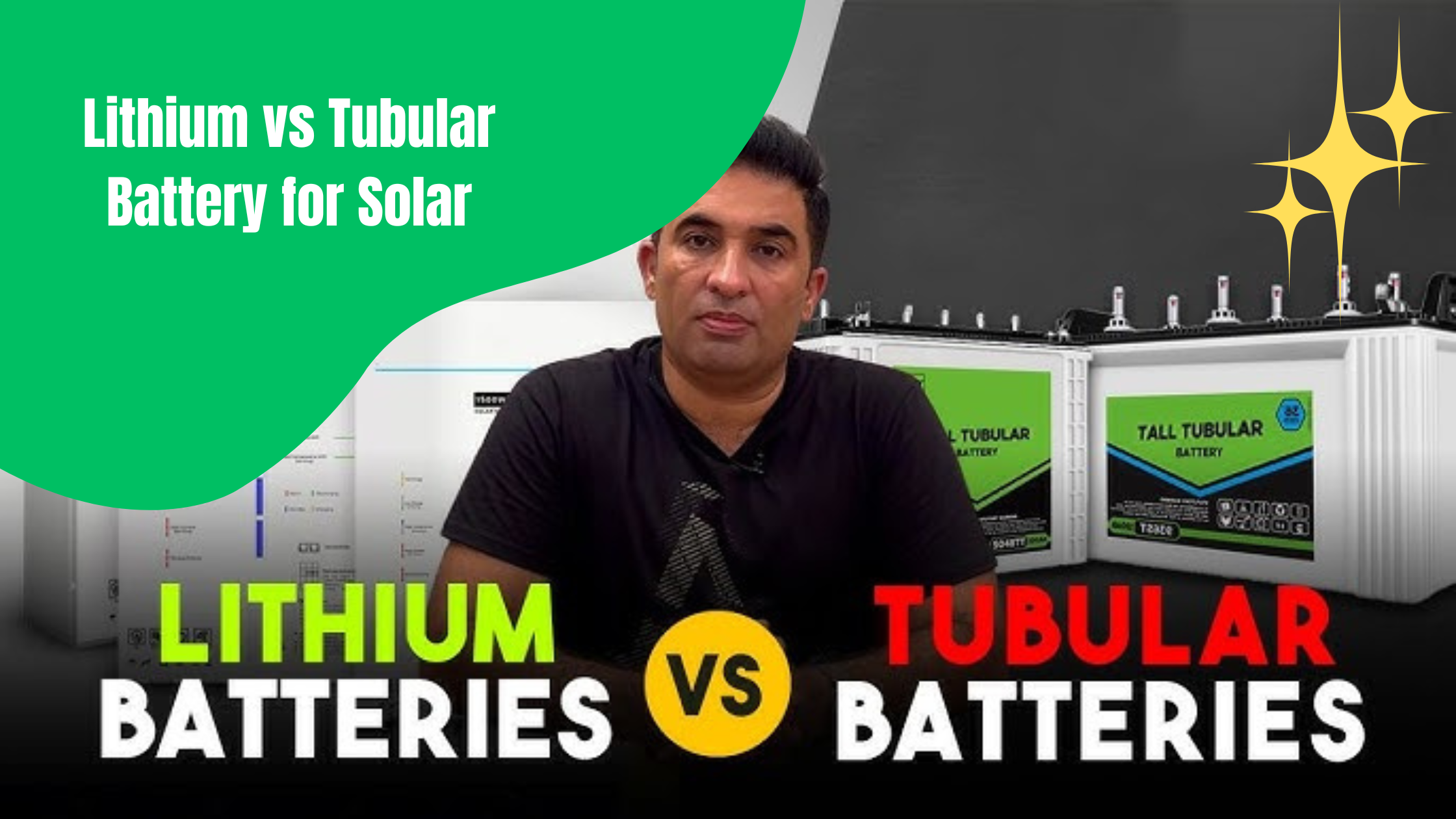
Choosing the right battery for your solar power system is one of the most important decisions you will make during installation. While solar panels often receive the most attention, the battery is what determines how reliably your system performs at night, during cloudy days, and throughout grid outages. The debate between lithium batteries and tubular batteries has become more intense as lithium prices fall and electricity tariffs continue to rise.
Many homeowners are tempted by the lower upfront cost of tubular batteries. Others prefer the long-term efficiency and maintenance-free convenience of lithium batteries. The real decision, however, should not be based on initial price alone. It should consider usable capacity, lifespan, charging efficiency, maintenance requirements, safety, and total cost of ownership over several years.
This guide provides a detailed and human-centered analysis of lithium vs tubular battery for solar systems. It explains how each battery works, compares performance metrics, presents financial projections, and helps you determine which technology aligns with your long-term energy goals.
Understanding Solar Battery Storage
Solar panels generate electricity during the day when sunlight is available. However, most residential and commercial electricity consumption happens in the evening. A battery stores excess solar energy produced during daylight hours and releases it when needed.
In grid-tied systems without storage, excess energy is either exported to the grid or wasted. In hybrid and off-grid systems, batteries are essential for ensuring consistent power supply. The type of battery installed directly affects system reliability, operational cost, and long-term satisfaction.
The two most common battery technologies in residential solar installations today are Lithium Iron Phosphate (LiFePO4) batteries and tubular lead-acid batteries. While both store energy, their internal chemistry and operational behavior differ significantly.
What Is a Lithium Battery for Solar?
Lithium batteries used in solar systems are typically Lithium Iron Phosphate batteries. This chemistry is known for stability, long cycle life, and deep discharge capability. Unlike older battery technologies, lithium batteries include an integrated Battery Management System (BMS) that automatically regulates charging, discharging, voltage protection, and temperature control.
Lithium batteries are sealed units that require no water topping or routine maintenance. They are compact, lightweight, and often wall-mounted, making them suitable for modern homes and commercial spaces with limited installation room.
Because of their high efficiency and durability, lithium batteries are increasingly used in hybrid inverter systems, commercial solar storage installations, telecom infrastructure, and high-performance residential setups.
What Is a Tubular Battery?
A tubular battery is a type of deep-cycle lead-acid battery designed for inverter and solar applications. It uses tubular positive plates instead of flat plates, which improves durability under repeated charge and discharge cycles.
Tubular batteries have been widely adopted in regions where budget considerations are significant. They are reliable when properly maintained and are often used in backup power systems.
However, tubular batteries contain liquid electrolyte and require periodic topping up with distilled water. During charging, they release gases and therefore need proper ventilation. Their performance also declines faster when frequently discharged deeply.
Technical Comparison: Lithium vs Tubular Battery
The core differences between lithium and tubular batteries can be understood through measurable technical parameters. The table below summarizes the most important distinctions.
| Feature | Lithium Battery (LiFePO4) | Tubular Battery (Lead-Acid) |
| Depth of Discharge (DoD) | 80%–95% | 40%–60% |
| Cycle Life | 3,000–6,000 cycles | 800–1,500 cycles |
| Charging Efficiency | 95%–98% | 75%–85% |
| Charging Speed | Fast | Slow |
| Maintenance | None | Regular water topping |
| Weight | Lightweight | Heavy |
| Installation Space | Compact | Bulky |
| Initial Cost | Higher | Lower |
| Long-Term Cost | Lower | Higher |
This comparison highlights a crucial insight: while tubular batteries cost less initially, lithium batteries provide greater usable capacity and longer service life.
Usable Capacity: The Hidden Cost Factor
Battery capacity is often misunderstood. A 5kWh battery does not necessarily provide 5kWh of usable energy. The percentage of capacity that can be safely discharged without shortening lifespan is known as Depth of Discharge.
Lithium batteries typically allow up to 90 percent usable capacity. Tubular batteries generally allow only about 50 percent if longevity is to be preserved.
The difference can be illustrated clearly:
Lithium 5kWh Battery
Total Capacity: 5kWh
Usable Capacity: ~4.5kWh
Tubular 5kWh Battery
Total Capacity: 5kWh
Usable Capacity: ~2.5kWh
This means that to match the usable energy of one 5kWh lithium battery, you may need nearly double the rated capacity in tubular batteries.
Lifespan and Cycle Analysis
Battery lifespan is measured in cycles. One cycle represents one full charge and discharge.
The table below shows expected lifespan under daily cycling conditions.
| Battery Type | Average Cycle Life | Approximate Years (1 cycle/day) |
| Lithium | 4,000 cycles | 10–12 years |
| Tubular | 1,000 cycles | 2–4 years |
If a household uses its battery daily, a lithium battery could last more than a decade, while a tubular battery may require replacement multiple times during that period.
Frequent replacement significantly increases long-term cost and installation inconvenience.
Charging Speed and Energy Efficiency
Lithium batteries charge much faster than tubular batteries. This is particularly important in areas with limited sunlight hours or unpredictable weather patterns.
Charging efficiency also differs substantially.
| Parameter | Lithium | Tubular |
| Round-Trip Efficiency | 95%–98% | 75%–85% |
| Energy Loss During Charging | Minimal | Higher |
| Solar Utilization | Maximized | Moderate |
Higher efficiency means more of the solar energy generated is actually stored and used, rather than lost as heat.
Five-Year Cost Projection
To better understand total cost of ownership, consider a household that needs 5kWh of usable storage capacity.
| Cost Factor | Lithium System | Tubular System |
| Initial Battery Cost | Higher | Lower |
| Replacement Within 5 Years | Unlikely | Likely |
| Maintenance Cost | Minimal | Moderate |
| Efficiency Loss | Low | Higher |
| Total 5-Year Cost | Lower overall | Higher overall |
Although lithium batteries require higher initial investment, tubular batteries may require replacement within five years, increasing cumulative expenses.
Maintenance and Operational Experience
Lithium batteries require virtually no routine maintenance. There is no need to top up electrolyte levels, no corrosion cleanup, and no ventilation management. The system is largely automated and managed electronically.
Tubular batteries require consistent maintenance. Distilled water must be added periodically, and terminals must be cleaned to prevent corrosion. Inadequate maintenance reduces lifespan and performance.
For homeowners seeking convenience and minimal supervision, lithium provides a more user-friendly experience.
Space and Installation Considerations
Lithium batteries are compact and lightweight. They can often be wall-mounted, reducing floor space usage.
Tubular batteries are heavier and occupy significant floor space. They also require ventilation clearance due to gas emission during charging.
For urban apartments or modern homes with limited space, lithium systems offer installation flexibility.
Safety and Environmental Impact
Lithium Iron Phosphate batteries are thermally stable and among the safest lithium chemistries available. They are less prone to overheating compared to older lithium technologies.
Tubular batteries release hydrogen gas during charging, which requires adequate ventilation to prevent accumulation.
In terms of environmental impact, lithium batteries last longer, reducing replacement frequency and waste generation. Tubular batteries require more frequent disposal, increasing environmental management considerations.
Return on Investment Analysis
Consider a household spending $1,800 annually on electricity. A well-designed solar storage system reduces grid reliance by 70 percent.
If lithium batteries maintain high efficiency and longevity, savings accumulate consistently without replacement costs.
If tubular batteries require replacement within five years, part of those savings is offset by reinvestment in new batteries.
Over a 10-year period, lithium systems generally provide superior return on investment despite higher upfront cost.
Final Verdict: Lithium vs Tubular Battery for Solar
Lithium batteries provide longer lifespan, deeper discharge capability, faster charging, higher efficiency, minimal maintenance, and compact installation. Their higher upfront cost is often justified by lower long-term ownership cost and greater reliability.
Tubular batteries remain a practical option for buyers with tight budgets or moderate energy needs, but they require regular maintenance and more frequent replacement.
For long-term financial optimization and convenience, lithium batteries are increasingly becoming the preferred choice in residential and commercial solar installations.