
Solar is no longer a “side option” in Nigeria. It’s now a serious career lane—covering residential inverter systems, commercial rooftops, industrial power backup, telecom sites, mini-grids, and utility-scale projects.
But if you’re considering the field (or you’re already in it), one question matters: how much do solar professionals actually earn in Nigeria?
This guide breaks down realistic salary ranges, what influences pay, how earnings differ by role and experience, and how to increase your income (without hype). You’ll also get tables, simple charts, and infographic prompts you can use for your blog visuals.
Important salary note: Nigerian solar salary data can be fragmented because many employers don’t publish pay publicly, and some salary platforms have small sample sizes. So, this article uses a blend of salary-report sites and live job ads with published salaries/ranges, then shows you how to interpret them safely.
Who Is a Solar Engineer in Nigeria?
In Nigeria, “solar engineer” is often used broadly. Employers may use it to describe any of these roles:
- Solar Installation Engineer (site installation + supervision)
- Solar Design/Power Systems Engineer (system sizing, load analysis, drawings)
- O&M Engineer / Technician (maintenance, troubleshooting, performance checks)
- Project Engineer / Site Engineer (project coordination, QA/QC, HSE compliance)
- Sales Engineer / Pre-sales Engineer (technical proposals + client conversion)
- Mini-grid Engineer (design + deployment + monitoring for communities)
Because the title is broad, salary depends heavily on what you actually do day-to-day.
Typical Monthly Salary Range (Nigeria)
Based on a mix of published job ads and salary-report platforms:
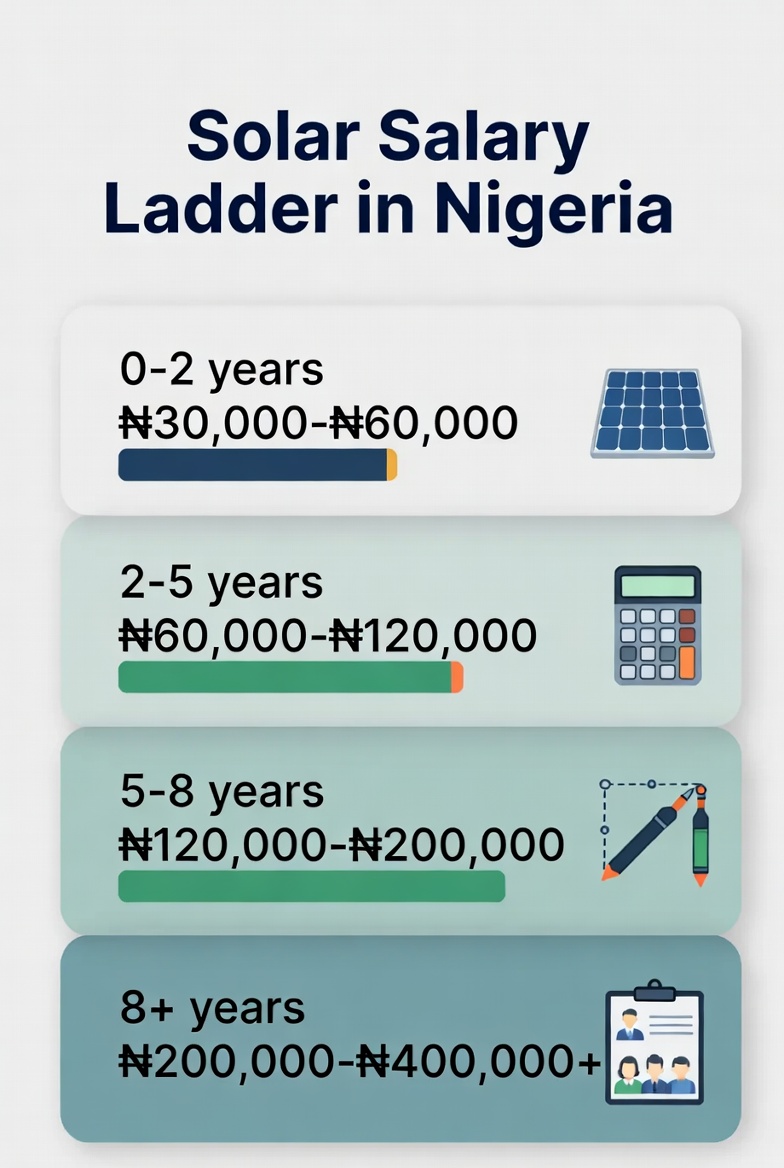
- Entry level / junior solar engineer: often around ₦100,000 – ₦180,000/month (varies widely)
- Mid-level solar engineer (2–5+ years): commonly ₦180,000 – ₦350,000/month
- Specialists / strong designers / project leads: ₦350,000 – ₦700,000+/month (more likely in Lagos/Abuja, EPCs, mini-grid firms, multinationals, or performance-linked roles)
What published sources suggest (snapshots)
- MySalaryScale reports an average ~₦141,000/month net for “Solar Engineer” (estimated from 7 employees).
- Job ads sometimes publish ₦250,000/month for “Electrical Engineer (Solar & Power Systems)” in Abuja.
- Jobberman listings can show ranges like ₦150,000 – ₦250,000/month for “Solar Technician/Engineer” (Lagos).
Treat the “averages” carefully: sample sizes can be small, and “net vs gross” is often unclear. The most reliable public signals come from job ads with salary posted (even those are not the whole market).
Salary Table 1: Solar Pay by Role (Nigeria)
These are typical ranges you’ll see across Nigeria, with Lagos and Abuja usually paying higher than smaller cities.
| Role | Typical Monthly Pay (₦) | Why Pay Moves Up/Down |
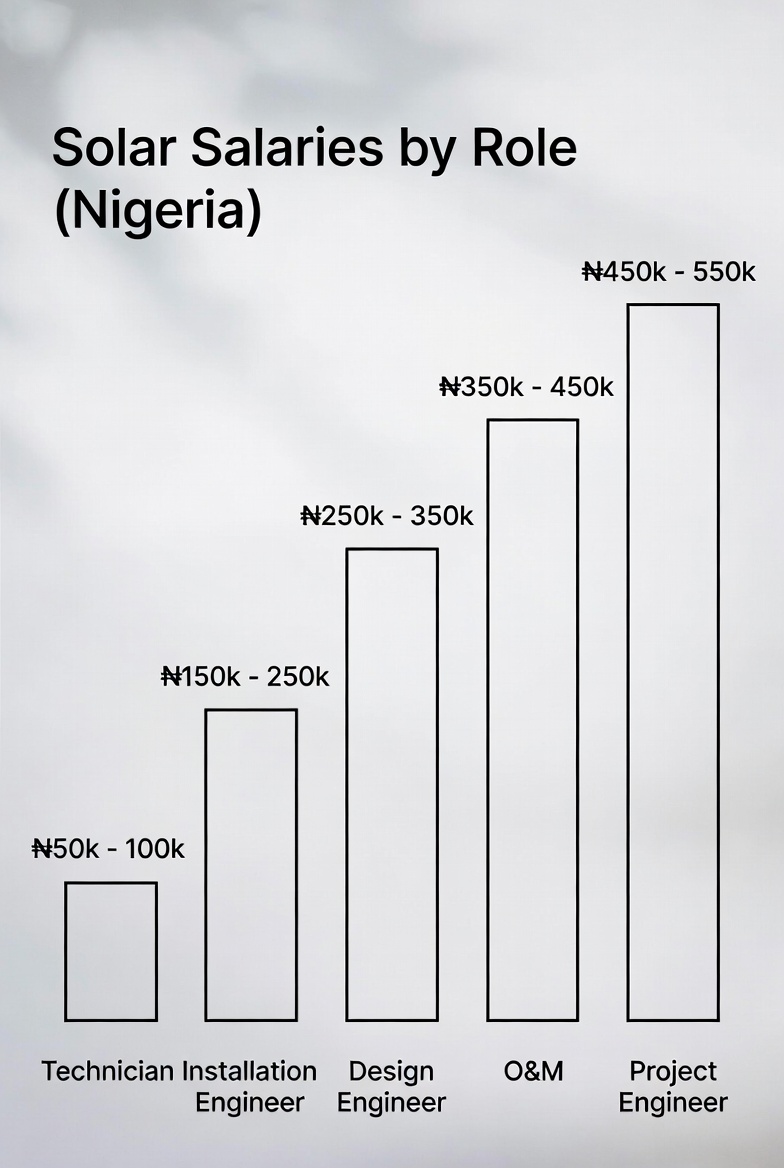
| Solar Technician (Installation/Repairs) | 80,000 – 200,000 | Tools, real troubleshooting skill, ability to work independently |
| Solar Installation Engineer | 150,000 – 300,000 | Site supervision, cabling quality, HSE, commissioning experience |
| Solar Design / Power Systems Engineer | 180,000 – 450,000 | System sizing accuracy, hybrid design, protections, documentation |
| O&M Engineer / Technician (Solar Plants) | 150,000 – 350,000 | Fault diagnosis speed, reporting, uptime KPIs |
| Project Engineer / Site Engineer | 200,000 – 500,000 | Client management, schedule control, QA/QC, team leadership |
| Sales/Pre-sales Engineer | 150,000 – 400,000 + commission | Ability to close deals + design credible proposals |
| Mini-grid Engineer | 250,000 – 600,000+ | Complexity: community loads, metering, distribution, monitoring |
Reality check: Some employers publish ranges around ₦150k–₦250k for combined “Solar Technician/Engineer” roles.
Salary Table 2: Real Examples From Public Salary Signals
Below are examples pulled from public sources (salary platforms + job ads). These are not “the only truth,” but they show what’s visible in the market.
| Source | What it shows | Pay figure shown |
| MySalaryScale (Solar Engineer) | Average net salary estimate (7 employees) | ₦141k/month |
| MySalaryScale (Solar Energy Systems Engineers) | Average net salary estimate (2 employees) | ₦305k/month |
| Indeed job ad (Abuja) | Electrical Engineer (Solar & Power Systems) | ₦250k/month |
| Jobberman listing (Lagos) | Solar Technician/Engineer | ₦150k–₦250k/month |
| Social job post (example) | Solar Engineer role salary range | ₦150k–₦200k/month |
Simple Chart: Salary by Experience (Typical Nigeria Range)
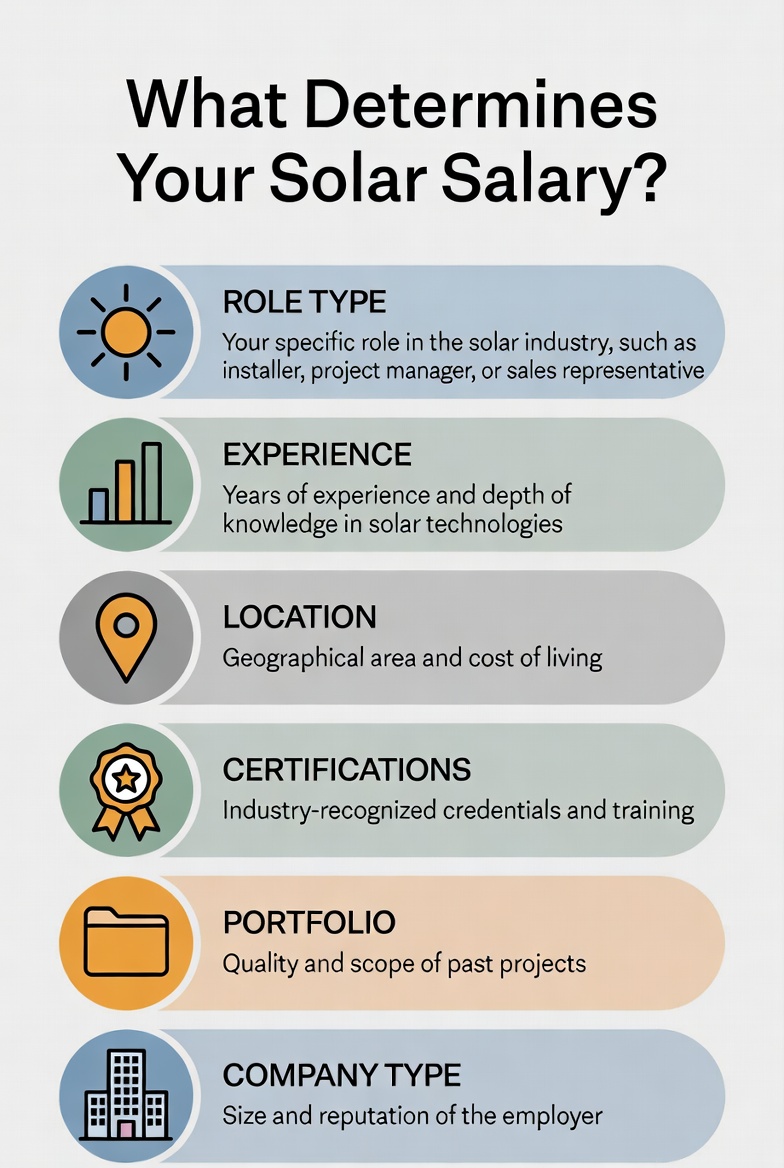
Text chart (each block ≈ ₦50k of earning power):
0–1 year (Intern/Junior): ₦80k–₦150k
█████ to █████████
2–4 years (Competent Engineer/Tech): ₦150k–₦300k
█████████ to ███████████████
5–8 years (Senior / Lead / Designer): ₦300k–₦500k
██████████████ to █████████████████████
8+ years (Lead / PM / Specialist): ₦500k–₦900k+
████████████████████ to ██████████████████████████████
Why Salaries Differ So Much in Nigeria’s Solar Industry
1) Location: Lagos and Abuja pay more (on average)
Urban markets have higher demand, more EPCs, and more corporate/commercial installations. That’s why you see more public salary postings in Lagos/Abuja job boards and ads.
2) Your “value skill” matters more than your title
In Nigeria, employers pay for outcomes:
- Can you size systems correctly (no under-sizing, no excessive cost)?
- Can you wire clean and safe (SPD, breakers, earthing, proper lugs)?
- Can you commission and troubleshoot fast?
- Can you write professional documentation (SLD, load schedule, test reports)?
The market rewards people who reduce callbacks and protect equipment.
3) Company type changes pay
- Small installers may pay less but offer faster hands-on learning.
- Large EPCs / mini-grid developers / multinationals may pay more and offer structure, but entry is tougher.
4) Net vs gross confusion
Some platforms explicitly say “net salary,” others don’t. For instance, MySalaryScale often references “net salary.”
Always ask employers: is this gross or take-home?
5) Tools and field conditions
If your role includes climbing roofs, long travel, and physical installation, pay sometimes includes:
- transport allowance
- site allowance/per diem
- overtime
But not every company is consistent.
Salary by City: What to Expect
Here’s a practical expectation model:
| City / Zone | Pay Tendency | Why |
| Lagos | Higher | More commercial demand, more firms, higher cost of living |
| Abuja | Higher | Corporate/government projects, structured firms |
| Port Harcourt | Medium–High | Industrial clients, EPC activity |
| Enugu / Owerri / Benin / Ibadan | Medium | Growing market; pay depends on firm maturity |
| Smaller towns | Lower–Medium | Fewer high-value projects; more residential focus |
Tip: If you live outside Lagos/Abuja, you can still earn Lagos-level money by positioning as a designer + remote support + field supervisor for multiple teams.
What “Good Pay” Looks Like by Career Stage
Entry Level (0–2 years)
Your first goal is not just salary—it’s skill density.
If you can do the basics reliably:
- load estimation
- inverter configuration
- battery selection + safety
- PV stringing basics
- protections + earthing basics
…you quickly move into better pay bands.
MySalaryScale’s entry-level snapshot for “Solar Engineer” shows around ₦131k/month (0–2 years) as an estimate.
Mid-Level (2–5 years)
This is where you earn by becoming “the person that fixes what others can’t.”
Mid-level growth usually comes from:
- troubleshooting discipline
- learning documentation
- managing junior techs
- better client handling
Senior (5+ years)
Senior compensation usually comes from:
- design accuracy (minimizing cost without sacrificing performance)
- project supervision
- O&M reporting and KPI performance
- managing teams and timelines
The Highest-Paying Solar Roles in Nigeria
- Mini-grid Engineer / Project Engineer
Because mini-grids add distribution networks, metering, monitoring, and community load management. - Solar Design Engineer with strong hybrid experience
If you can design systems for complex loads (ACs, pumps, workshops) and document them professionally, you’re valuable. - O&M Lead for solar plants
Strong troubleshooting + reporting + uptime accountability can command better pay, especially in larger plants.
How to Increase Your Salary Fast (Without Guesswork)
1) Build a measurable portfolio
Employers pay more when you can show:
- photos of neat installations (no branding)
- sample load schedules
- single line diagrams (SLDs)
- commissioning checklist
- “before/after” troubleshooting cases (e.g., fixed nuisance trips, corrected cable sizing)
2) Add certifications that matter in the market
A “certificate of attendance” is okay, but competency validation can stand out. Some training providers explicitly mention competency examinations linked to recognized bodies, and regional PV technician certification exams have been conducted in Nigeria.
3) Specialize in one painful problem
Pick one niche that businesses pay for repeatedly:
- Inverter/battery troubleshooting
- Earthing & surge protection in high-lightning zones
- AC + pump solar design
- Mini-grid deployment support
- O&M reporting + preventive maintenance systems
4) Learn quotation + costing
Many solar pros lose money because they price blindly. If you can:
- cost BOS correctly (cables, breakers, SPD, rack, trunking)
- estimate labor realistically
- include commissioning and support
…you become a project owner, not just a worker.
Freelance & Side-Income: What Solar Professionals Can Earn
Many solar engineers in Nigeria earn extra through:
- A) Design gigs (remote)
- System sizing + BOM + wiring diagram
- Typical: ₦20k–₦100k per design, depending on complexity.
- B) Commissioning + troubleshooting calls
- Fee per visit: ₦15k–₦60k+, depending on distance and seriousness.
- C) Maintenance retainers
Small businesses may pay monthly for:
- preventive maintenance
- battery checks
- performance checks
- emergency response
If you already work on a solar plant (like O&M), your strongest side income is usually remote design + weekend troubleshooting—because your day job builds your competence.
Table 3: Skills That Push You Into Higher Pay
| Skill | Why it increases salary | How to prove it |
| Accurate load estimation | Prevents under-sizing and angry clients | Show load schedule + design assumptions |
| Protection devices & earthing | Reduces equipment damage | Photos of clean DB, SPD, bonding |
| Troubleshooting discipline | Saves time and cost | Case logs: symptoms → tests → fix |
| Documentation (SLD, reports) | Enables larger projects | Sample SLD + commissioning checklist |
| Team supervision | Employers pay for leadership | Site photos + brief project summaries |
FAQ: Solar Engineer Salary in Nigeria
How much do solar engineers earn in Nigeria monthly?
Public signals show a wide range. Some salary platforms estimate around ₦141k/month net for “Solar Engineer,” but job ads and role differences can push pay from roughly ₦100k to ₦500k+ depending on experience and responsibilities.
Do solar engineers earn more in Lagos than other states?
Often yes, because more commercial projects exist and competition for skilled talent is higher. Job boards show frequent Lagos postings with published ranges (e.g., ₦150k–₦250k for some roles).
What role pays more: installation or design?
Design roles often scale higher—especially when they include hybrid sizing, documentation, and project coordination—because one good designer can support many installations.
Can a solar professional make ₦500k+ per month in Nigeria?
Yes, but typically as a senior engineer, team lead, project engineer, mini-grid engineer, or through a mix of salary + commissions/side gigs. It usually requires strong documentation, troubleshooting ability, and a proven portfolio.
Final Take: A Realistic Way to Predict Your Salary
If you want a quick self-assessment, score yourself on these:
- Can you size systems confidently and explain your assumptions?
- Can you wire and protect systems safely (breakers/SPD/earthing)?
- Can you troubleshoot faults methodically?
- Can you produce professional documentation?
- Can you supervise a team or handle clients?
If you’re “yes” on 3+ items, you’re already above the entry band and should negotiate for better pay or move to a more structured company.